
Country information
Eswatini (Swaziland)
- Capital
- Mbabane
- Population
- 1,235,549
Languages spoken
About Eswatini (Swaziland)
siSwati (Swazi) - an official language, spoken by the Swazi people, a Bantu ethnic group who make up the vast majority of the population.
English - the other official language, used in government and business.
English and siSwati are both official languages of Eswatini.
| Geography |
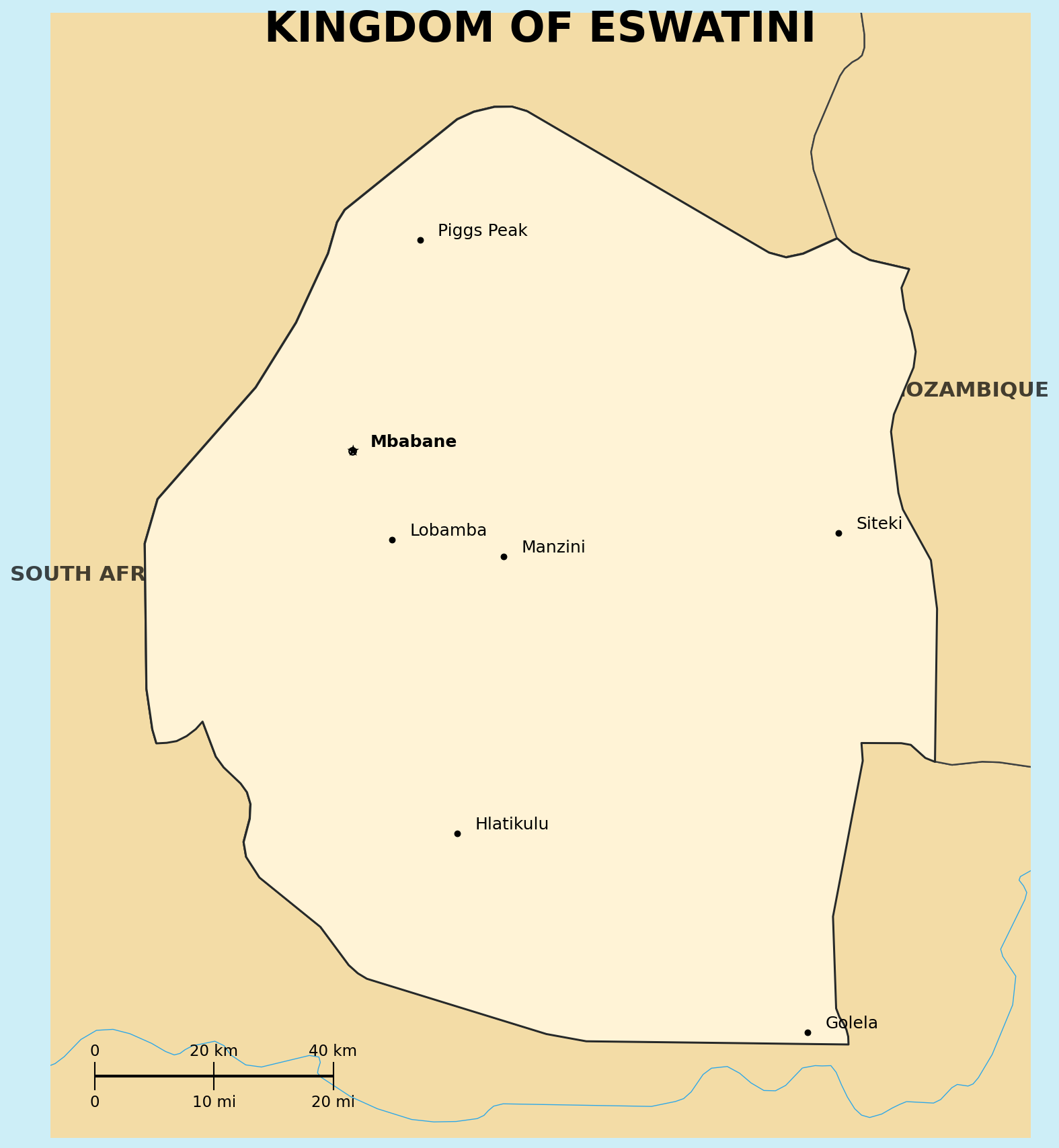
Location: Southern Africa, landlocked between South Africa and Mozambique
Map references: Africa
Area:
total: 17,364 sq km
Land boundaries:
border countries: Mozambique, South Africa
Terrain: mountainous regions, rolling hills, and fertile valleys; the Lubombo Mountain range runs along the eastern border, reaching elevations up to 1,400 m
| People |
Population: 1.12-1.3 million (varies by source; 2022-2026 est.)
Age structure:
0-14 years: 33.63%
65 years and over: 3.83% (2022 est.)
Life expectancy at birth: total population 64.1 years (World Bank, 2025); (male 57.62, female 61.81 in earlier estimate)
Infant mortality rate: 39.63-43.5 deaths/1,000 live births
Nationality:
noun/adjective: Swazi(s)/Liswati (singular)/Emaswati (plural)
Ethnic groups: predominantly Swazi, a Bantu ethnic group
Languages: English (official), siSwati (official)
| Government |
Country name:
conventional long form: Kingdom of Eswatini
conventional short form: Eswatini
former: Swaziland; renamed by King Mswati III in 2018 to reflect the name most commonly used by its citizens
Data code: WZ
Government type: absolute monarchy
National capital: Mbabane (administrative); Lobamba (royal and legislative)
Executive branch:
chief of state and head of government: King Mswati III
Independence: 6 September 1968 (from the UK)
Background: a Swazi kingdom was founded in the mid-18th century and ruled by a series of kings, including Mswati II, a 19th-century ruler whose name was adopted for the country and its predominant ethnic group; European countries defined the kingdom's modern borders in the late 19th century, and Swaziland was administered as a UK high commission territory from 1903 until independence in 1968; a 2005 constitution provided for a more independent parliament and judiciary, though the legal status of political parties remains unclear and the kingdom is still considered an absolute monarchy; in 2021 Mswati III used security forces to suppress pro-democracy protests, and an agreed national dialogue and reconciliation process has not materialized
| Economy |
Economy - overview: lower-middle-income, landlocked Southern African economy; diverse sectors including agriculture, mining, and manufacturing (coal, wood pulp, sugar, soft drink concentrates, textiles); heavily tied to South Africa economically
GDP (purchasing power parity): $16.32 billion (2025 est.)
GDP - real growth rate: 5.1% (2025)
GDP - per capita: $13,730 PPP (2025 est.)
Inflation rate: 6.1% (2011 est.)
Unemployment rate: 34.2-40% (varies by source/year)
Population below poverty line: 69% (2006)
Currency: Swazi lilangeni (SZL); South African rand also widely used
| Military |
Military branches: Umbutfo Eswatini Defense Force (UEDF): Army (includes a small air wing); Royal Eswatini Police Service (REPS) (2025)