

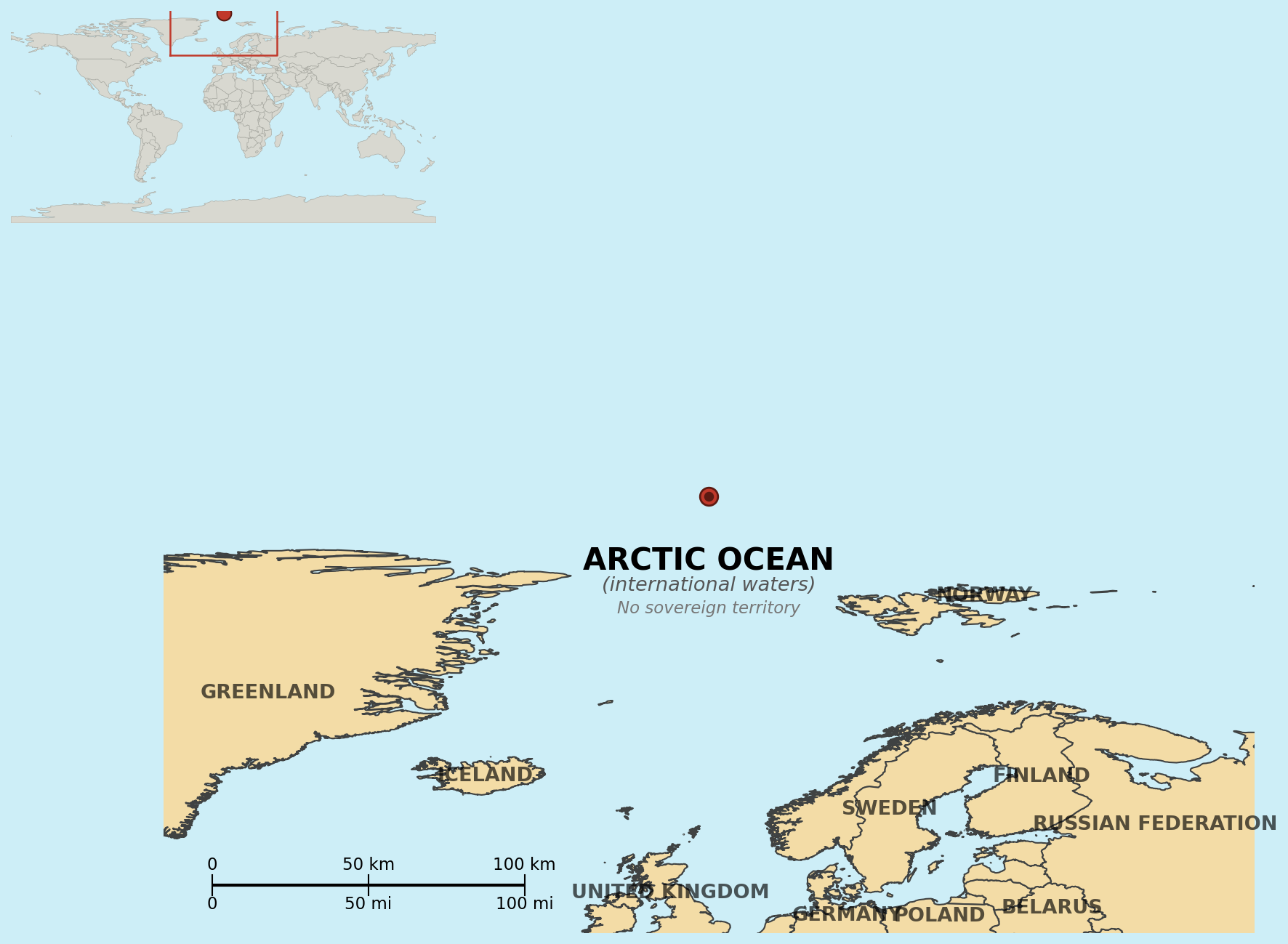
Country information
Arctic Ocean

- Capital
- N/A
- Population
- 0
Languages spoken
No languages recorded for Arctic Ocean yet.
About Arctic Ocean
The Arctic coastal areas surrounding the ocean are home to indigenous peoples speaking a variety of languages, including Inuktitut and other Inuit languages (Canada, Greenland, Alaska), Saami languages (northern Scandinavia), and various Russian indigenous languages (Siberia), alongside the national languages of the bordering countries (English, Danish, Norwegian, Russian).
| Geography |
Location: body of water mostly north of the Arctic Circle
Geographic coordinates: 90 00 N, 0 00 E
Map references: Arctic Region
Area:
total: 14.056 million sq km
note: includes Baffin Bay, Barents Sea, Beaufort Sea, Chukchi Sea, East Siberian
Sea, Greenland Sea, Hudson Bay, Hudson Strait, Kara Sea, Laptev Sea, Northwest
Passage, and other tributary water bodies
Area - comparative: slightly less than 1.5 times the size of the US; smallest of the world's four oceans (after Pacific Ocean, Atlantic Ocean, and Indian Ocean)
Coastline: 45,389 km
Climate: polar climate characterized by persistent cold and relatively narrow annual temperature ranges; winters characterized by continuous darkness, cold and stable weather conditions, and clear skies; summers characterized by continuous daylight, damp and foggy weather, and weak cyclones with rain or snow
Terrain: central surface covered by a perennial drifting polar icepack that averages about 3 meters in thickness, although pressure ridges may be three times that size; clockwise drift pattern in the Beaufort Gyral Stream, but nearly straight line movement from the New Siberian Islands (Russia) to Denmark Strait (between Greenland and Iceland); the icepack is surrounded by open seas during the summer, but more than doubles in size during the winter and extends to the encircling land masses; the ocean floor is about 50% continental shelf (highest percentage of any ocean) with the remainder a central basin interrupted by three submarine ridges (Alpha Cordillera, Nansen Cordillera, and Lomonsov Ridge)
Elevation extremes:
lowest point: Fram Basin -4,665 m
highest point: sea level 0 m
Natural resources: sand and gravel aggregates, placer deposits, polymetallic nodules, oil and gas fields, fish, marine mammals (seals and whales)
Natural hazards: ice islands occasionally break away from northern Ellesmere Island; icebergs calved from glaciers in western Greenland and extreme northeastern Canada; permafrost in islands; virtually icelocked from October to June; ships subject to superstructure icing from October to May
Environment - current issues: endangered marine species include walruses and whales; fragile ecosystem slow to change and slow to recover from disruptions or damage
Environment - international agreements:
party to : none of the selected agreements
signed, but not ratified: none of the selected agreements
Geography - note: major chokepoint is the southern Chukchi Sea (northern access to the Pacific Ocean via the Bering Strait); strategic location between North America and Russia; shortest marine link between the extremes of eastern and western Russia, floating research stations operated by the US and Russia; maximum snow cover in March or April about 20 to 50 centimeters over the frozen ocean; snow cover lasts about 10 months
| Government |
Data code: none; the US Government has not approved a standard for hydrographic codes - see the Cross-Reference List of Hydrographic Data Codes appendix
| Economy |
Economy - overview: Economic activity is limited to the exploitation of natural resources, including petroleum, natural gas, fish, and seals.
| Communications |
Telephone system:
international: no submarine cables
| Transportation |
Ports and harbors: Churchill (Canada), Murmansk (Russia), Prudhoe Bay (US)
Transportation - note: sparse network of air, ocean, river, and land routes; the Northwest Passage (North America) and Northern Sea Route (Eurasia) are important seasonal waterways
| Military |
:
| Transnational Issues |
Disputes - international: some maritime disputes (see littoral states); Svalbard is the focus of a maritime boundary dispute between Norway and Russia