
About Botswana
Setswana - the national language and mother tongue of ~77.3% of the population.
English - the official language of government and business, spoken by ~2.8%.
Sekalanga (~7.4%), Shekgalagadi (~3.4%), Shona (~2%), and other minority languages are also spoken.
English is the official language of Botswana, while Setswana is the national language.
| Geography |
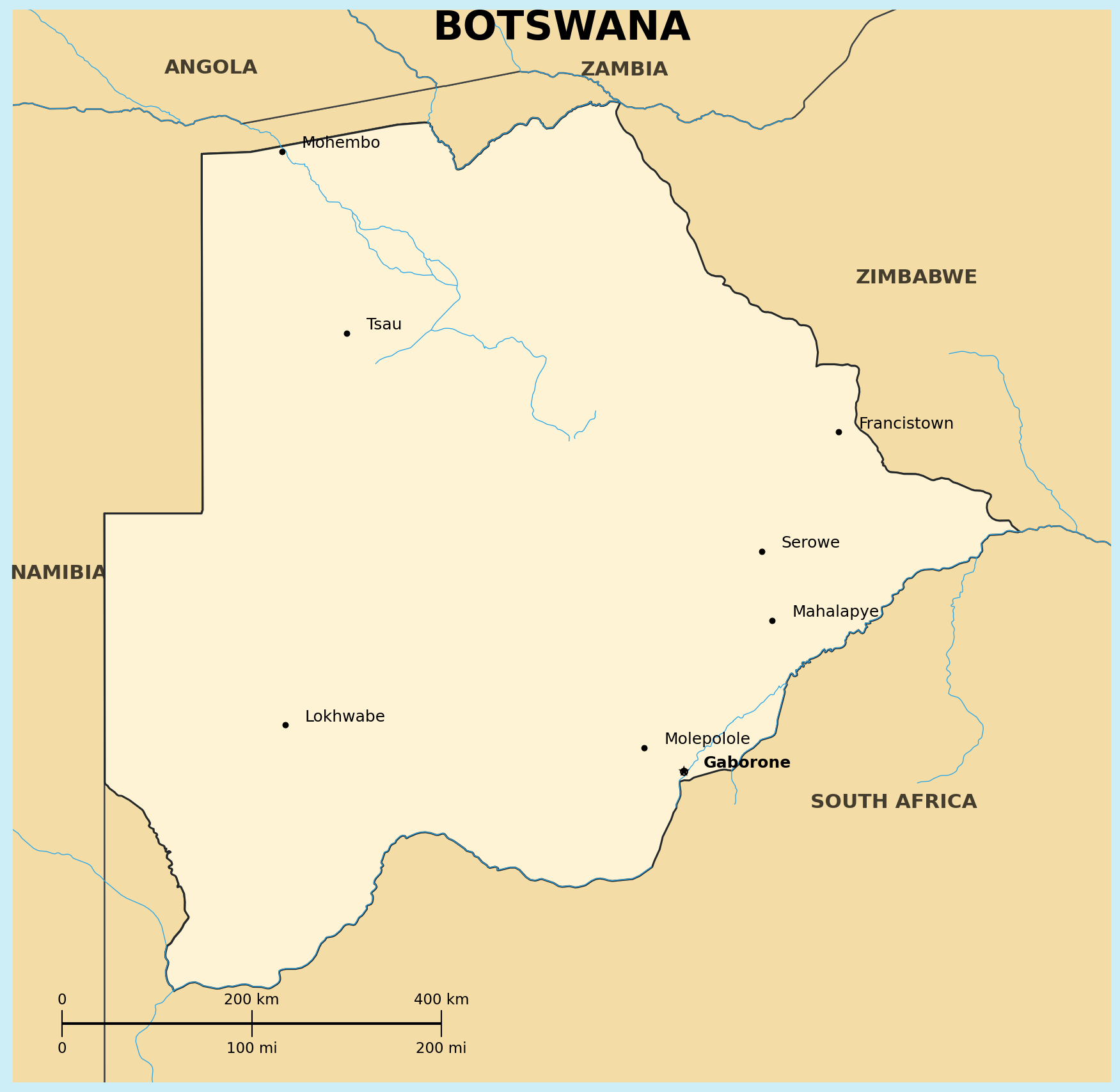
Location: Southern Africa, landlocked, north of South Africa
Map references: Africa
Area:
total: 581,730 sq km
Land boundaries:
border countries: Namibia, South Africa, Zambia, Zimbabwe
Terrain: topographically flat; approximately 70% of the territory is part of the Kalahari Desert
| People |
Population: 2,359,609-2,521,534 (2022-2025 est.); sparsely populated
Nationality:
noun: Motswana (singular), Batswana (plural)
adjective: Motswana/Batswana
Ethnic groups: Tswana (Setswana) 79%, Kalanga 11%, San (Basarwa) 3%, other (Kgalagadi, European ancestry) 7% (2024)
Religions: Christian 79.1% (Protestant 70.2%, other Christian 8.9%), none 15.2%, Badimo 4.1%, other 1.4% (2021 est.)
Languages: Setswana 77.3%, Sekalanga 7.4%, Shekgalagadi 3.4%, English (official) 2.8%, Zezuru/Shona 2%, Sesarwa 1.7%, other 5.4% (2011 est.)
Population distribution: urban population 72.9% of total (2023)
| Government |
Country name:
conventional long form: Republic of Botswana
conventional short form: Botswana
Data code: BC
Government type: unitary parliamentary republic with an executive presidency
National capital: Gaborone
Independence: 30 September 1966 (from the UK)
Executive branch:
chief of state and head of government: President Duma BOKO
Background: in the early 1800s, conflicts and population movements destabilized the region until the Tswana ethnic group became dominant; Great Britain claimed the territory as the protectorate of Bechuanaland in 1885; upon independence in 1966 the country was renamed Botswana ("land of the Tswana"); more than five decades of uninterrupted civilian leadership have created an enduring democracy - a rare distinction in Africa, with unbroken elections since independence
| Economy |
Economy - overview: upper-middle-income economy, one of Africa's most celebrated development successes; diamonds, mined in joint venture with De Beers, have historically driven growth, though the rise of lab-grown diamonds has significantly reduced global demand for mined stones since the early 2020s, prompting the finance ministry to forecast negative growth in 2025; beef exports and Okavango Delta safari tourism diversify the economy only modestly; high youth unemployment remains a challenge
GDP (purchasing power parity): $52.65-54.82 billion (2025-2026 est.)
GDP - real growth rate: 2.3% (2026f)
GDP - per capita: $19,050-19,540 PPP (2025-2026 est.)
Inflation rate: 4% (2024 est.)
Unemployment rate: 24.5% (2025 est.)
Population below poverty line: 16.3% (2016)
Currency: Botswana pula (BWP)
| Military |
Military branches: Botswana Defense Force (BDF): Ground Forces Command, Air Arm Command, Defense Logistics Command (2025)