

About Brazil
Portuguese - the sole official language and the most widely spoken, used by nearly the entire population.
Less common languages include Spanish (in border areas and schools), German, Italian, Japanese, and English, reflecting Brazil's history of European and Asian immigration.
A large number of minor Amerindian (indigenous) languages are also spoken across the country.
Portuguese is the sole official language of Brazil.
| Geography |
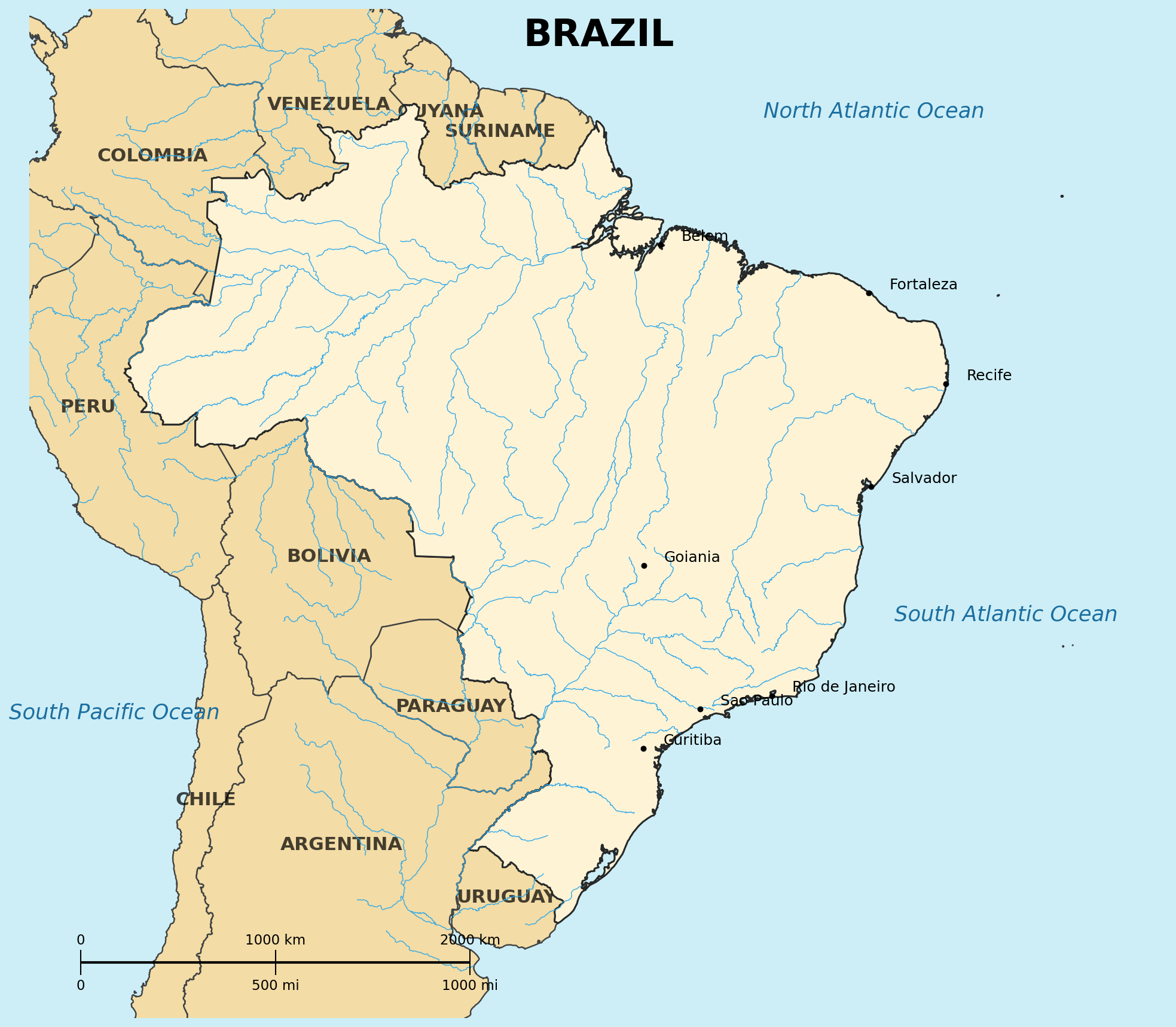
Location: Eastern South America, bordering the Atlantic Ocean
Map references: South America
Area:
total: 8,515,770 sq km (largest country in South America, 5th largest in the world)
Land boundaries:
border countries: Argentina, Bolivia, Colombia, French Guiana, Guyana, Paraguay, Peru, Suriname, Uruguay, Venezuela
Climate: mostly tropical, but temperate in south
Terrain: mostly flat to rolling lowlands in north; some plains, hills, mountains, and narrow coastal belt
Natural resources: bauxite, gold, iron ore, manganese, nickel, phosphates, platinum, tin, rare earth elements, uranium, petroleum, hydropower, timber
| People |
Population: 213,421,037 (2025 est.)
Age structure:
0-14 years: 19.6%
15-64 years: 69.5%
65 years and over: 10.9% (2024 est.)
Population growth rate: 0.58% (2025 est.)
Life expectancy at birth:
total population: 76.3 years
male: 72.6 years
female: 80.1 years (2024 est.)
Infant mortality rate: 12.7 deaths/1,000 live births (2025 est.)
Total fertility rate: 1.52 children born/woman (2025 est.)
Nationality:
noun/adjective: Brazilian(s)
Religions: Roman Catholic 56.8%, Evangelical 26.9%, none 9.3%, other 4%, Spiritism (Espirita) 1.8%, Umbanda and Candomble 1.1% (2022)
Languages: Portuguese (official and most widely spoken language); less common languages include Spanish (border areas and schools), German, Italian, Japanese, English, and many minor Amerindian languages
Population distribution: the vast majority live along or near the Atlantic coast in the east; the population core is in the southeast, anchored by Sao Paulo, Brasilia, and Rio de Janeiro
Major urban areas: 22.620 million Sao Paulo, 13.728 million Rio de Janeiro, 6.248 million Belo Horizonte, 4.873 million Brasilia (capital) (2023)
| Government |
Country name:
conventional long form: Federative Republic of Brazil
conventional short form: Brazil
local long form: Republica Federativa do Brasil
Data code: BR
Government type: federal presidential republic
National capital: Brasilia
Independence: 7 September 1822 (from Portugal)
Background: largest and most populous country in South America; underwent more than a half century of populist and military government until 1985, when the military regime peacefully ceded power to civilian rulers
| Economy |
Economy - overview: one of the world's largest emerging markets; industrial and agricultural growth continues alongside development of the interior; historically weathered periods of global financial difficulty and remains a major contributor to global growth
GDP (purchasing power parity): $5.230 trillion (2026 est.)
GDP - real growth rate: 2.3% (2025 est.)
GDP - per capita: $24,428 PPP (2026 est.)
Inflation rate: 4.14% (March 2026)
Unemployment rate: 5.8% (April 2026)
Labor force: 108,318,282 (2025)
Population below poverty line: 21% on less than $8.30/day (2024)
Industries: textiles, shoes, kitchenware, petrochemical, cement, lumber, iron ore, tin, steel, aircraft, motor vehicles and parts, other machinery, electrical equipment
Exports: $348.7 billion (2025); soybean and derivatives, iron ore and derivatives, oil, pulp/cellulose, maize, beef, chicken meat, coffee, sugar
Currency: Brazilian real (BRL)
| Military |
Military branches: Brazilian Armed Forces (Forcas Armadas Brasileiras): Brazilian Army, Brazilian Navy (includes Naval Aviation and Marine Corps), Brazilian Air Force (2025)
| Transnational Issues |
Trafficking in persons - tier rating: Tier 2 Watch List (2025)