
Country information
Timor-Leste (East Timor)
- Capital
- Dili
- Population
- 1,400,000
Languages spoken
About Timor-Leste (East Timor)
Tetum (Tetun) - an official language and the most widely spoken, used as a lingua franca throughout the country.
Portuguese - also official, reflecting the country's history as a Portuguese colony; used in government, law, and education.
Indonesian and English are designated working languages and are widely understood, especially Indonesian among older adults.
More than 15 other local languages are spoken, including Mambai, Makasae, Tukudede, Bunak, Galoli, and Kemak.
Tetum and Portuguese are the official languages of Timor-Leste.
| Geography |
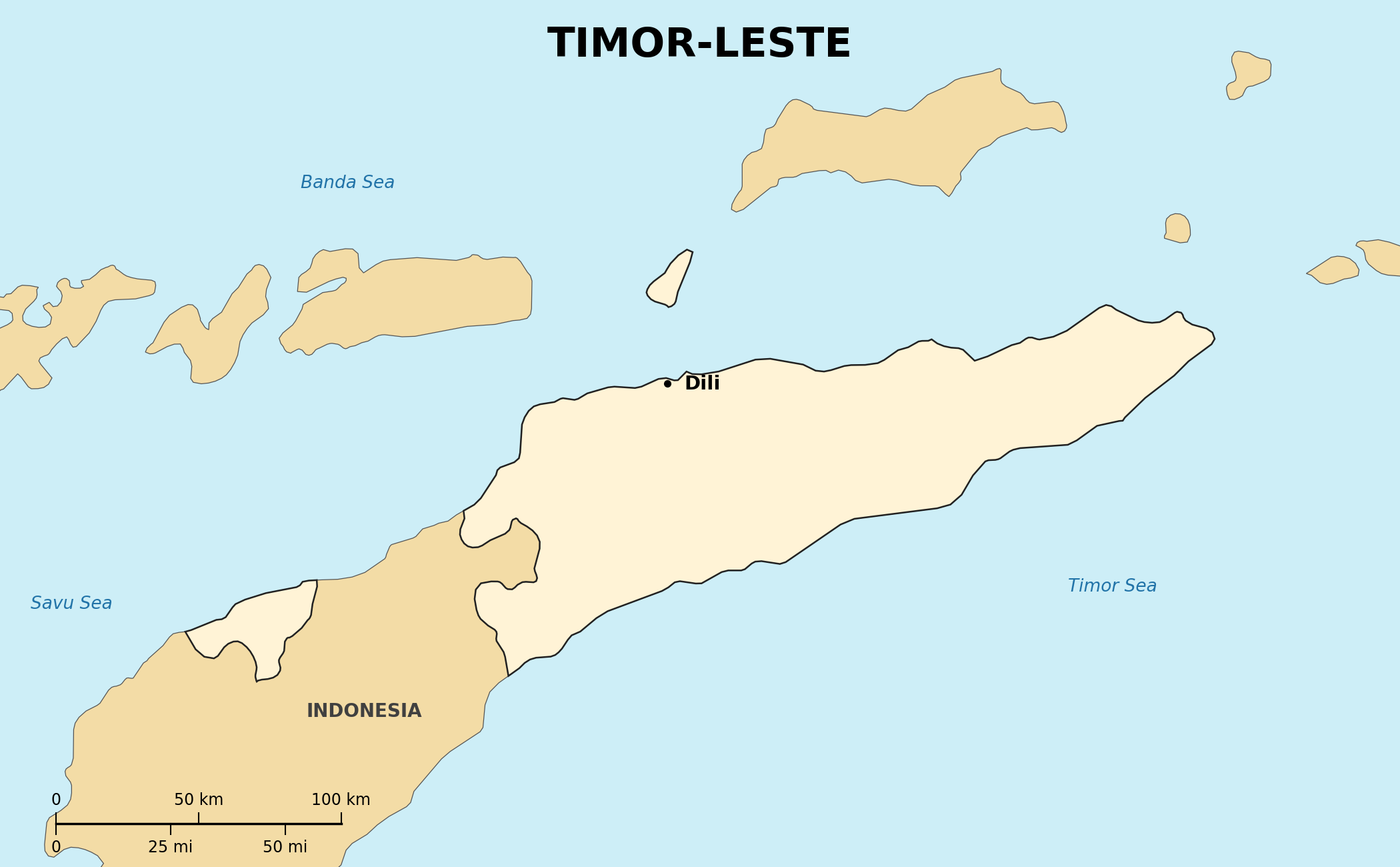
Location: Southeastern Asia, the eastern half of the island of Timor, plus the exclave of Oecusse on the northwest coast and the islands of Atauro and Jaco
Map references: Southeast Asia
Area:
total: 14,874 sq km
Land boundaries:
border countries: Indonesia
Coastline: 706 km
Climate: tropical; hot, humid; distinct rainy and dry seasons
Terrain: mountainous
| People |
Population: about 1.4 million (2024 est.)
Nationality:
noun: Timorese
adjective: Timorese
Religions: Roman Catholic about 97%, Protestant about 2%, Muslim under 1%
Languages: Tetum (official), Portuguese (official), Indonesian and English (working languages), and more than 15 local languages
| Government |
Country name:
conventional long form: Democratic Republic of Timor-Leste
conventional short form: Timor-Leste
local short form: Timor Lorosa'e
Data code: TL
Government type: semi-presidential republic
National capital: Dili
Independence: 28 November 1975 (from Portugal, declared); 20 May 2002 (from Indonesian occupation and UN administration, internationally recognized)
Background: Portugal colonized the eastern half of Timor in the 16th century; Indonesia invaded in 1975 and occupied the territory until 1999, when an independence referendum led to UN administration; Timor-Leste became the first new sovereign state of the 21st century in 2002 and joined ASEAN in 2025