
About Bulgaria
Bulgarian - the sole official language, spoken by ~77-78% of the population, using the Cyrillic alphabet.
Turkish - spoken by ~7.9% of the population, mainly by the ethnic Turkish minority.
Romani - spoken by ~3.5% of the population (Romani populations are often underestimated in official statistics and may represent 9-11% of Bulgaria's population).
Bulgarian is the sole official language of Bulgaria.
| Geography |
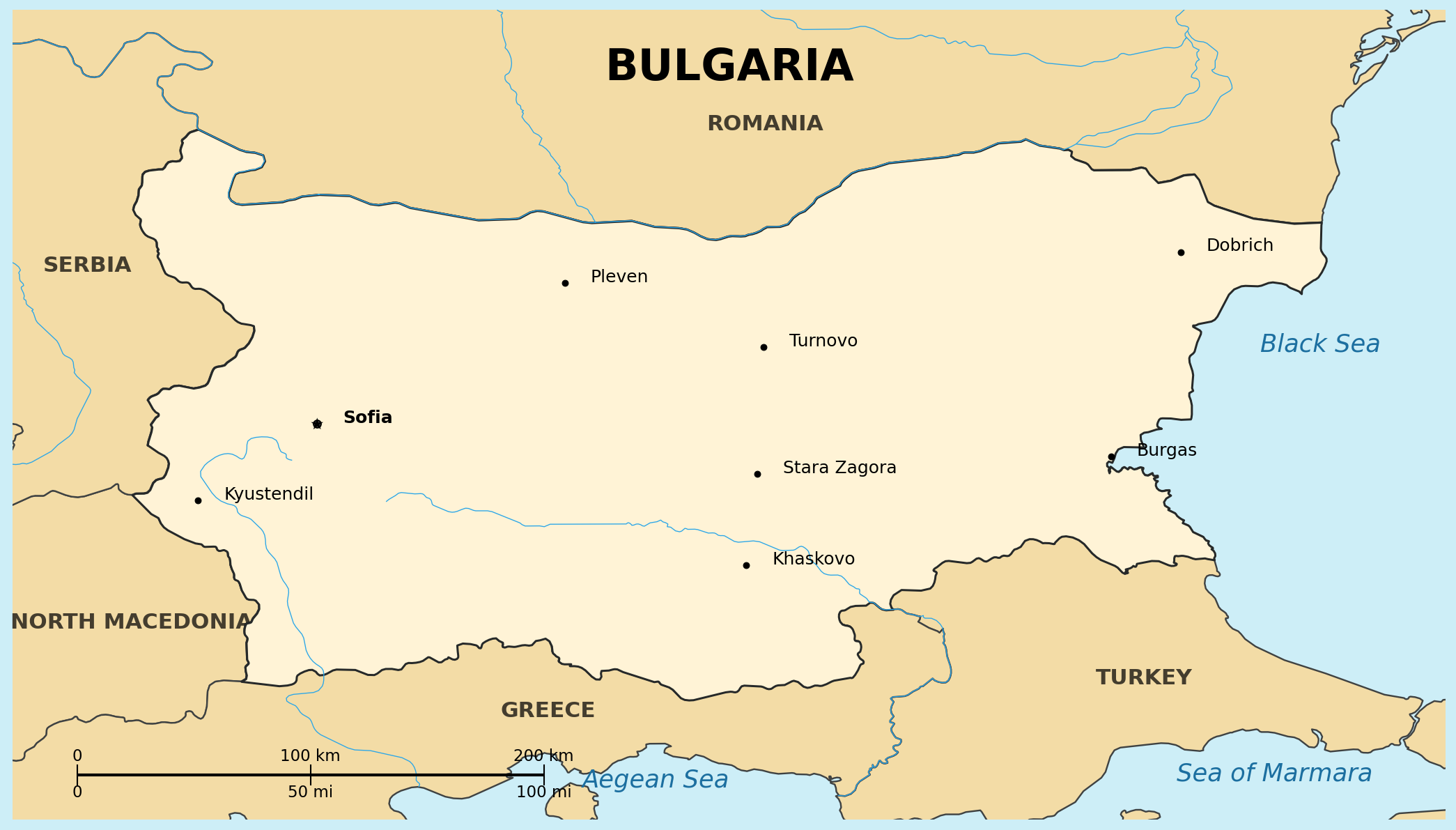
Location: Southeastern Europe, bordering the Black Sea, between Romania and Turkey
Map references: Europe
Area:
total: 110,879 sq km
Land boundaries:
border countries: Greece, North Macedonia, Romania, Serbia, Turkey
Climate: temperate; cold, damp winters; hot, dry summers
Terrain: mostly mountains with lowlands in north and southeast
Natural resources: bauxite, copper, lead, zinc, coal, timber, arable land
| People |
Population: 6,737,997 (2025 est.)
Population distribution: fairly even distribution throughout most of the country, with urban areas attracting larger populations
Infant mortality rate: 7.5 deaths/1,000 live births (2025 est.)
Nationality:
noun/adjective: Bulgarian(s)
Ethnic groups: Bulgarian 78.5%, Turkish 7.8%, Roma 4.1%, other 1.2%, unspecified 9.4% (2021 est.); note - Romani populations usually underestimated in official statistics and may represent 9-11% of the population
Religions: predominantly Eastern Orthodox Christian, with Muslim minority (mainly among ethnic Turks and Roma)
Languages: Bulgarian (official) 77.3%, Turkish 7.9%, Romani 3.5%, other 1%, unspecified 10.4% (2021 est.)
| Government |
Country name:
conventional short form: Bulgaria
Data code: BU
Government type: parliamentary republic
National capital: Sofia
Background: the Bulgars, a Central Asian Turkic tribe, merged with local Slavic inhabitants in the late 7th century to form the first Bulgarian state; the Ottoman Turks overran the country by the end of the 14th century; Bulgaria joined NATO in 2004 and the EU in 2007
| Economy |
Economy - overview: advanced, high-income economy and Eurozone member (adopted the euro); mixed system combining private enterprise and state ownership in key sectors; supported by tourism, agriculture, and manufacturing
GDP (purchasing power parity): $283.48 billion (2026 est.)
GDP - real growth rate: 3.1% (2025 est.)
GDP - per capita: $45,640 PPP (2026 est.)
Inflation rate: 2.6% (2025 est.)
Unemployment rate: 3.5% (2025 est.)
Population below poverty line: 22.1% (2020)
Currency: Euro (EUR) - adopted from the Bulgarian lev
| Military |
Military branches: Bulgarian Armed Forces (Bulgarian Army): Land Forces, Air Force, Navy; Ministry of Interior: General Directorate National Police, General Directorate Border Police, Special Unit for Combating Terrorism (2025)
Military - note: Bulgaria joined NATO in 2004; participates in overseas peacekeeping missions under the EU, NATO, and UN