

About Burkina Faso
French - the official language, a remnant of colonial rule.
Moore (Mossi) - spoken by over half the population, the language of the largest ethnic group.
Dyula and Fula are also official languages (as of 1998), and more than 60 other indigenous languages are spoken; the constitution allows additional languages to be made official by law.
French, Moore, Dyula, and Fula are official languages of Burkina Faso.
| Geography |
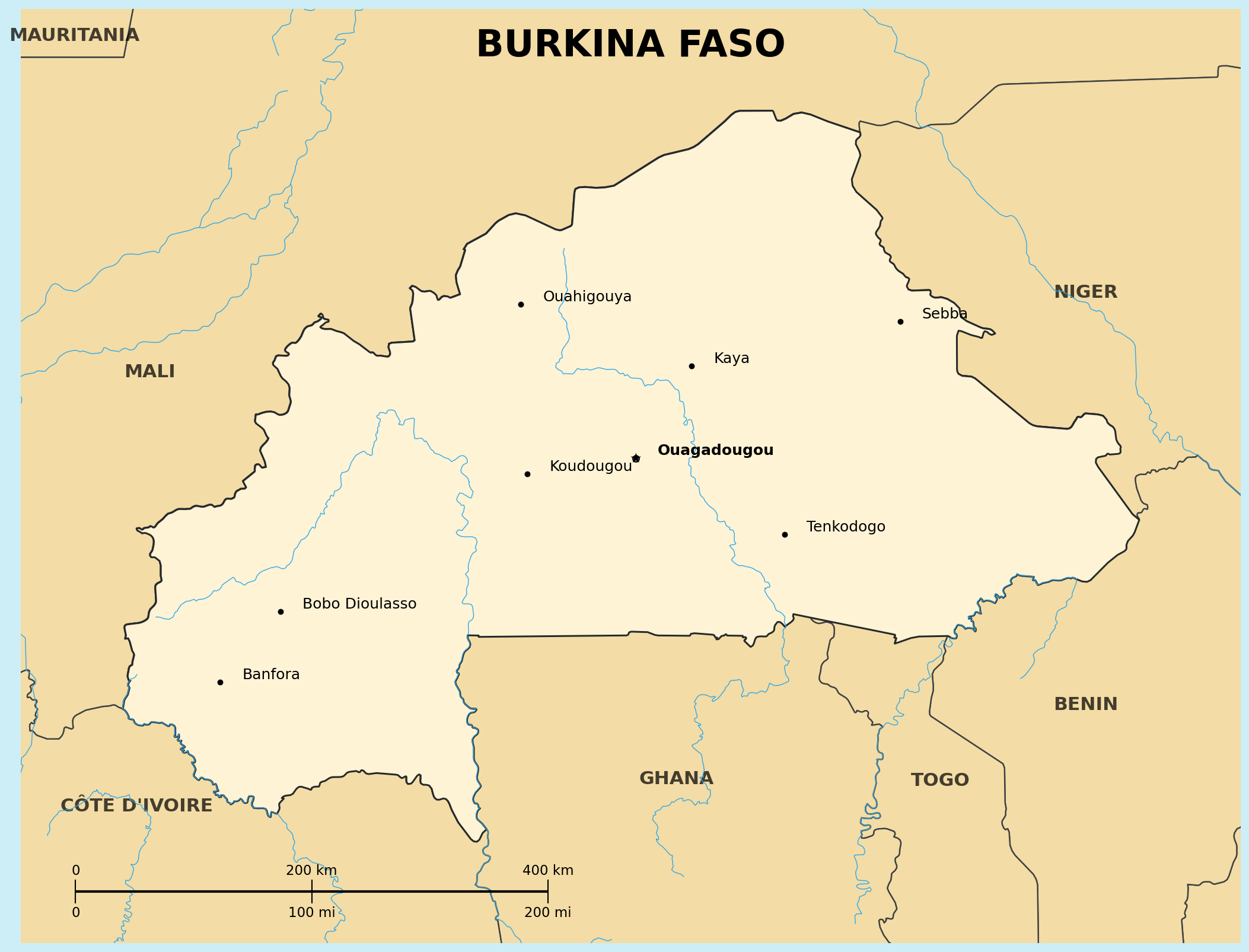
Location: Western Africa, landlocked, north of Ghana and Cote d'Ivoire
Map references: Africa
Area:
total: 272,967-274,200 sq km
Land boundaries:
border countries: Benin, Cote d'Ivoire, Ghana, Mali, Niger, Togo (6 countries)
Geography - note: landlocked at the interior of West Africa; depends on coastal corridors through neighboring countries to reach global markets
| People |
Population: 23,025,776-23,490,300 (2023-2025 est.)
Nationality:
noun/adjective: Burkinabe
Ethnic groups: more than 60 ethnic groups; Mossi the largest, comprising approximately 40% of the population; other significant groups include Fula, Gourounsi, and Lobi
Religions: Islam 63.8%, Christianity 26.3%, traditional/other minority faiths
Languages: French (official), Moore (Mossi, spoken by over half the population), Dyula (official), Fula (official); more than 60 indigenous languages spoken
Literacy: total population 41.4% (male 48.4%, female 35.7%) (2023 est.)
| Government |
Country name:
conventional short form: Burkina Faso; note - the name translates as "Land of the Worthy Men," from the Dyula word burkina ("worthy") and faso ("land"/"father village")
Data code: UV
Government type: military junta (transitional government)
National capital: Ouagadougou
Background: many of Burkina Faso's ethnic groups arrived between the 12th and 15th centuries; the Gurma and Mossi peoples established several of the largest regional kingdoms, using horse-mounted warriors in military campaigns; formerly Upper Volta, renamed Burkina Faso under Thomas Sankara in the 1980s; since 2015 the country has faced a persistent jihadist insurgency that has displaced roughly two million people and closed thousands of schools; formed the Alliance of Sahel States with Mali and Niger in September 2023 to pool counterterrorism efforts, and the current military government has pivoted toward Russia and away from France
| Economy |
Economy - overview: highly agrarian, low-income economy; limited natural resources and widespread poverty; ongoing terrorism significantly disrupts economic activity; gold has displaced cotton as the primary export, though mined amid significant insecurity in large swathes of the country
GDP (purchasing power parity): $68.19-72.82 billion (2024-2025 est.)
GDP - real growth rate: 4.3-5.3% (2025)
GDP - per capita: $2,980-3,000 PPP (2025 est.)
Inflation rate: 4.2% (2024)
Unemployment rate: 3.5-5% (2023-2025)
Population below poverty line: 27.7-40.1% (varies by source/year)
Currency: West African CFA franc (XOF)
| Military |
Military branches: Armed Forces of Burkina Faso (FABF): Army, Air Force, National Gendarmerie, National Fire Brigade; Homeland Defense Volunteers (VDP); Ministry of Territorial Administration: National Police (2025)
| Transnational Issues |
Trafficking in persons - tier rating: Tier 2 Watch List (2025)