

About Cambodia
Khmer - the sole official language, spoken by ~95.8% of the population.
Minority languages account for ~2.9% of speakers, with small Chinese (~0.6%) and Vietnamese (~0.5%) speaking communities.
Khmer is the sole official language of Cambodia.
| Geography |
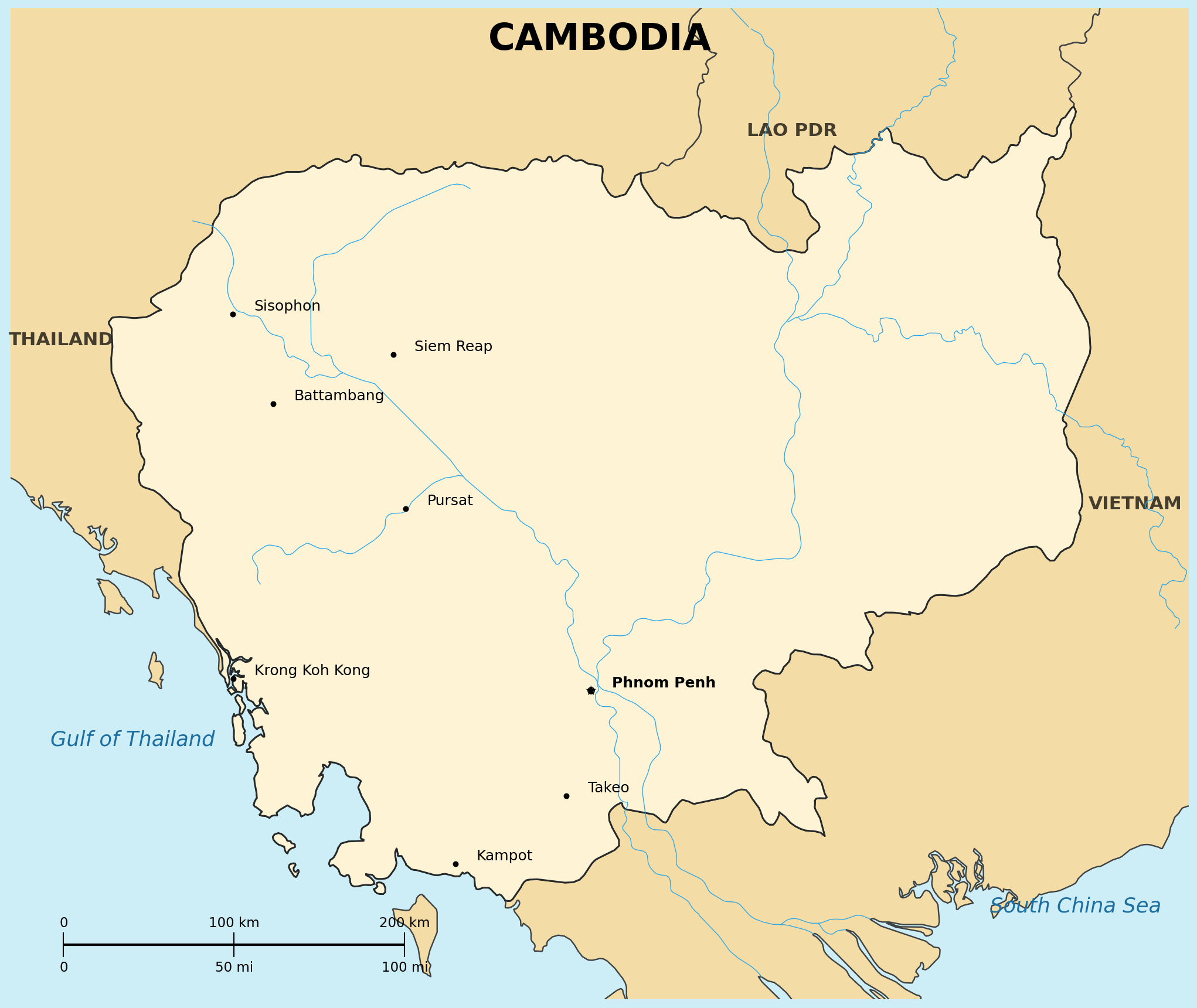
Location: Southeastern Asia, bordering the Gulf of Thailand, between Thailand, Vietnam, and Laos
Map references: Southeast Asia
Terrain: a land of paddies and forests dominated by the Mekong River and Tonle Sap (Southeast Asia's largest freshwater lake)
Climate: monsoonal rains (June to November); flooding; occasional droughts
Natural hazards: monsoonal rains (June to November); flooding; occasional droughts
| People |
Population: 17,230,333 (2025 est.)
Population distribution: concentrated in the southeast, particularly in and around the capital, Phnom Penh; further distribution linked closely to the Tonle Sap and Mekong Rivers
Nationality:
noun/adjective: Cambodian(s)
Ethnic groups: Khmer 97.6%, Cham 1.2%, Chinese 0.1%, Vietnamese 0.1%, other 0.9% (2013 est.)
Religions: Buddhist (official) 96.9%, Muslim 1.9%, Christian 0.4%, other 0.8%
Languages: Khmer (official) 95.8%, minority languages 2.9%, Chinese 0.6%, Vietnamese 0.5%, other 0.2% (2019 est.)
Literacy:
total population: 71.9%
male: 81.5%
female: 63.6% (2021 est.)
| Government |
Country name:
conventional short form: Cambodia
Data code: CB
Government type: parliamentary constitutional monarchy, dominated in practice by the Cambodian People's Party (CPP)
National capital: Phnom Penh; the name means "mountain of plenty," from Khmer phnom (mountain/hill) and penh (full)
Administrative divisions: 24 provinces (khett) and 1 municipality (krong) - Phnom Penh
Background: the Khmer Rouge regime (1975-1979) under Pol Pot caused the deaths of at least 1.5 million people; overthrown by a Vietnamese invasion in 1979; the CPP, led for decades by HUN SEN, has remained in power through elections criticized as lacking fairness; HUN SEN transferred the premiership to his son HUN MANET in 2023 while retaining significant influence as CPP leader and Senate president
| Economy |
Economy - overview: one of the poorest countries in Asia; agriculture (rice), garment manufacturing, and tourism are key sectors; considerable Chinese investment; long-term development inhibited by corruption, limited human resources, and income inequality
GDP (purchasing power parity): $150.05 billion (2025 est.)
GDP - real growth rate: 4.0% (2025 est.)
GDP - per capita: $8,650 PPP (2025 est.)
Inflation rate: 2% (2023 est.)
Unemployment rate: 0.3% (2017 est.; high underemployment per official statistics)
Labor force: 9,230,114 (2019)
Population below poverty line: 14.2% (2022)
Industries: tourism, garments, construction, rice milling, fishing, wood and wood products, rubber, cement, gem mining, textiles
Exports: $26.16 billion (2024 est.); clothing, precious metal scraps, gold, leather footwear
Exports - partners: United States 35.7%, Germany 6.12% (2023)
Currency: riel (KHR)
| Military |
Military branches: Royal Cambodian Armed Forces (RCAF): Royal Cambodian Army, Royal Khmer Navy, Royal Cambodian Air Force, Royal Gendarmerie; National Committee for Maritime Security (2025)
Military - note: in July 2025, following months of rising tensions, the RCAF and Thai military forces clashed in multiple locations along the shared border