
About Cameroon
French - one of two official languages, spoken by the majority.
English - the other official language, spoken predominantly in two western Anglophone regions.
More than 24 major African language groups (270+ distinct languages) are also spoken across the country, reflecting Cameroon's extraordinary linguistic diversity - it is often called "Africa in miniature."
French and English are both official languages of Cameroon.
| Geography |
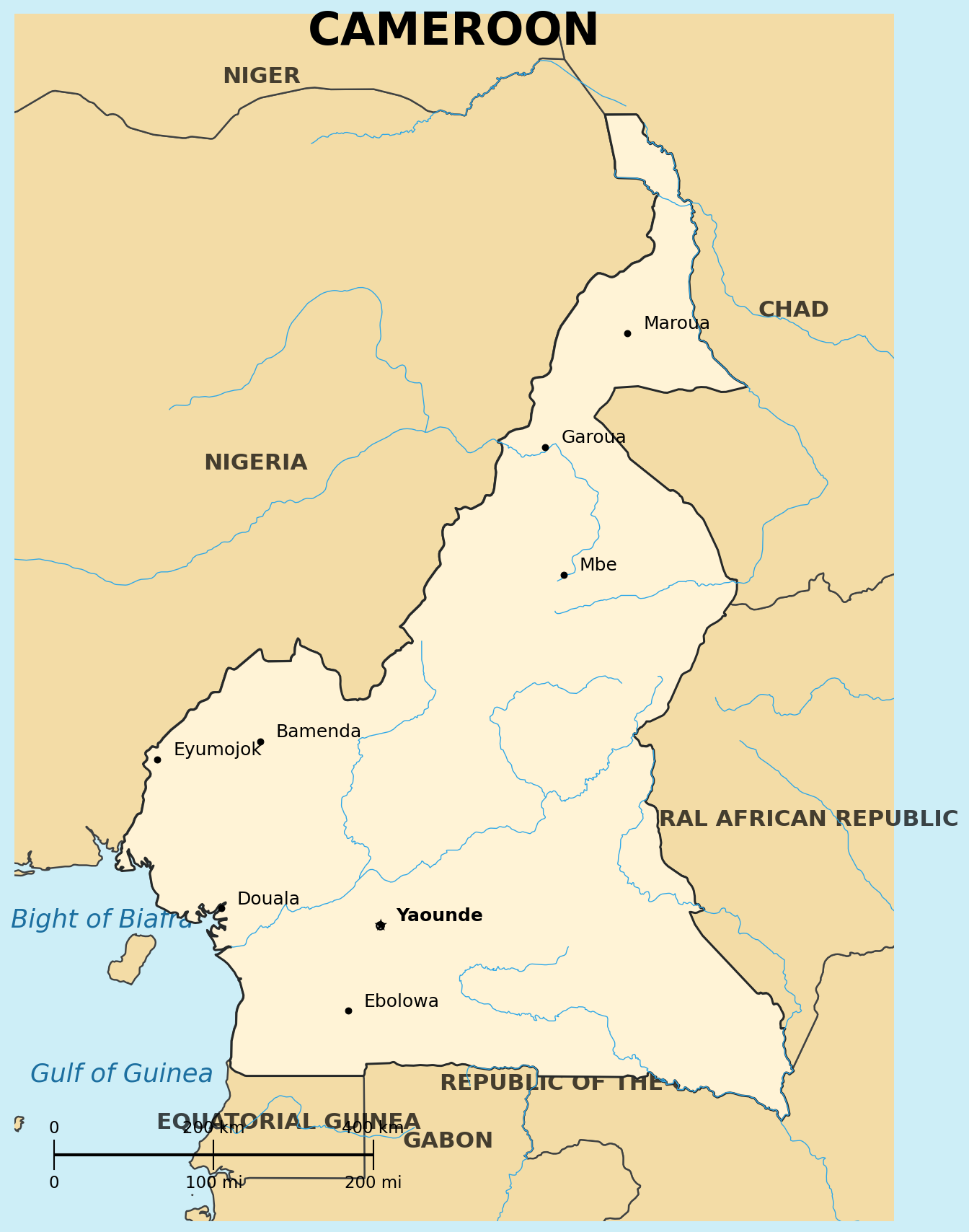
Location: Central Africa, bordering the Bight of Biafra, between Equatorial Guinea and Nigeria
Map references: Africa
Land boundaries:
border countries: Central African Republic, Chad, Republic of the Congo, Equatorial Guinea, Gabon, Nigeria (6 countries)
Geography - note: sometimes called the "hinge of Africa" for its central location and position at the juncture of the Gulf of Guinea; areas of thermal springs and volcanic activity; Mount Cameroon, the highest peak in Sub-Saharan West Africa, is an active volcano
| People |
Population: 29.1-31,518,954 million (2024-2025 est.)
Nationality:
noun/adjective: Cameroonian(s)
Ethnic groups: Bamileke-Bamu 22.2%, Biu-Mandara 16.4%, Arab-Choa/Hausa/Kanuri 13.5%, Beti/Bassa/Mbam 13.1%, Grassfields 9.9%, Adamawa-Ubangi 9.8%, other 12.7% (2022 est.)
Religions: Roman Catholic 38.3%, Protestant 25.5%, Muslim 24.4%, other Christian 6.9%, animist 2.2% (2018 est.)
Languages: 24 major African language groups, French (official), English (official)
Population distribution: median age around 18-19 years; more than 60% of the population is under 25; urbanization approaching 60%
| Government |
Country name:
conventional long form: Republic of Cameroon
conventional short form: Cameroon
Data code: CM
Government type: presidential republic, dominated by a strong presidency with power over the legislative and judicial branches
National capital: Yaounde
Executive branch:
chief of state: President Paul BIYA (in power since 1982; re-elected to an eighth term in the disputed October 2025 election, with 53.66% of the vote officially, extending his rule to 2032)
Background: a 2008 constitutional amendment removed presidential term limits, allowing Biya, in power since 1982, to continue running; the October 2025 election was heavily contested, with opposition candidate Issa Tchiroma Bakary disputing the results and claiming victory himself; protests following the announcement resulted in deaths and mass arrests; Cameroon also faces an ongoing Anglophone separatist insurgency in its English-speaking regions and Boko Haram attacks in the Far North
| Economy |
Economy - overview: lower-middle-income, diversified Central African economy; oil, agriculture (cocoa, coffee, cotton), and timber are key sectors; chronic corruption has dampened growth despite significant natural resource wealth
GDP (purchasing power parity): $173.30 billion (2025 est.)
GDP - real growth rate: 3.6% (2025)
GDP - per capita: $5,790 PPP (2025 est.)
Inflation rate: 3.4% (2025 est.)
Unemployment rate: 3.6% (2025 est.)
Population below poverty line: 22-23% (2024)
Industries: petroleum production and refining, aluminium production, food processing, light consumer goods, textiles, lumber, ship repair
Currency: Central African CFA franc (XAF)