

About Canada
English - the most widely spoken official language, spoken by ~87.1% of the population.
French - the other official language, spoken by ~29.1% of the population, predominant in Quebec.
Chinese languages (~4.2%), Spanish (~3.2%), Punjabi (~2.6%), Arabic (~2.4%), Tagalog (~2.3%), and Italian (~1.5%) are also widely spoken due to Canada's large immigrant population.
Canada is officially bilingual, with English and French as its two official languages.
| Geography |
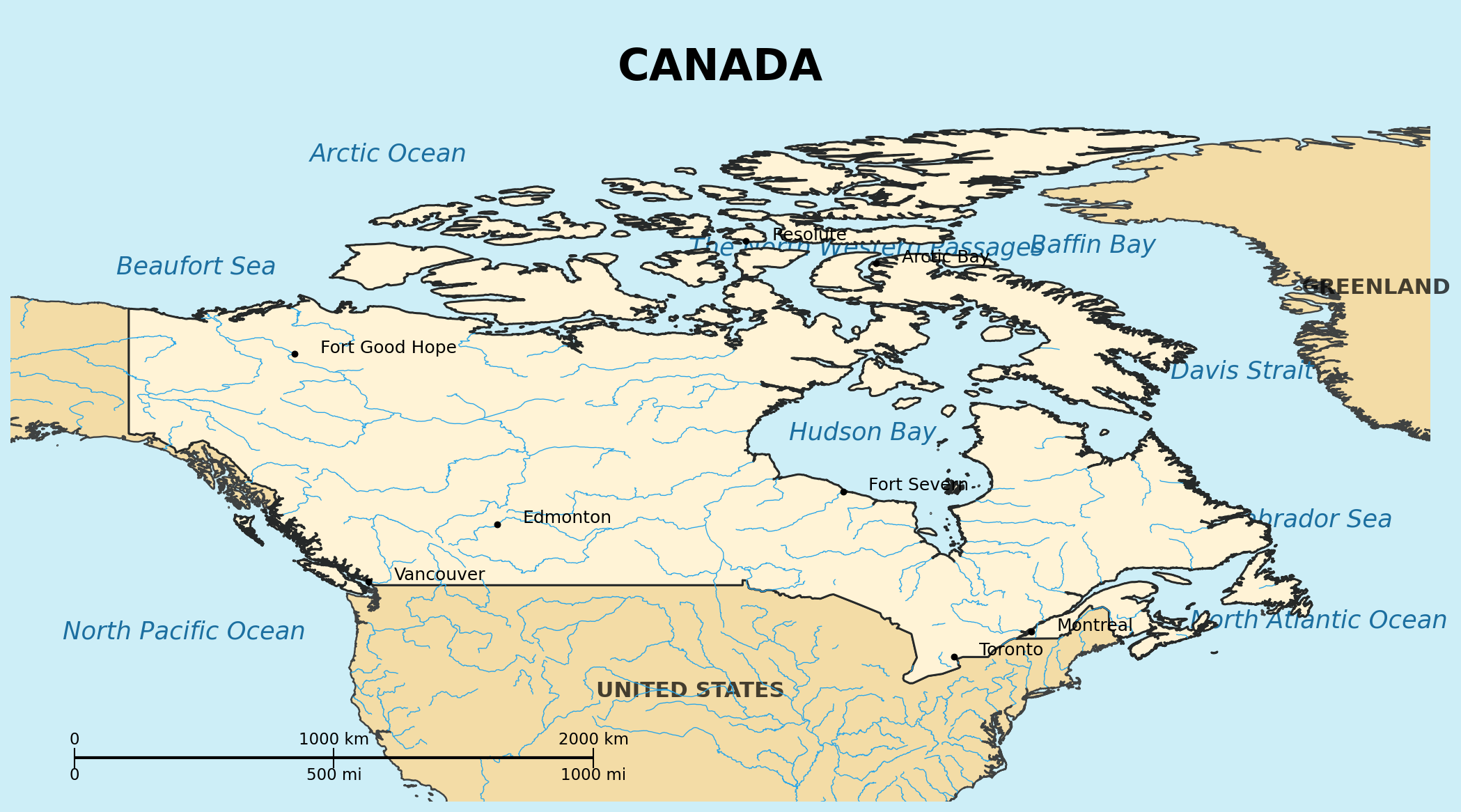
Location: Northern North America, bordering the North Atlantic Ocean, North Pacific Ocean, and Arctic Ocean, north of the United States
Map references: North America
Area:
total: 9,984,670 sq km (2nd largest country in the world, after Russia; largest in the Americas)
Land boundaries:
border countries: United States
Climate: varies from temperate in south to subarctic and arctic in north
Terrain: mostly plains, with mountains in west, lowlands in southeast
Natural resources: iron ore, nickel, zinc, copper, gold, lead, rare earth elements, molybdenum, potash, diamonds, silver, fish, timber, wildlife, coal, petroleum, natural gas, hydropower
Geography - note: approximately 90% of the population is concentrated within 160 km (100 mi) of the US border; Canada has more fresh water than any other country, with at least 2 million and possibly over 3 million lakes - more than all other countries combined
| People |
Population: 41,651,653 (2025 est.)
Median age: 41.1 years
Life expectancy at birth: total population 81.6 years (2025 est.)
Infant mortality rate: 4.4 deaths/1,000 live births
Nationality:
noun/adjective: Canadian(s)
Ethnic groups: Canadian 15.6%, English 14.7%, Scottish 12.1%, French 11%, Irish 12.1%, German 8.1%, Chinese 4.7%, Italian 4.3%, First Nations 1.7%, Indian 3.7%, Ukrainian 3.5%, Metis 1.5% (2021 est.; totals exceed 100% due to multiple responses)
Religions: Christian 53.3%, Muslim 4.9%, Hindu 2.3%, Sikh 2.1%, Buddhist 1%, Jewish 0.9%, Traditional (North American Indigenous) 0.2%, none 34.6% (2021 est.)
Languages: English (official) 87.1%, French (official) 29.1%, Chinese languages 4.2%, Spanish 3.2%, Punjabi 2.6%, Arabic 2.4%, Tagalog 2.3%, Italian 1.5% (2022 est.)
Population distribution: vast majority lives in a discontinuous band within approximately 300 km of the southern border with the US; most populated province is Ontario, followed by Quebec and British Columbia
| Government |
Country name:
conventional short form: Canada
Data code: CA
Government type: federal parliamentary democracy under a constitutional monarchy; a Commonwealth realm
National capital: Ottawa
Independence: 1 July 1867 (union of British North American colonies); 11 December 1931 (recognized by UK per Statute of Westminster)
| Economy |
Economy - overview: high-income, advanced economy; second-largest trading partner of the United States; key industries include timber, oil, and gas; faces trade uncertainties, weak business investment, growing public debt, and above-target inflation
GDP (purchasing power parity): $2.81 trillion (2026 est.)
GDP - real growth rate: 1.4% (2025 est.)
GDP - per capita: $67,756 PPP (2026 est.)
Inflation rate: 2.2% (November 2025)
Unemployment rate: 6.9% (2025 est.)
Labor force: 21.34 million (2022)
Population below poverty line: 3.2% (2022, official)
Currency: Canadian dollar (CAD)
| Communications |
Internet country code: .ca