
About Chile
Spanish - spoken by ~99.5% of the population and the sole official language.
English is spoken by ~10.2% as a second language.
Indigenous languages (~1%) including Mapudungun, Aymara, Quechua, and Rapa Nui are spoken by Chile's indigenous communities, who make up over 11% of the population.
Spanish is the sole official language of Chile.
| Geography |
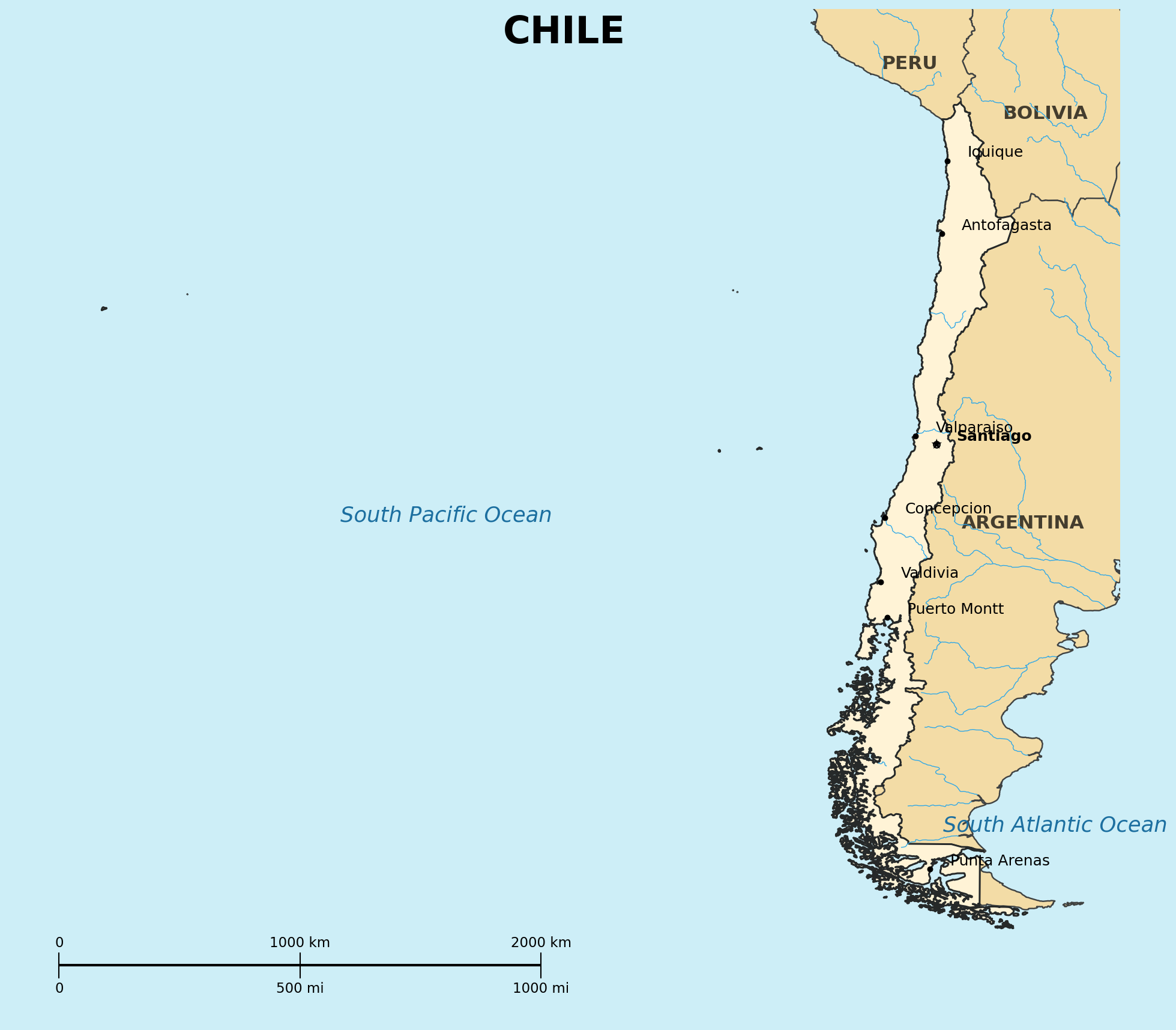
Location: Southern South America, bordering the South Pacific Ocean, between Argentina and Peru; a long, narrow country stretching over 4,300 km north to south
Map references: South America
Maritime claims:
territorial sea: 12 nm
contiguous zone: 24 nm
exclusive economic zone: 200 nm
continental shelf: 200/350 nm
Climate: temperate; desert in north; Mediterranean in central region; cool and damp in south
Terrain: low coastal mountains, fertile central valley, rugged Andes in east
Elevation extremes:
highest point: Nevado Ojos del Salado 6,893 m (highest volcano in the world)
lowest point: Pacific Ocean 0 m
Natural resources: copper, timber, iron ore, nitrates, precious metals, molybdenum, hydropower
| People |
Population: 19,091,343 (2025 est.)
Nationality:
noun/adjective: Chilean(s)
Ethnic groups: Spanish-Native American (mestizo) majority, European descent, Native American (over 11% of the population, predominantly Mapuche, also Aymara, Rapa Nui)
Religions: Roman Catholic ~55%, Evangelical/Protestant ~16%, irreligious/unaffiliated ~25%
Languages: Spanish 99.5% (official), English 10.2%, indigenous 1% (Mapudungun, Aymara, Quechua, Rapa Nui), other 2.3%, unspecified 0.2% (2012 est.)
Literacy: total population 95.8%
| Government |
Country name:
conventional long form: Republic of Chile
conventional short form: Chile
Data code: CI
Government type: presidential republic
National capital: Santiago; note - Valparaiso is the seat of the national legislature
Executive branch: President Jose Antonio KAST, elected in the 2025 presidential election (runoff), succeeding Gabriel BORIC
Background: a three-year-old Marxist government was overthrown in 1973 by a dictatorial military regime led by Augusto PINOCHET, which ruled until a freely elected president was installed in 1990; economic reforms maintained consistently since the 1980s contributed to steady growth, reduced poverty rates by over half, and helped secure the country's commitment to democratic government
| Economy |
Economy - overview: high-income, developing/emerging economy; Latin America's most stable and prosperous economies; copper mining is a cornerstone industry; has increasingly assumed regional and international leadership roles
GDP (purchasing power parity): $752.4 billion (2026 est.)
GDP - real growth rate: 2.3% (2025 est.)
GDP - per capita: $37,336 PPP (2026 est.)
Unemployment rate: 9.0% (2025 est.)
Labor force: 9,847,754 (2023)
Population below poverty line: 6.2% (2022)
Currency: Chilean peso (CLP)
| Communications |
Broadcast media: national and local terrestrial TV channels with extensive cable networks; state-owned Television Nacional de Chile (TVN) is self-financed through advertising and not under direct government control; large number of privately owned TV stations; about 250 radio stations
| Military |
Military branches: Armed Forces of Chile: Chilean Army, Chilean Navy (includes Marine Corps), Chilean Air Force (2025)
Military manpower: approximately 70,000 active Armed Forces personnel; approximately 50,000 Carabineros (national police) (2025)