
About China
Standard Chinese/Mandarin (Putonghua, based on the Beijing dialect) - the official language, used nationally in education, media, and government.
Regional Chinese varieties are also widely spoken as first languages, including Yue (Cantonese), Wu (Shanghainese), Minbei (Fuzhou), Minnan (Hokkien-Taiwanese), Xiang, Gan, and Hakka.
Minority languages have official regional status: Zhuang in Guangxi, Yue in Guangdong, Mongolian in Nei Mongol, Uyghur and Kyrgyz in Xinjiang, and Tibetan in Xizang (Tibet).
Standard Chinese (Mandarin) is China's official language nationwide.
| Geography |
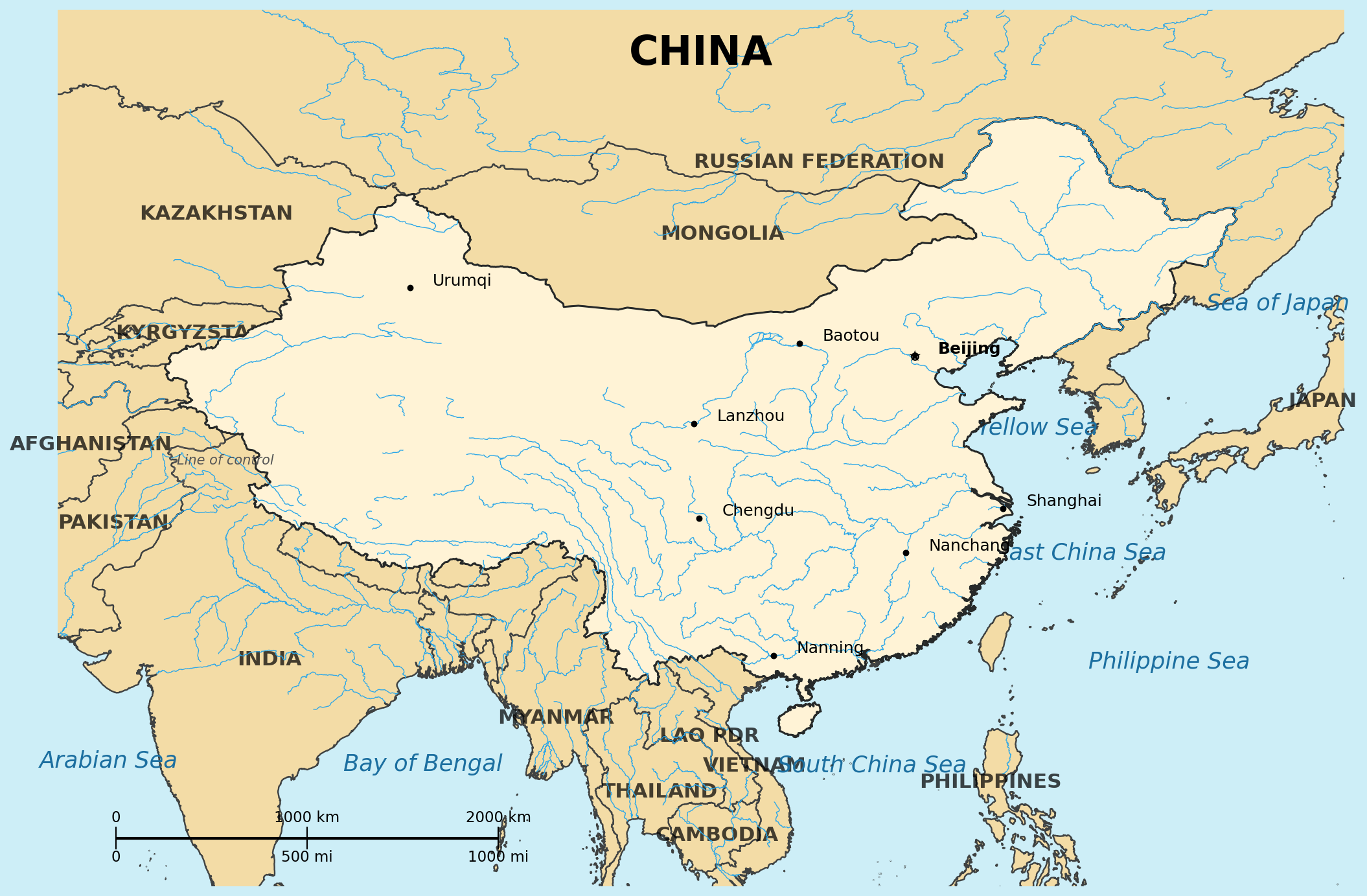
Location: Eastern Asia, bordering the East China Sea, Korea Bay, Yellow Sea, and South China Sea
Map references: Asia
Area:
total: 9,596,960 sq km (3rd/4th largest country in the world)
Land boundaries:
border countries: 14 countries including Russia, India, Kazakhstan, Mongolia, Myanmar, Vietnam, North Korea, and others
Climate: extremely diverse; tropical in south to subarctic in north
Terrain: mostly mountains, high plateaus, deserts in west; plains, deltas, and hills in east
Natural resources: coal, iron ore, petroleum, natural gas, mercury, tin, tungsten, antimony, manganese, molybdenum, vanadium, magnetite, aluminum, lead, zinc, rare earth elements, uranium, hydropower potential (world's largest)
| People |
Population: 1,407,181,209 (2025 est.) - 2nd most populous country in the world, surpassed by India in 2023
Nationality:
noun/adjective: Chinese
Ethnic groups: Han Chinese 91.11%, Zhuang 1.39%, Uyghur 0.84%, Hui 0.81%, Miao 0.79%, Manchu 0.74%, Yi 0.70%, Tujia 0.68%, Tibetan 0.50%, Mongol 0.45%, other 2.44% (2020)
Religions: folk religion 21.9%, Buddhist 18.2%, Christian 5.1%, Muslim 1.8%, other 0.7% (includes Daoist), unaffiliated 52.1% (2021 est.)
Languages: Standard Chinese/Mandarin (official; Putonghua), Yue (Cantonese), Wu (Shanghainese), Minbei (Fuzhou), Minnan (Hokkien-Taiwanese), Xiang, Gan, Hakka dialects, minority languages; note - Zhuang official in Guangxi, Yue official in Guangdong, Mongolian official in Nei Mongol, Uyghur/Kyrgyz official in Xinjiang, Tibetan official in Xizang
Literacy:
total population: 96.7%
male: 98.4%
female: 95.1% (2020 est.)
Population policy note: in October 2015 the government announced a two-child policy (effective 2016), loosening the 1979 one-child mandate to address rapid population aging
| Government |
Country name:
conventional long form: People's Republic of China
conventional short form: China
local long form: Zhonghua Renmin Gongheguo
local short form: Zhongguo
abbreviation: PRC
Data code: CH
Government type: unitary one-party communist state
National capital: Beijing
Independence: 221 BC (unification under the Qin Dynasty); 1 January 1912 (Republic of China established); 1 October 1949 (People's Republic of China proclaimed)
Executive branch:
chief of state: CCP General Secretary and President XI Jinping
head of government: Premier LI Qiang
Background: historical civilization dates from at least 1200 BC; alternated between unity and disunity under successive imperial dynasties for over two millennia
| Economy |
Economy - overview: world's 2nd-largest economy by nominal GDP and largest by PPP; newly industrialized, developing economy with rapid economic expansion
GDP (purchasing power parity): $44.295 trillion (2026 est.)
GDP - real growth rate: 5.0% (2025 est.)
GDP - per capita: $31,596 PPP (2026 est.)
Inflation rate: 0.2% (2026)
Unemployment rate: 5.1% (December 2025); youth unemployment 16.5%
Labor force: 840 million (2026) - world's largest
Population below poverty line: 20% on less than $8.30/day (2026)
Currency: Renminbi/Yuan (CNY)
| Transnational Issues |
Trafficking in persons - tier rating: Tier 3 (2025) - China does not fully meet the minimum standards for the elimination of trafficking and is not making significant efforts to do so