

About Colombia
Spanish - the official language, spoken by ~98.9% of the population.
Indigenous languages account for ~1% of speakers; approximately 65 indigenous languages exist across the country (including Wayuu, Paez, and Embera).
Portuguese is spoken by a small minority (~0.1%), mainly near the Brazilian border.
Note: while Spanish is the official language nationwide, indigenous languages are also official within their own territories.
| Geography |
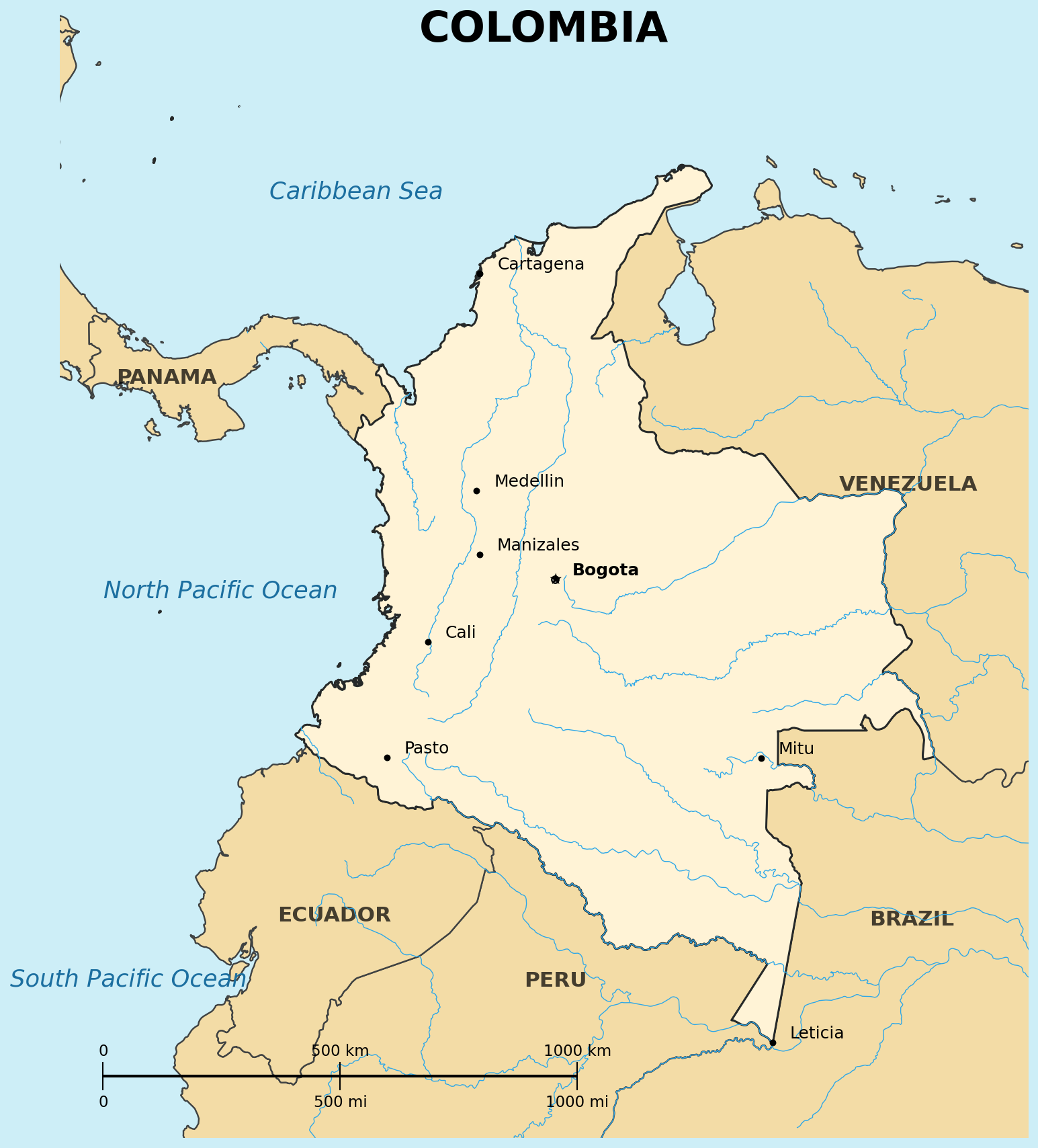
Location: Northern South America, bordering the Caribbean Sea and the North Pacific Ocean, between Panama and Venezuela, and bordering Ecuador and Peru
Map references: South America
Area:
total: 1,138,910 sq km
Land boundaries:
border countries: Brazil, Ecuador, Panama, Peru, Venezuela
Climate: tropical along coast and eastern plains; cooler in highlands
Terrain: flat coastal lowlands, central highlands, high Andes Mountains, eastern lowland plains (Los Llanos)
Natural resources: petroleum, natural gas, coal, iron ore, nickel, gold, copper, emeralds, hydropower
| People |
Population: 49,842,298 (2025 est.)
Age structure:
0-14 years: 24.5%
15-64 years: 64.1%
65 years and over: 11.4%
Life expectancy at birth:
total population: 74.9 years
male: 71.3 years
female: 78.7 years
Infant mortality rate: 11.7 deaths/1,000 live births (2024 est.)
Nationality:
noun/adjective: Colombian(s)
Ethnic groups: Mestizo and White 87.6%, Afro-Colombian (includes Mulatto, Raizal, Palenquero) 6.8%, Indigenous 4.3%, unspecified 1.4% (2018 est.)
Religions: Roman Catholic 63.6%, Protestant 17.2% (Evangelical 16.7%), Jehovah's Witness 0.6%, none 14.2%, unspecified 1.8% (2023 est.)
Languages: Spanish (official) 98.9%, indigenous 1%, Portuguese 0.1%; approximately 65 indigenous languages exist (2023 est.)
| Government |
Country name:
conventional short form: Colombia
Data code: CO
Government type: presidential republic
National capital: Bogota
Background: Colombia was one of three countries that emerged after the dissolution of Gran Colombia in 1830, the others being Ecuador and Venezuela; despite decades of internal conflict and drug-trade-related challenges, Colombia has one of the more consistent growth economies in Latin America
| Economy |
Economy - overview: prior to COVID-19, one of the most consistently growing economies in the region; declining poverty; sound, flexible exchange rate regime; economy affected by internal conflict and drug trade challenges
GDP (purchasing power parity): $1.26 trillion (2026 est.)
GDP - real growth rate: 2.6% (2025 est.)
GDP - per capita: $23,576 PPP (2026 est.)
Inflation rate: 11.7% (2023)
Unemployment rate: 8.3% (2025 est.)
Labor force: 26,788,369 (2019)
Population below poverty line: 33% (2023)
Currency: Colombian peso (COP)
| Military |
Military - note: the Colombian military has a considerable internal security role in addition to defending national sovereignty; its primary focus is counterinsurgency and counter-narcotics operations against domestic illegal armed groups, including drug traffickers and factions of the FARC and ELN
Military service age and obligation: 18-24 years of age for compulsory (men) and voluntary (men and women) service; conscript obligation 18 months (or 12 months with a college degree) (2025)
| Terrorism |
Terrorist group(s): National Liberation Army (ELN); Revolutionary Armed Forces of Colombia - People's Army (FARC-EP) dissident factions; Segunda Marquetalia