

About Costa Rica
Spanish - the sole official language, spoken by the vast majority of the population.
English is also widely understood, particularly in tourist areas.
Limonese Creole, Bribri, Ngabere, and other indigenous languages are spoken by smaller communities.
Spanish is the sole official language of Costa Rica.
| Geography |
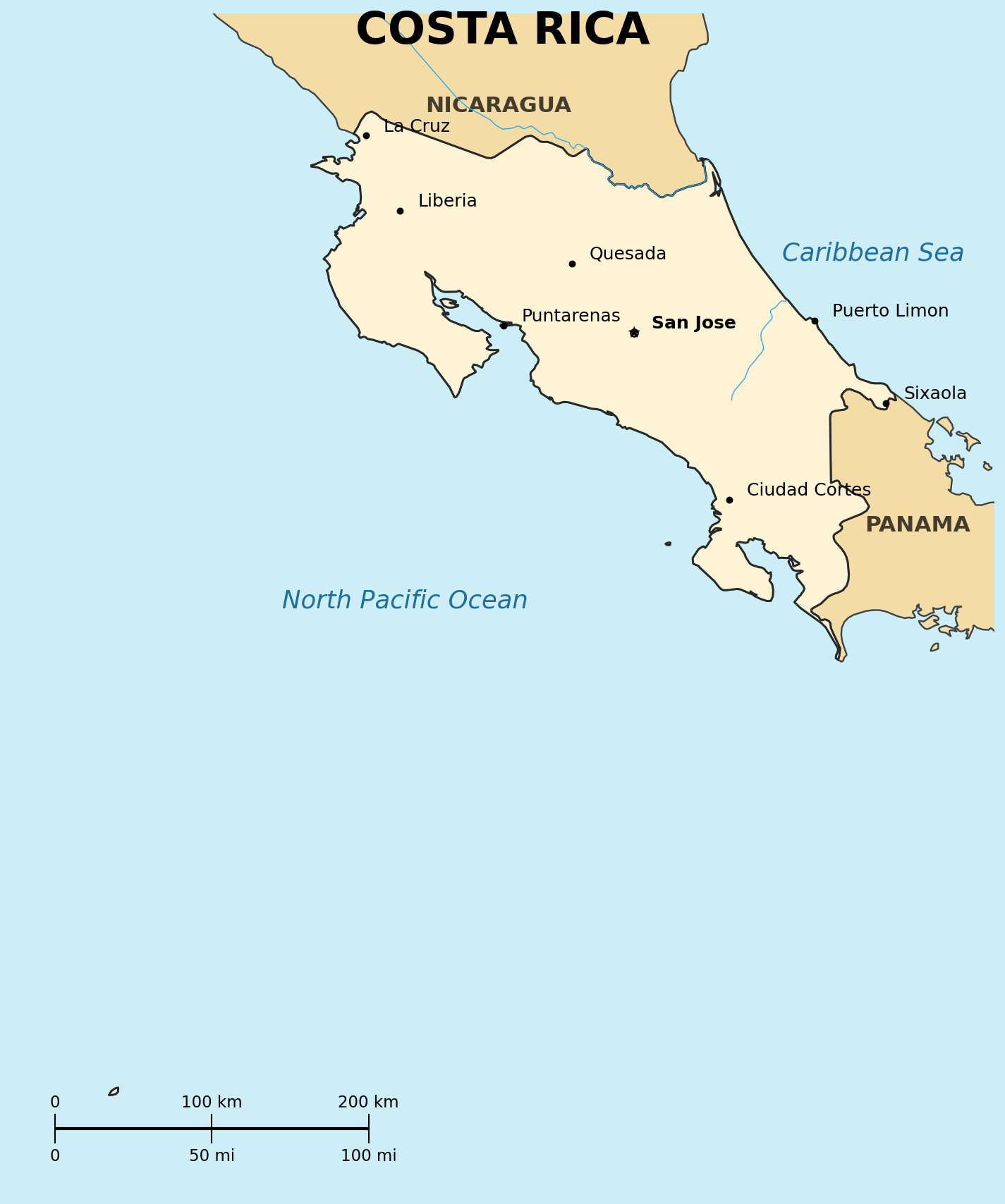
Location: Central America, bordering both the Caribbean Sea and the North Pacific Ocean, between Nicaragua and Panama
Map references: Central America and the Caribbean
Area:
total: 51,100-51,179.92 sq km
Land boundaries:
border countries: Nicaragua, Panama
| People |
Population: 5,044,197-5,304,932 (2022-2025 est.)
Age structure:
0-14 years: 18.8-21.49%
15-64 years: 68.59-70.2%
65 years and over: 9.92-11.1%
Median age: 36 years (2025 est.)
Nationality:
noun/adjective: Costa Rican(s)
Religions: Roman Catholic 47.5%, Evangelical and Pentecostal 19.8%, none 27%, other 5.7% (2021 est.)
Languages: Spanish (official), English
Population distribution: roughly half the population lives in urban areas; the capital, San Jose, is the largest city, home to about one-fifth of the population; almost 9% of the population is foreign-born, with Nicaraguans making up nearly three-quarters of the foreign population
| Government |
Country name:
conventional long form: Republic of Costa Rica
conventional short form: Costa Rica
Data code: CS
Government type: presidential republic
National capital: San Jose
Independence: 15 September 1821 (from Spain); 14 November 1838 (from the Federal Republic of Central America)
Background: Costa Rica's political stability, high standard of living, and well-developed social benefits system set it apart from its Central American neighbors; the country abolished its military in 1949
| Economy |
Economy - overview: upper-middle to high-income, trade-based economy; a recognized green-economy leader, having reversed historical deforestation; investing in blue-economy infrastructure; sustained government social spending (nearly 20% of GDP annually) has enabled universal access to education, healthcare, and sanitation; poverty declined steadily until COVID-19 setbacks; lingering inequality and growing government debt (around 60% of GDP) remain concerns
GDP (purchasing power parity): $169.034-184.97 billion (2025-2026 est.)
GDP - real growth rate: 3.6% (2026)
GDP - per capita: $31,462-34,157 PPP (2025-2026 est.)
Inflation rate: -0.33% (May 2024)
Unemployment rate: 6.8% (2025 est.)
Population below poverty line: 20.3% (2024)
Currency: Costa Rican colon (CRC)
| Military |
Military - note: Costa Rica has no standing military; relies on specialized paramilitary units within the Ministry of Public Security for internal security and countering transnational threats such as narcotics smuggling; these forces receive advisory and training support from the US (2025)