

About Croatia
Croatian - the sole official language, spoken by ~95.2% of the population.
Serbian - spoken by ~1.2%, mainly by the ethnic Serb minority.
Other minority languages (~3.1%) include Bosnian, Romani, Albanian, and Italian.
Some local government areas also officially recognize Italian, Czech, Hungarian, Ruthenian, Serbian, and Slovak for minority use.
Croatian is the sole official language of Croatia at the national level.
| Geography |
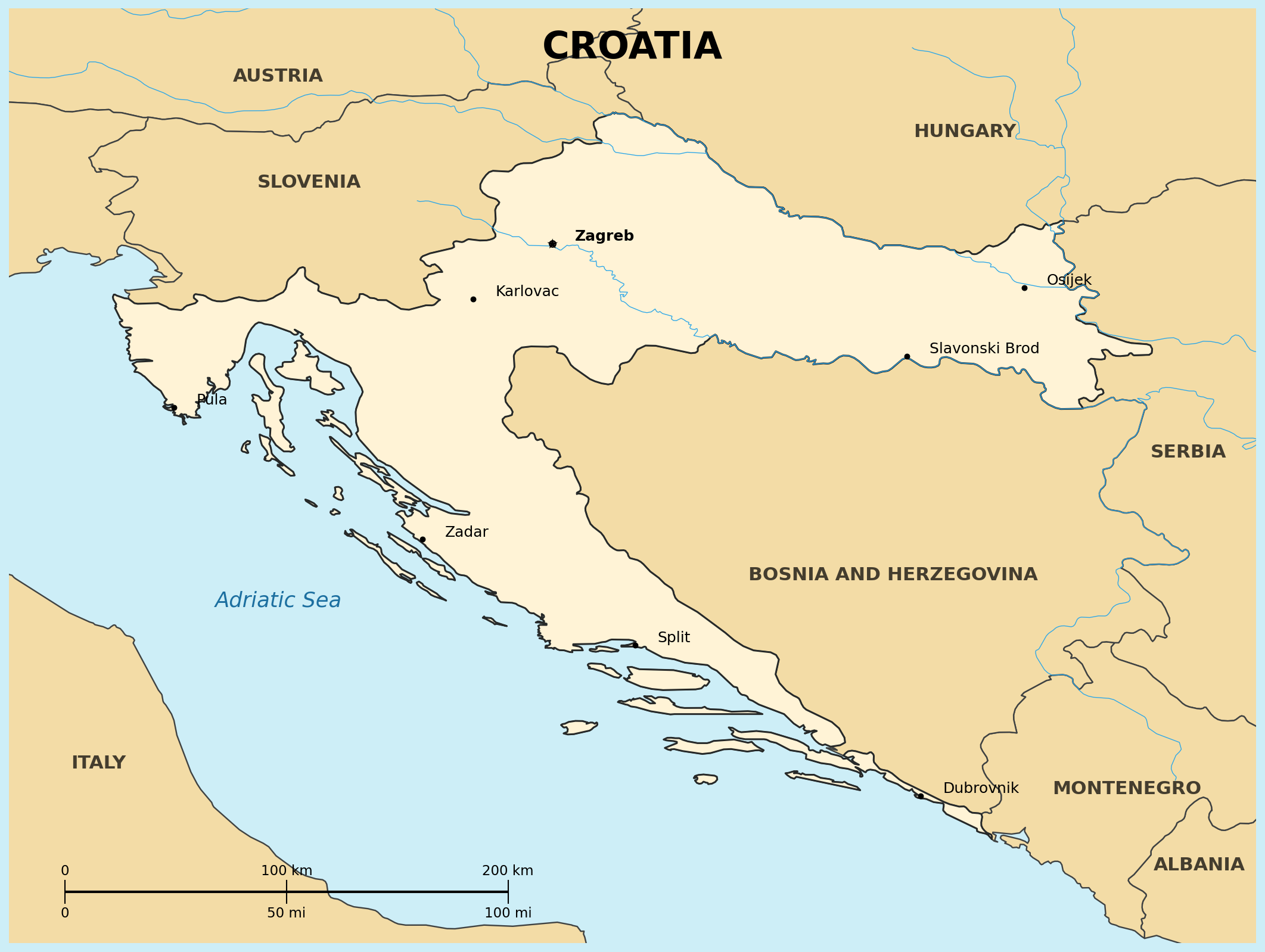
Location: Southeastern Europe, bordering the Adriatic Sea, between Bosnia and Herzegovina and Slovenia
Map references: Europe
Area:
total: 56,594 sq km
Land boundaries:
border countries: Bosnia and Herzegovina, Hungary, Montenegro, Serbia, Slovenia
Climate: Mediterranean and continental; continental climate predominant with hot summers and cold winters; mild winters, dry summers along coast
Terrain: geographically diverse; flat plains along Hungarian border, low mountains and highlands near Adriatic coastline and islands
Natural resources: oil, coal, bauxite, low-grade iron ore, calcium, gypsum, natural asphalt, silica, mica, clays, salt, hydropower
Geography - note: controls most land routes from Western Europe to the Aegean Sea and Turkish Straits; most Adriatic Sea islands lie off the coast of Croatia - some 1,200 islands, islets, ridges, and rocks
| People |
Population: 4,071,208 (2025 est.)
Age structure:
0-14 years: 14.1%
15-64 years: 63%
65 years and over: 22.9% (2023)
Life expectancy at birth:
total population: 78.6 years
male: 75.4 years
female: 81.8 years (2023)
Infant mortality rate: 3.4 deaths/1,000 live births (2025 est.)
Nationality:
noun/adjective: Croatian(s)
Ethnic groups: Croat 91.6%, Serb 3.2%, other 3.9% (including Bosniak, Romani, Albanian, Italian, Hungarian), unspecified 1.3% (2021 est.)
Religions: Roman Catholic 79%, Orthodox 3.3%, Protestant 0.3%, other Christian 4.8%, Muslim 1.3%, none/atheist 4.7%, unspecified 3.9% (2021 est.)
Languages: Croatian (official) 95.2%, Serbian 1.2%, other 3.1% (Bosnian, Romani, Albanian, Italian), unspecified 0.5% (2021 est.); Italian, Czech, Hungarian, Ruthenian, Serbian, and Slovak are in official use in some local government areas
Population distribution: more of the population lives in the northern half of the country, with approximately a quarter residing in and around the capital, Zagreb; many islands are sparsely populated
| Government |
Country name:
conventional short form: Croatia
local short form: Hrvatska
Data code: HR
Government type: parliamentary republic
National capital: Zagreb
Independence: 25 June 1991 (from Yugoslavia)
Executive branch:
chief of state: President Zoran MILANOVIC (since 2020; re-elected 2025)
Background: part of the Austro-Hungarian Empire until the end of WWI; joined the Kingdom of Serbs, Croats, and Slovenes in 1918 (later Yugoslavia); Croatia declared independence from Yugoslavia in 1991, followed by four years of sporadic but often bitter fighting; joined NATO in 2009 and the EU in 2013; joined the Eurozone and Schengen Area in January 2023
| Economy |
Economy - overview: advanced, high-income economy; EU and Eurozone member; key industries include tourism, chemicals and plastics, machine tools, and shipbuilding
GDP (purchasing power parity): $207.40 billion (2026 est.)
GDP - real growth rate: 2.6% (2026f)
GDP - per capita: $54,359 PPP (2026 est.)
Inflation rate: 3.9% (2026)
Unemployment rate: 3.7% (May 2026)
Labor force: 1,788,994 (2025)
Industries: chemicals and plastics, machine tools, fabricated metal, electronics, pig iron and rolled steel products, aluminium, paper, wood products, construction materials, textiles, shipbuilding, petroleum refining, food and beverages, tourism
Currency: Euro (EUR) - adopted from the Croatian kuna in 2023
| Military |
Military branches: Armed Forces of the Republic of Croatia (OSRH): Croatian Army, Croatian Navy (includes Coast Guard), Croatian Air Force (2025)
Military service age and obligation: 18-29 for voluntary service; conscription abolished in 2008 but scheduled to be reinstated in 2026, mandatory for men aged 19-29 to undergo two months of basic training