

About Djibouti
French and Arabic - both official languages, used in government and formal education.
Somali and Afar - the national languages, spoken by the majority ethnic Somali (~60%) and Afar (~35%) populations in daily life.
French and Arabic are official languages of Djibouti, while Somali and Afar are national languages.
| Geography |
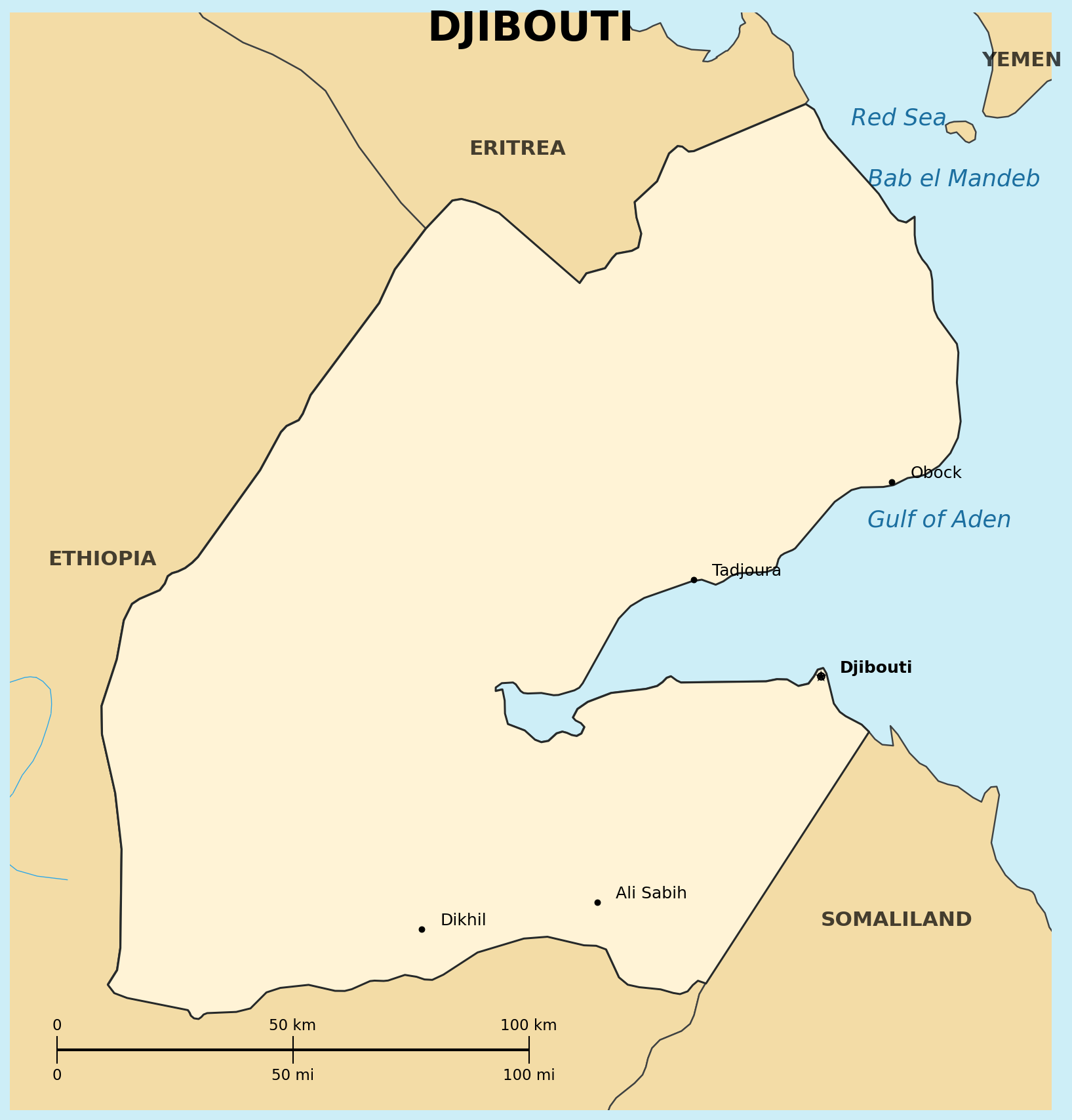
Location: Eastern Africa, bordering the Bab el Mandeb Strait (between the Gulf of Aden and the Red Sea), between Eritrea and Somalia
Map references: Africa
Area:
total: 23,200-23,700 sq km
Land boundaries:
border countries: Eritrea, Ethiopia, Somalia
Natural hazards: earthquakes; droughts; occasional cyclonic disturbances from the Indian Ocean bring heavy rains and flash floods; limited volcanic activity (Ardoukoba last erupted 1978)
Geography - note: strategic location near some of the world's busiest shipping lanes and close to Arabian oilfields; Lake Assal is the lowest point in Africa and the saltiest lake in the world
| People |
Population: 872,932-1,013,703 (varies significantly by source; 2015-2025 est.)
Age structure:
0-14 years: 28.4%
15-64 years: 67.4%
65 years and over: 4.2% (2024 est.)
Infant mortality rate: 44.3 deaths/1,000 live births (2025 est.)
Nationality:
noun/adjective: Djiboutian(s)
Ethnic groups: Somali ~60%, Afar ~35%, other (French, Arab, Ethiopian, Italian) 5%
Religions: Sunni Muslim 94% (nearly all Djiboutians), other 6% (mainly foreign-born residents)
Languages: French (official), Arabic (official); Somali and Afar (national languages)
Population distribution: most densely populated areas are in the east; the capital, Djibouti city, is by far the largest city; urban population 78.6-84.1% of total (2023)
| Government |
Country name:
conventional long form: Republic of Djibouti
conventional short form: Djibouti
former: French Somaliland
Data code: DJ
Government type: presidential republic
National capital: Djibouti
Background: present-day Djibouti was the site of the medieval Ifat and Adal Sultanates; in the late 19th century, Afar sultans signed treaties allowing France to establish the colony of French Somaliland in 1862; additional treaties with ethnic Somali followed in 1885; tensions between the Afar and Somali populations grew over perceived French favoritism toward the Afar; a 1958 referendum allowed residents to choose continued association with France over joining an independent Somalia
| Economy |
Economy - overview: developing economy whose potential derives largely from its strategic location on the Red Sea; mostly barren, with little agricultural or industrial development; a harsh climate and largely unskilled labor force limit growth; heavily reliant on port, logistics, and shipping services
GDP (purchasing power parity): $10.72 billion (2026 est.)
GDP - real growth rate: 6.0% (2025-2026)
GDP - per capita: $10,030 PPP (2026 est.)
Inflation rate: 1.4% (2026)
Unemployment rate: 40% (2017)
Population below poverty line: 23%
Currency: Djiboutian franc (DJF)
| Military |
Military branches: Djibouti Armed Forces (FAD): Army, Navy (includes Coast Guard), Air Force; National Gendarmerie; Ministry of Interior: National Police (2025)
Military - note: China, France, Italy, Japan, and the US maintain military bases in Djibouti for regional missions including counterterrorism and counter-piracy; Germany and Spain maintain smaller contingents; the EU and NATO also maintain a presence to support multinational naval operations (2025)
| Transnational Issues |
Trafficking in persons - tier rating: Tier 2 Watch List (2025)