

About Egypt
Arabic - the sole official language, spoken by nearly the entire population.
English and French are widely understood among educated classes.
Arabic is the sole official language of Egypt.
| Geography |
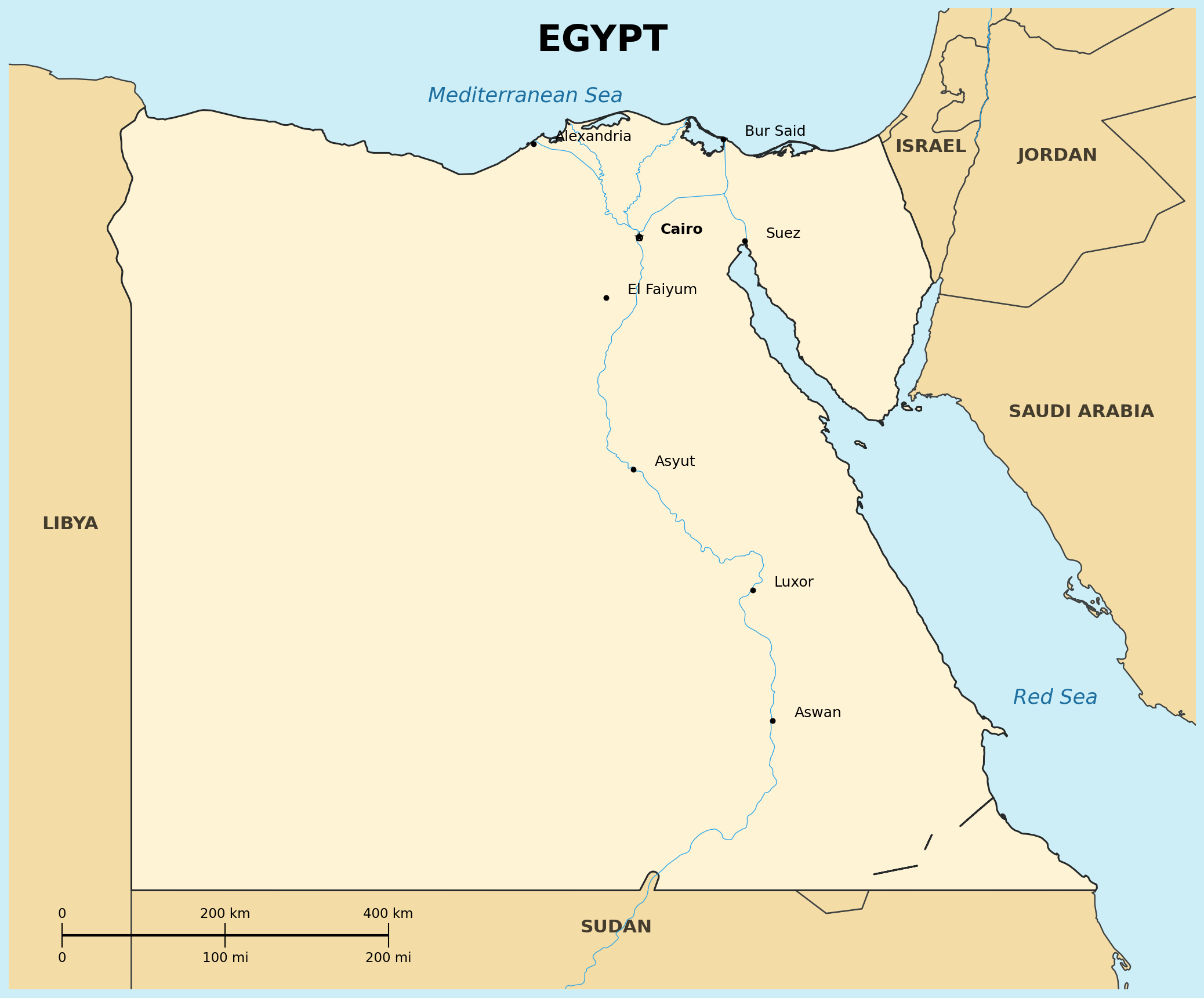
Location: Northern Africa, bordering the Mediterranean Sea and the Red Sea, between Libya and the Gaza Strip; the Sinai Peninsula is the only land bridge between Africa and the rest of the Eastern Hemisphere
Map references: Africa
Area:
total: 1,001,450 sq km
Land boundaries:
border countries: Gaza Strip, Israel, Libya, Sudan
Climate: desert; hot, dry summers with moderate winters
Terrain: vast desert plateau interrupted by the Nile valley and delta
Natural hazards: periodic droughts; frequent earthquakes; flash floods; landslides; hot, driving windstorms called khamsin in spring; dust storms; sandstorms
Geography - note: controls the Sinai Peninsula, the only land bridge between Africa and the rest of the Eastern Hemisphere; controls the Suez Canal, a sea link between the Indian Ocean and the Mediterranean Sea
| People |
Population: 112,870,457 (2025 est.)
Life expectancy at birth:
total population: 74.45 years
male: 73.26 years
female: 75.72 years
Infant mortality rate: 16.4 deaths/1,000 live births (2025 est.)
Nationality:
noun/adjective: Egyptian(s)
Ethnic groups: Egyptians, Bedouin, Berbers, Nubians, Beja, Sudanese Arabs, and other minority groups; predominantly Egyptian Arab in identity
Religions: predominantly Sunni Muslim, with a Coptic Christian minority
Languages: Arabic (official); English and French widely understood by educated classes
Literacy: total population 98.8% (urban 99.3%, rural 98.4%) (2022 est.)
Population distribution: approximately 95% of the population lives within 20 km (12 mi) of the Nile River and its delta; vast areas remain sparsely populated or uninhabited
| Government |
Country name:
conventional long form: Arab Republic of Egypt
conventional short form: Egypt
Data code: EG
Government type: presidential republic
National capital: Cairo
Background: a unified kingdom arose circa 3200 BC, and a series of dynasties ruled Egypt for the next three millennia; Arab conquerors introduced Islam and the Arabic language in the 7th century; completion of the Suez Canal in 1869 elevated Egypt as an important world transportation hub
| Economy |
Economy - overview: lower-middle income, developing economy; key sectors include textiles, tourism, chemicals, pharmaceuticals, hydrocarbons, and construction
GDP (purchasing power parity): $2.567 trillion (2026 est.)
GDP - real growth rate: 4.2% (2026)
GDP - per capita: $23,321 PPP (2026 est.)
Inflation rate: 14.8% (2026)
Unemployment rate: 6.8-7.4% (2025-2026 est.); youth unemployment 18.8% (2024)
Labor force: 33.75 million (2024)
Industries: textiles, food processing, tourism, chemicals, pharmaceuticals, hydrocarbons, construction, cement, metals, light manufactures
Exports: $53.1 billion (2024); refined petroleum, gold, nitrogenous fertilizer, insulated wire, citrus
Currency: Egyptian pound (EGP)
| Military |
Military service age and obligation: voluntary enlistment from age 16 (men) or 17 (women); 18-30 years of age for compulsory service (2025)