

About El Salvador
Spanish - the sole official language, spoken by nearly the entire population.
Nawat (also known as Pipil) - spoken among some indigenous communities.
Spanish is the sole official language of El Salvador.
| Geography |
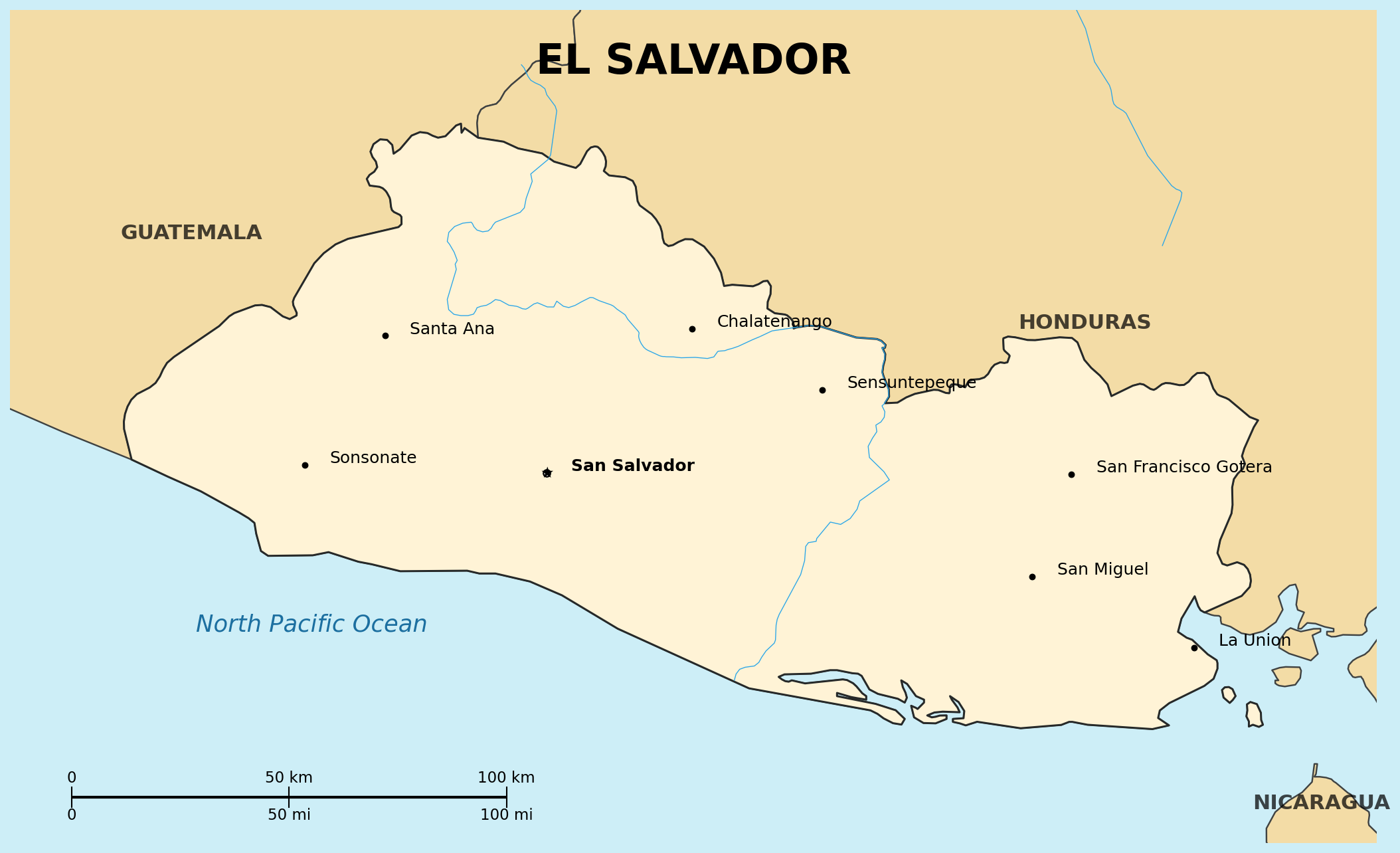
Location: Central America, bordering the North Pacific Ocean, between Guatemala and Honduras
Map references: Central America and the Caribbean
Area:
total: 21,041 sq km (smallest and most densely populated country in Central America)
Land boundaries:
border countries: Guatemala, Honduras
Terrain: mostly mountains with narrow coastal belt and central plateau; notable volcanic landscapes, including Izalco volcano
| People |
Population: 6,334,723 (2025 est.)
Age structure:
0-14 years: 25.3%
15-64 years: 66.3%
65 years and over: 8.4% (2024 est.)
Median age: 31.2 years (2025 est.)
Life expectancy at birth:
total population: 75.37 years
male: 71.88 years
female: 79.04 years
Infant mortality rate: 10 deaths/1,000 live births (2025 est.)
Nationality:
noun/adjective: Salvadoran(s)
Ethnic groups: Mestizo 86.3%, White 12.7%, Indigenous 0.2%, Black 0.1%, other 0.6%
Religions: Roman Catholic 43.9%, Protestant 39.6% (mostly Evangelical), none 16.3% (2023 est.)
Languages: Spanish (official), Nawat (among some indigenous communities)
Literacy: total population 89.8% (2024 est.)
Population distribution: high population density country-wide, with particular concentration around the capital, San Salvador
| Government |
Country name:
conventional long form: Republic of El Salvador
conventional short form: El Salvador
Data code: ES
Government type: presidential republic
National capital: San Salvador; founded in 1525, became the capital in 1839; the country's leading financial, commercial, and industrial center
| Economy |
Economy - overview: upper-middle income, developing economy; notably adopted Bitcoin as legal tender alongside the US dollar; heavily dependent on remittances, which represent roughly 24% of GDP; growth increasingly focused on technology and renewable energy sectors; challenges include poverty, inequality, and historically high crime, though recent security initiatives have improved conditions
GDP (purchasing power parity): $95.404 billion (2026 est.)
GDP - real growth rate: 3.3% (2026)
GDP - per capita: $14,838 PPP (2026 est.)
Inflation rate: 1.088% (2018)
Unemployment rate: 3.3% (2025 est.)
Labor force: 2.89 million (2024)
Population below poverty line: 22.8% (2019 est.)
Currency: Bitcoin (XBT) and United States dollar (USD)
| Military |
Military branches: Armed Forces of El Salvador (FAES): Army, Naval Force, Salvadoran Air Force; Ministry of Justice and Public Safety: National Civil Police (2025)