

About United Kingdom
English - the de facto national language, spoken by the vast majority of the population (there is no de jure official language).
Officially recognized regional/minority languages include Scots, Scottish Gaelic, Welsh, Irish, Ulster Scots, Cornish, and British Sign Language.
Scots is spoken by about 30% of the population of Scotland; Welsh by about 20% of the population of Wales; Irish by about 10% of the population of Northern Ireland.
Other languages such as Cantonese, Hindi, and Punjabi are also spoken among Commonwealth-descended communities.
English is the UK's national language, though the UK has no official language in law.
| Geography |
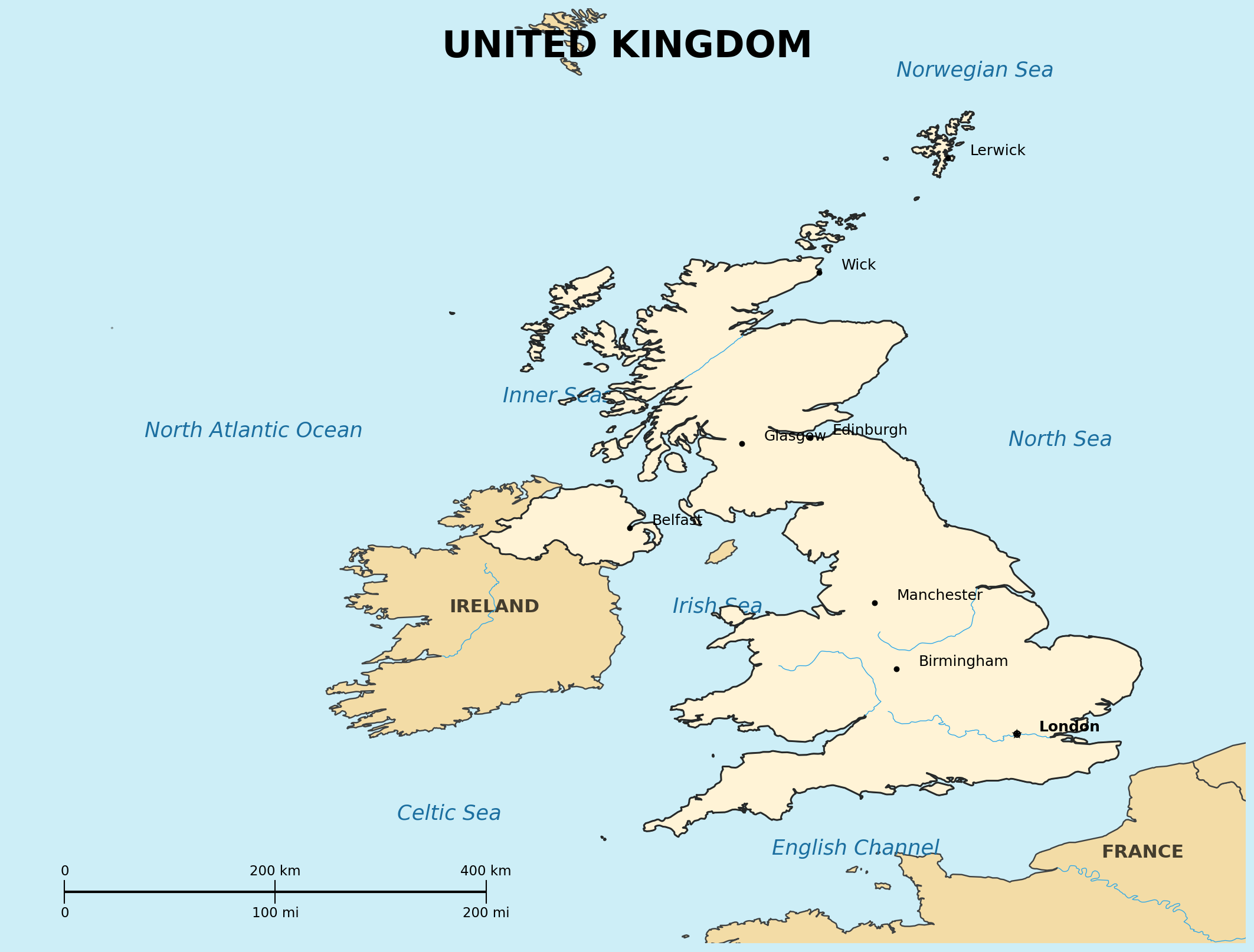
Location: Western Europe, islands including the northern one-sixth of the island of Ireland, between the North Atlantic Ocean and the North Sea, northwest of France
Map references: Europe
Area:
total: 244,376 sq km
Land boundaries:
border countries: Ireland
Terrain: mostly rugged hills and low mountains; level to rolling plains in east and southeast
Geography - note: lies near vital North Atlantic sea lanes; only 35 km (22 mi) from France and linked by tunnel under the English Channel (the Channel Tunnel); because of a heavily indented coastline, no location is more than 125 km (78 mi) from tidal waters
| People |
Population: 68,751,311-69,414,000 (2025 est.)
Age structure:
0-14 years: 17.2%
15-64 years: 64.0%
65 years and over: 18.8% (2022)
Life expectancy at birth:
male: 78.6 years
female: 82.6 years (2020-2022)
Infant mortality rate: 4.0 deaths/1,000 live births (2021)
Nationality:
noun: Briton(s), British
adjective: British
Ethnic groups: White 83.1%, Asian 8.6%, Black 3.7%, Mixed 2.7%, other 2.0% (2021 census)
Religions: Christianity 46.6%, no religion 37.6%, Islam 6.0%, Hinduism 1.6%, other 2.2%, not stated 5.9% (2021)
Languages: English (national language, no de jure official language); recognized regional languages: Scots (~30% of Scotland's population), Scottish Gaelic (~60,000 speakers), Welsh (~20% of Wales), Irish (~10% of Northern Ireland), Cornish (2,000-3,000 speakers)
Population distribution: approximately 84% of residents live in England, 8% in Scotland, ~5% in Wales, under 3% in Northern Ireland; core population lies in and around London, with significant clusters around Manchester, Liverpool, the Scottish lowlands (Edinburgh-Glasgow), Cardiff, and Belfast
| Government |
Country name:
conventional long form: United Kingdom of Great Britain and Northern Ireland
conventional short form: United Kingdom
Data code: UK
Government type: unitary parliamentary constitutional monarchy; Scotland, Wales, and Northern Ireland have their own devolved governments and parliaments
National capital: London
Executive branch:
chief of state: King Charles III
head of government: Prime Minister Keir STARMER
Background: made up of four parts - England, Scotland, Wales, and Northern Ireland; joined the European Economic Community (later the EU) in 1973; left the EU (Brexit) effective 31 January 2020
| Economy |
Economy - overview: highly developed, service-based economy; service industries contribute about two-thirds/80% of GDP; historically a major global financial and trading center; spearheaded the 19th-century Industrial Revolution
GDP (purchasing power parity): $4.72 trillion (2026 est.)
GDP - real growth rate: 1.3% (2025f)
GDP - per capita: $67,559 PPP (2026 est.)
Inflation rate: 2.8% (April 2026)
Unemployment rate: 4.7-5% (2025-2026 est.)
Labor force: 33,496,000 (Jan-Mar 2026); 75.1% in employment
Population below poverty line: 21% (2023)
Currency: Pound sterling (GBP)