

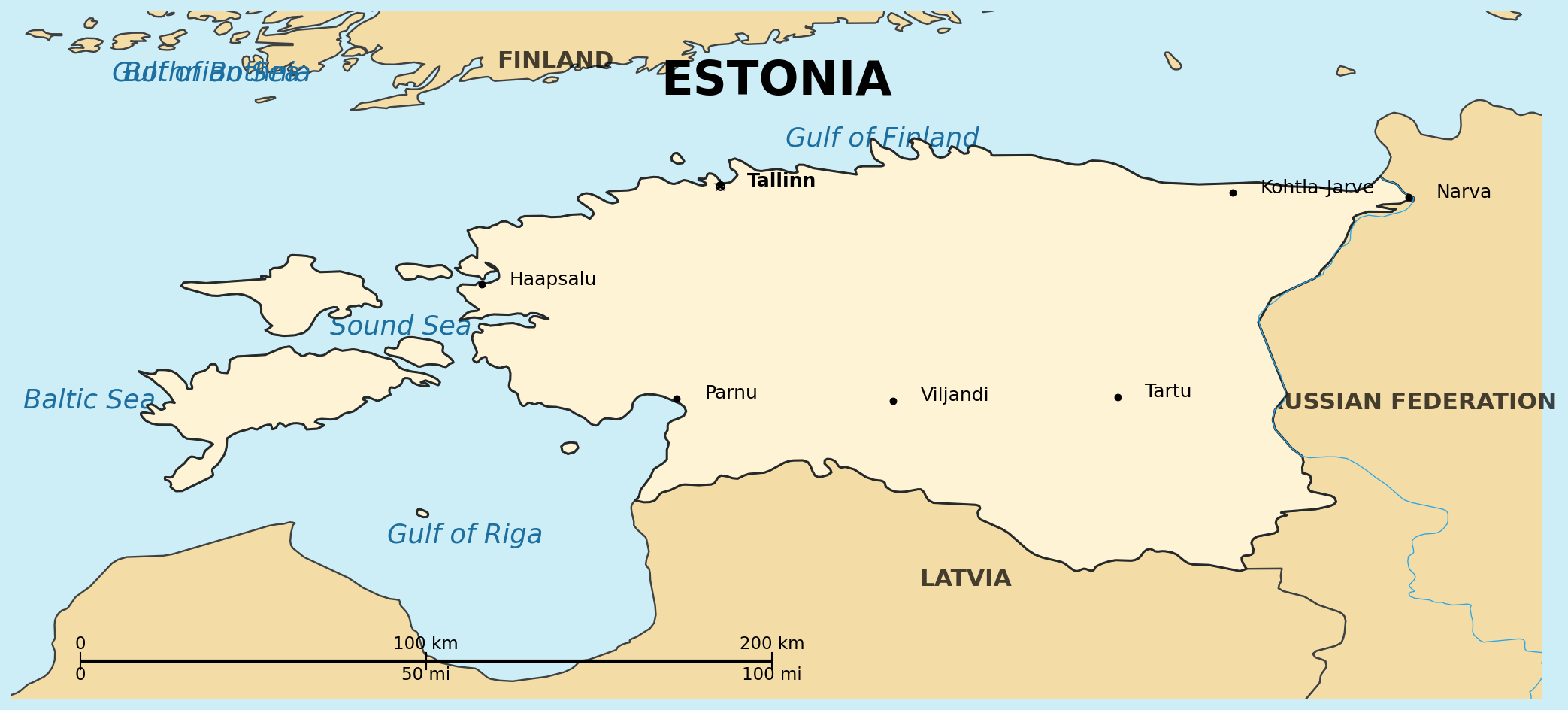

About Estonia
Estonian - the sole official language, a Finno-Ugric language closely related to Finnish and distantly related to Hungarian.
Russian - spoken by the significant Russian minority (~20.9% of the population), reflecting Soviet-era demographic history.
English is also widely understood, particularly among younger Estonians.
Estonian is the sole official language of Estonia.
| Geography |
Location: Northern Europe, bordering the Baltic Sea and Gulf of Finland, between Latvia and Russia
Map references: Europe
Area:
total: 45,228 sq km; more than 2,000 islands off its coast
Land boundaries:
border countries: Latvia, Russia
Natural resources: oil shale, peat, rare earth elements, phosphorite, clay, limestone, sand, dolomite, arable land, sea mud
| People |
Population: 1,340,478-1,369,285 (2021-2025 est.)
Age structure:
0-14 years: 15.2-16.35%
15-64 years: 62.2-63.22%
65 years and over: 20.43-22.6%
Life expectancy at birth:
total population: 79.5 years
male: 75.1 years
female: 84.4 years (2024)
Infant mortality rate: 1.50 deaths/1,000 live births
Nationality:
noun/adjective: Estonian(s)
Ethnic groups: Estonian 68.2-69%, Russian 20.9%, and smaller Ukrainian and Belarusian minorities
Religions: mostly irreligious (58.4% none/unspecified), Orthodox 16.5%, Protestant/Lutheran 9.2% (2021 est.)
Languages: Estonian (official), Russian, English also spoken
Population distribution: fairly even distribution throughout most of the country, with urban areas attracting larger and denser populations
| Government |
Country name:
conventional short form: Estonia
Data code: EN
Government type: parliamentary republic
National capital: Tallinn
Background: after centuries of Danish, Swedish, German, and Russian rule, Estonia attained independence in 1918; forcibly incorporated into the USSR in 1940 (an action never recognized by the US and many other countries); regained freedom in 1991 with the Soviet collapse; the last Russian troops departed in 1994; joined NATO and the EU in 2004; is a global leader in digital governance and e-services
| Economy |
Economy - overview: advanced, high-income EU and Eurozone economy; strong engineering, electronics, wood products, and IT/telecommunications sectors; recent years have seen negative growth (2023-2024) followed by recovery in 2025; known for its highly digitized public services
GDP (purchasing power parity): $70.7 billion (2026 est.)
GDP - real growth rate: 2.2% (2025)
GDP - per capita: $51,653 PPP (2026 est.)
Inflation rate: 2.5% (2025)
Unemployment rate: 8.3% (2025 est.)
Currency: Euro (EUR)
| Military |
Military - note: Estonia's defense focus is primarily on deterring Russia; a NATO member since 2004, fully integrated into NATO structures; since Russia's 2022 invasion of Ukraine, Estonia has significantly boosted defense spending and sent arms to Ukraine; has hosted a UK-led multinational NATO battlegroup since 2017 as part of Enhanced Forward Presence (2025)
Military service age and obligation: 18-27 for compulsory military or governmental service for men; conscript service 8-11 months depending on education; women may volunteer for any branch since 2018 (2025)