
About Finland
Finnish - the official language, spoken by ~85.9% of the population.
Swedish - also an official language, spoken by ~5.2% of the population, mainly in coastal regions.
Russian is spoken by ~1.7% (a growing linguistic minority), and other languages by ~7.2%.
Both Finnish and Swedish are official languages of Finland.
| Geography |
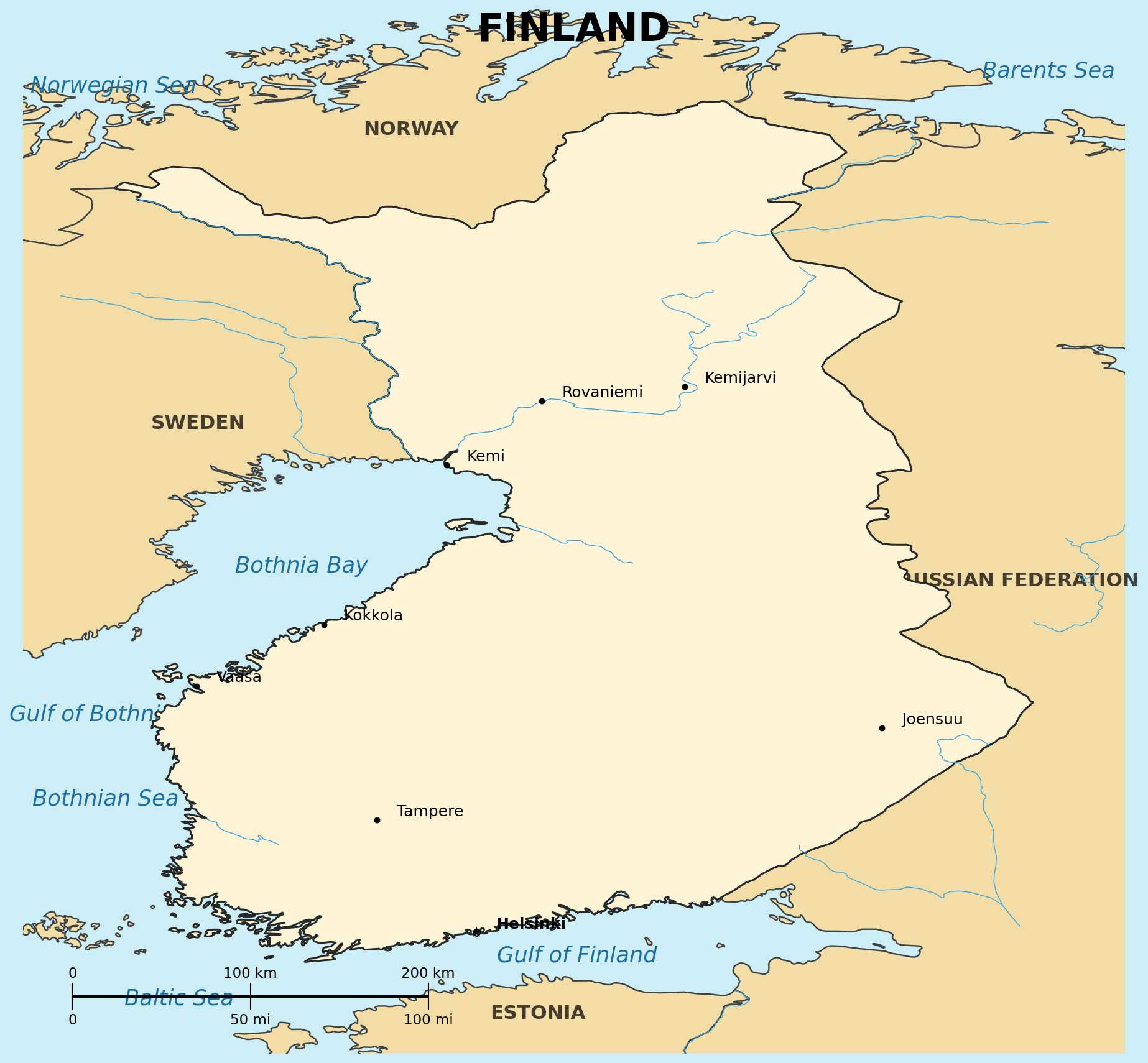
Location: Northern Europe, bordering the Baltic Sea, Gulf of Bothnia, and Gulf of Finland, between Sweden and Russia
Map references: Europe
Area:
total: 338,145 sq km
Land boundaries:
border countries: Norway, Russia, Sweden
Climate: cold temperate; potentially subarctic but comparatively mild due to the moderating influence of the North Atlantic Current, the Baltic Sea, and more than 60,000 lakes
Terrain: mostly low, flat to rolling plains interspersed with lakes and low hills
Geography - note: long boundary with Russia; Helsinki is the northernmost national capital on the European continent; population is concentrated on the small southwestern coastal plain
| People |
Population: 5,550,449-5,615,564 (2025 est.)
Life expectancy at birth:
total population: 82.2 years
male: 79.3 years
female: 85.2 years (2024 est.)
Nationality:
noun/adjective: Finn(s)/Finnish
Languages: Finnish (official) 85.9%, Swedish (official) 5.2%, Russian 1.7%, other 7.2% (2022 est.)
| Government |
Country name:
conventional short form: Finland
local short form: Suomi
Data code: FI
Government type: parliamentary republic
National capital: Helsinki
Background: the key features of Finland's modern welfare state are high-quality education, promotion of equality, and a national social welfare system, though it faces challenges from an aging population and export fluctuations; following Russia's full-scale invasion of Ukraine in 2022, Finland applied for and gained NATO membership in April 2023, becoming the organization's 31st member
| Economy |
Economy - overview: highly industrialized, largely free-market economy with per capita GDP comparable to Germany and Belgium; except for timber and some minerals, Finland depends on imports of raw materials and energy; forestry remains an important export industry
GDP (purchasing power parity): $384.94 billion (2026 est.)
GDP - real growth rate: 1.5% (2026f)
GDP - per capita: $68,550 PPP (2026 est.)
Inflation rate: 1.7% (2026 est.)
Unemployment rate: 9.5-10.6% (2025-2026 est.); youth unemployment 21.4% (2025)
Labor force: 2,889,462 (2024)
Industries: metals and metal products, electronics, machinery and scientific instruments, shipbuilding, pulp and paper, foodstuffs, chemicals, textiles, clothing
Exports: EUR 115.6 billion (2024); electrical and optical equipment, machinery, transport equipment, paper and pulp, chemicals, basic metals, timber
Currency: Euro (EUR)
| Military |
Military - note: the Finnish Defense Forces are focused primarily on territorial defense, based on a large trained reserve force created by general conscription; Finland joined NATO in April 2023 following Russia's invasion of Ukraine and joined NATO's Air Policing mission in Eastern Europe in 2024