
About Germany
German - the sole official language, spoken by the vast majority of the population.
Danish, Frisian, Sorbian, and Romani are official minority languages, and Low German, North Frisian, Sater Frisian, Lower Sorbian, and Upper Sorbian are recognized as regional languages under the European Charter for Regional or Minority Languages.
Due to immigration, Turkish, Ukrainian, Syrian, Romanian, and Polish speaking communities are also present.
German is the sole official language of Germany.
| Geography |
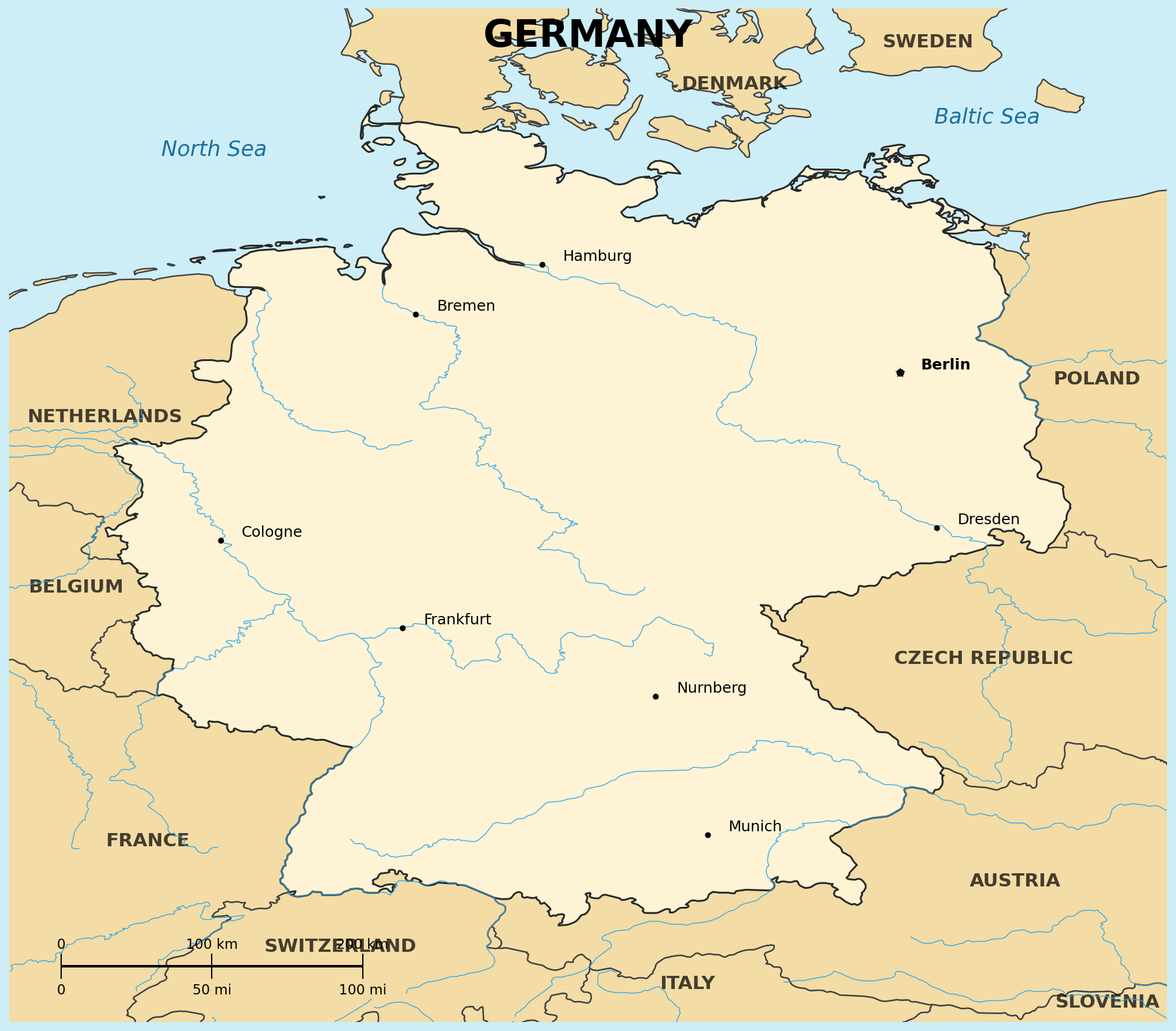
Location: Central Europe, bordering the Baltic Sea and North Sea, between the Netherlands and Poland, south of Denmark
Map references: Europe
Area:
total: 357,022 sq km
Land boundaries:
border countries: Austria, Belgium, Czech Republic, Denmark, France, Luxembourg, Netherlands, Poland, Switzerland
Geography - note: strategic location on the North European Plain and along the entrance to the Baltic Sea; most major rivers - the Rhine, Weser, Oder, Elbe - flow northward; the Danube, originating in the Black Forest, flows eastward
Environment - current issues: air pollution and acid rain from coal-burning utilities and industries; water pollution from raw sewage and industrial effluents; hazardous waste disposal
| People |
Population: 84,012,284-84,968,000 (2025 est.) - 2nd most populous country in Europe (after Russia)
Age structure:
0-14 years: 13.75%
15-64 years: 62.97%
65 years and over: 23.28% (2023 est.)
Life expectancy at birth:
total population: 81.9 years
male: 79.6 years
female: 84.4 years (2024 est.)
Infant mortality rate: 3 deaths/1,000 live births (2025 est.)
Nationality:
noun/adjective: German(s)
Ethnic groups: German 85.4%, Turkish 1.8%, Ukrainian 1.4%, Syrian 1.1%, Romanian 1%, Polish 1%, other/stateless/unspecified 8.3% (2022 est.)
Religions: Roman Catholic 24.8%, Protestant 22.6%, Muslim 3.7%, other 5.1%, none 43.8% (2022 est.)
Languages: German (official); Danish, Frisian, Sorbian, and Romani are official minority languages; Low German, North Frisian, Sater Frisian, Lower Sorbian, and Upper Sorbian are recognized regional languages
Population distribution: fairly even distribution throughout most of the country, with urban areas attracting larger and denser populations, particularly in the far-western industrial state of North Rhine-Westphalia
Major urban areas: 3.574 million Berlin (capital), 1.788 million Hamburg, 1.576 million Munich, 1.144 million Cologne, 796,000 Frankfurt (2023)
| Government |
Country name:
conventional long form: Federal Republic of Germany
conventional short form: Germany
Data code: GM
Government type: federal parliamentary republic
National capital: Berlin
Executive branch:
chief of state: President Frank-Walter STEINMEIER (since 19 March 2017)
head of government: Chancellor Friedrich MERZ (since 6 May 2025)
Background: Europe's largest economy and second most populous nation (after Russia); a key member of the continent's economic, political, and defense organizations; European power struggles immersed Germany in two world wars in the first half of the 20th century, after which it was occupied by the Allied powers; reunified in 1990
| Economy |
Economy - overview: leading export-driven, core EU and Eurozone economy; key automotive, chemical, engineering, finance, and green energy industries; growth stalled in recent years by energy costs and structural pressures
GDP (purchasing power parity): $6.41 trillion (2026 est.)
GDP - real growth rate: 0.8% (2026)
GDP - per capita: $76,750 PPP (2026 est.)
Inflation rate: 1.94% (2026f)
Unemployment rate: 3.7% (2025 est.)
Population below poverty line: 21.1% at risk of poverty or social exclusion (2024)
Currency: Euro (EUR)