

Country information
Ghana
- Capital
- Accra
- Population
- 33,742,380
Languages spoken
About Ghana
English - the sole official language, used in government, education, and business.
Twi, Ewe, and Dagbani are among the most widely spoken indigenous languages.
Ghana is home to over 100 distinct ethnic groups, with the Akan, Mole-Dagbani, Ewe, and Ga-Dangme being the most prominent, each with its own language.
English is the sole official language of Ghana.
| Geography |
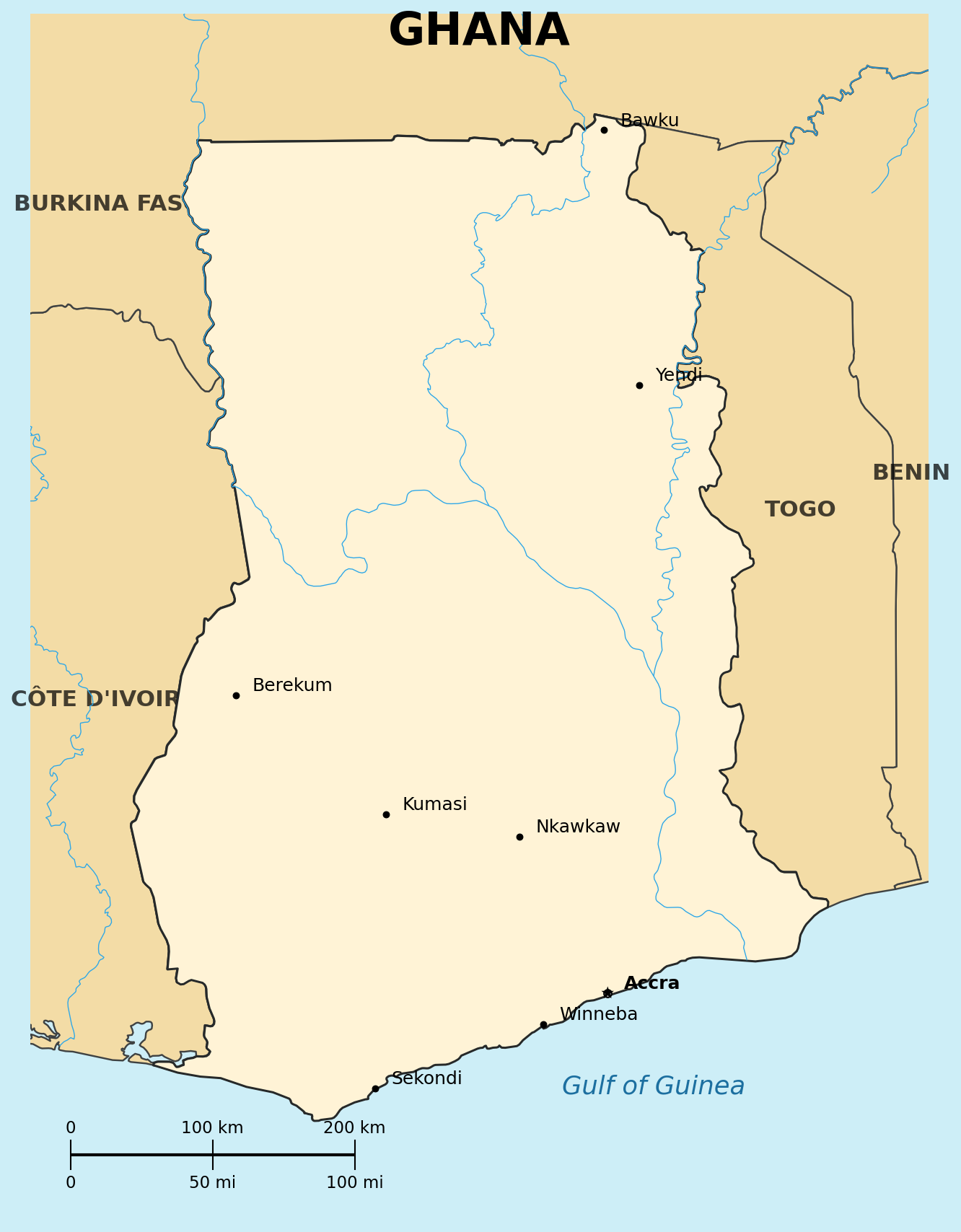
Location: Western Africa, bordering the Gulf of Guinea, between Cote d'Ivoire and Togo
Map references: Africa
Area:
total: 238,533-240,000 sq km
Land boundaries:
border countries: Burkina Faso, Cote d'Ivoire, Togo
| People |
Population: 33.3-35.7 million (2023-2025 est.)
Nationality:
noun/adjective: Ghanaian(s)
Ethnic groups: over 100 distinct ethnic groups; Akan, Mole-Dagbani, Ewe, and Ga-Dangme are the most prominent
Languages: English (official); major indigenous languages include Twi, Ewe, and Dagbani
Population distribution: three main geographic regions - the urban coastal region, central forest region, and northern savannah - each with its own distinct population; about 59.2% of the population lived in urban areas in 2023
| Government |
Country name:
conventional long form: Republic of Ghana
conventional short form: Ghana
Data code: GH
Government type: presidential republic
National capital: Accra
Independence: 6 March 1957 (Dominion status from the UK); 1 July 1960 (Republic declared)
Background: inhabited for several thousand years; by the 12th century the gold trade boomed in the Bono state, giving rise to Akan power in the region; Portuguese and other European powers arrived from the 15th century, competing for trading rights; the powerful Asante (Ashanti) Empire in the south and the Kingdom of Dagbon in the north emerged; by the mid-18th century Asante was a highly organized state that supplied enslaved people for the Atlantic slave trade in exchange for firearms; after a string of coups and economic instability post-independence, Ghana restored constitutional rule and has since earned a reputation for political stability, ranking among West Africa's most stable and democratic countries
| Economy |
Economy - overview: lower-middle-income economy, multiethnic and rich in natural resources; among the fastest-growing economies in the region, driven primarily by cocoa production, gold mining, and oil exports
GDP (purchasing power parity): $294.9-314.592 billion (2025 est.)
GDP - real growth rate: 4.0% (2025)
GDP - per capita: $8,042-8,410 PPP (2025 est.)
Inflation rate: 41.2% (2023 est.)
Population below poverty line: 23.4% (2016)
Currency: Ghanaian cedi (GHS)
| Military |
Military branches: Ghana Armed Forces (GAF): Army, Air Force, Ghana Navy; Ministry of Interior: Ghana Police Service (2025)