
Country information
Haiti
- Capital
- Port-au-Prince
- Population
- 11,867,032
Languages spoken
About Haiti
Haitian Creole - the first language of about 95% of Haitians, especially in rural areas; most of its vocabulary derives from French, but its syntax resembles other Caribbean and Indian Ocean creole languages.
French - the second official language, spoken as a second language by roughly one-tenth of the population and used in more formal settings; the school system uses French as the primary language of instruction.
Both Haitian Creole and French are official languages of Haiti.
| Geography |
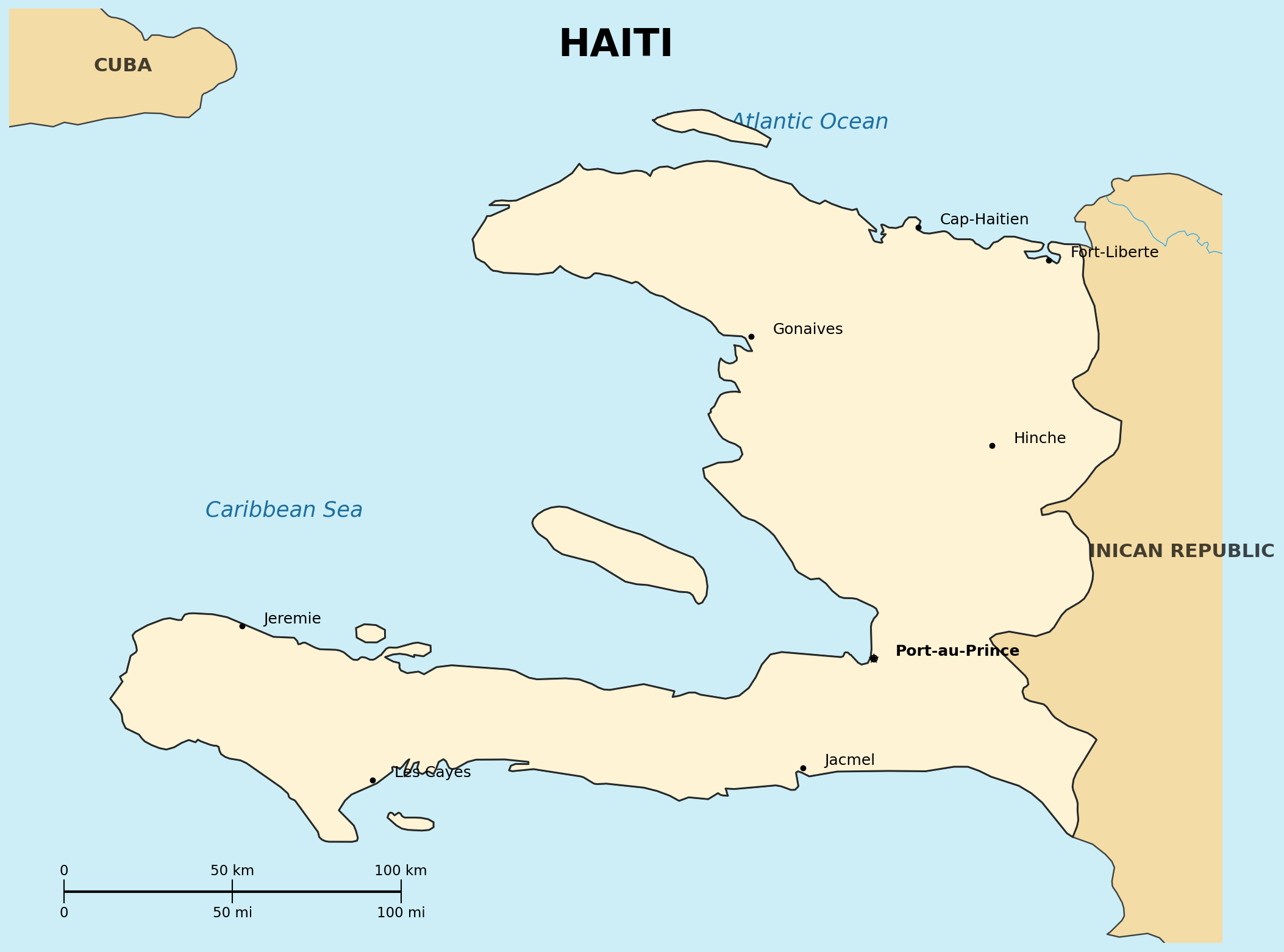
Location: Caribbean, western one-third of the island of Hispaniola, between the Caribbean Sea and the North Atlantic Ocean, shares island with the Dominican Republic
Map references: Central America and the Caribbean
Area:
total: 27,560-27,750 sq km
Land boundaries:
border countries: Dominican Republic
Climate: tropical; semiarid where mountains in the east cut off trade winds
Natural hazards: lies in the middle of the hurricane belt, subject to severe storms from June to October; occasional flooding and earthquakes; periodic droughts
Geography - note: the most mountainous nation in the Caribbean
| People |
Population: 11,470,261-11,898,812 (2023-2025 est.)
Life expectancy at birth:
total population: 63.8 years (male), 67.4 years (female) (2024 est.)
Infant mortality rate: 36.8-40.3 deaths/1,000 live births
Nationality:
noun/adjective: Haitian(s)
Ethnic groups: population is almost entirely descended from enslaved Africans brought during the colonial era; a small mixed and white minority also present
Religions: Roman Catholic 54.7%, Protestant 28.5% (Baptist, Pentecostal, Adventist, Methodist), Vodou 2.1%, none 10.2% (2003 est.); Vodou was recognized as a second official state religion in 2003
Languages: French (official), Haitian Creole (official)
Literacy: total population 68% (male 72.9%, female 63.9%) (2017 est.)
| Government |
Country name:
conventional long form: Republic of Haiti
conventional short form: Haiti; derived from the Arawak name Ayti, meaning "Land of Mountains," originally applied to the entire island of Hispaniola
Data code: HA
Government type: semi-presidential republic (currently marked by significant political instability)
National capital: Port-au-Prince; founded in 1749 by the French, originally called L'Hopital; the country's largest city and political, economic, and cultural center
Independence: 1 January 1804 (from France); the second country in the Americas, after the United States, to free itself from colonial rule, following a successful uprising by enslaved people
Background: Francois "Papa Doc" Duvalier and his son Jean-Claude "Baby Doc" Duvalier led repressive, corrupt regimes from 1957-1986; Jean-Bertrand Aristide became Haiti's first democratically elected president in 1991 but was interrupted by coups; President Jovenel Moise was assassinated in 2021, pushing the country into an extra-constitutional governance structure; escalating gang violence since 2024 has severely destabilized the country, with armed groups seizing control of large parts of the capital
| Economy |
Economy - overview: poorest country in the Western Hemisphere; free market economy with low labor costs; heavily reliant on remittances (nearly 19% of GDP); severely constrained by political instability, gang violence, and natural disasters
GDP (purchasing power parity): $38.2 billion (2025 est.)
GDP - real growth rate: 1.1% (2025); contracting in more recent estimates amid ongoing crisis
GDP - per capita: $3,040 PPP (2025 est.)
Inflation rate: 12.885% (2018)
Unemployment rate: 14.9% (2025 est.)
Population below poverty line: 58.5% (2012)
Currency: Haitian gourde (HTG)
| Military |
Military - note: Haiti's military was disbanded in 1995 after coup involvement and human rights violations; reinstated in 2017 after the UN ended its peacekeeping operation; the military has since been called upon to assist the overwhelmed National Police in combating armed gangs that have killed hundreds and seized swaths of territory (2025)