

About Honduras
Spanish - the sole official language, spoken by nearly the entire population.
Amerindian dialects are also spoken by smaller communities, including Lenca and Miskito populations.
Spanish is the sole official language of Honduras.
| Geography |
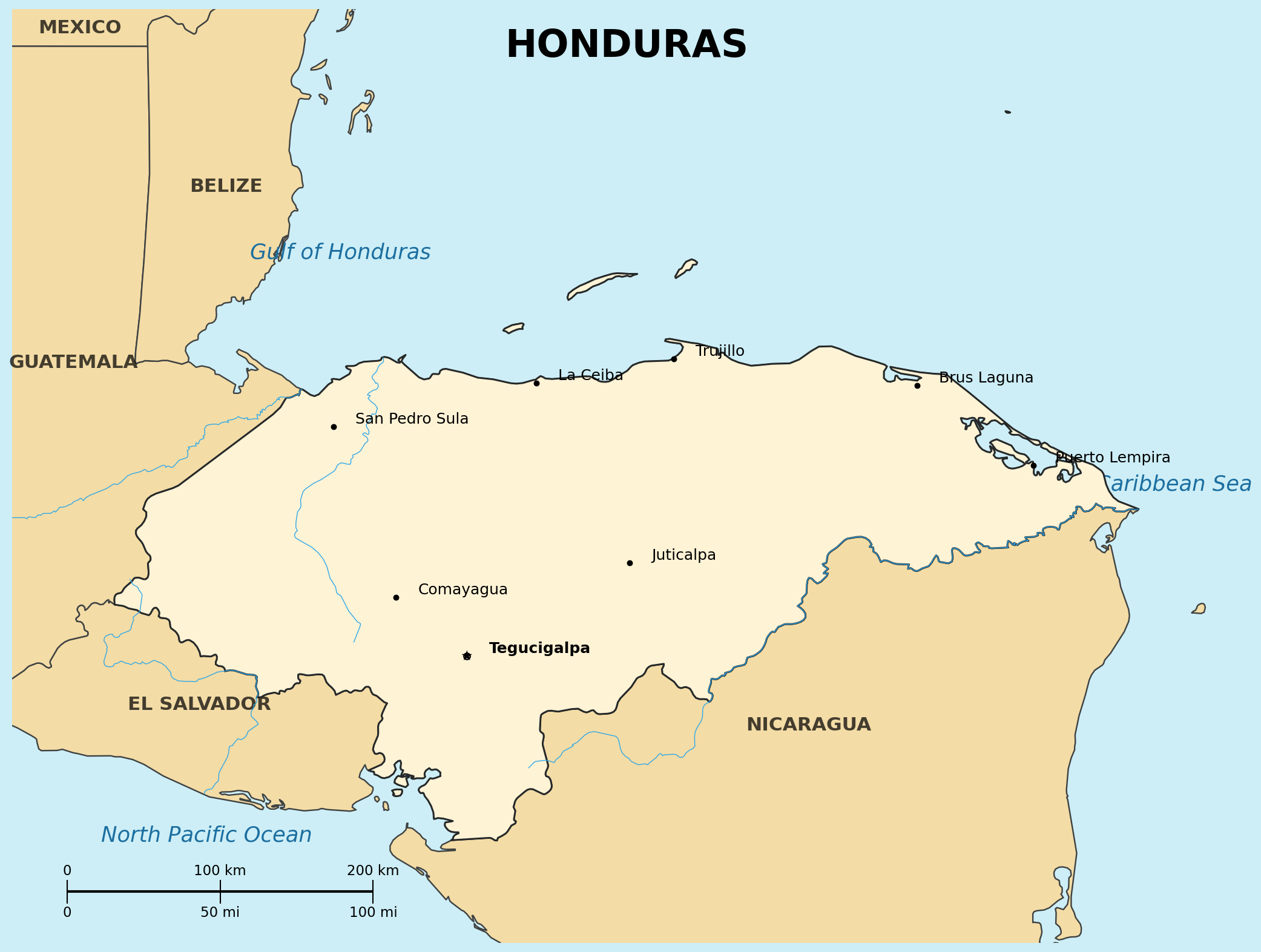
Location: Central America, bordering the Caribbean Sea, between Guatemala and Nicaragua, and bordering the North Pacific Ocean
Map references: Central America and the Caribbean
Area:
total: 112,090 sq km
Land boundaries:
border countries: El Salvador, Guatemala, Nicaragua
Geography - note: has only a short Pacific coast but a long Caribbean shoreline, including the virtually uninhabited eastern Mosquito Coast
| People |
Population: 9,529,188-10,044,000 (2024-2025 est.)
Age structure:
0-14 years: 28.7-30.9%
15-64 years: 63.2-65.7%
65 years and over: 5.6-5.9%
Life expectancy at birth:
total population: 75.17 years
male: 71.63 years
female: 78.82 years
Infant mortality rate: 15.4 deaths/1,000 live births (2025 est.)
Nationality:
noun/adjective: Honduran(s)
Ethnic groups: Multiracial/Mestizo majority; White, Indigenous (including Lenca and Miskito), and Black minorities
Religions: Evangelical 55%, Roman Catholic 33.4%, none 10.1% (2023 est.)
Languages: Spanish (official), Amerindian dialects
Literacy: total population 88.2% (male 87.6%, female 88.8%) (2024 est.)
Population distribution: most residents live in the mountainous western half of the country; Honduras is the only Central American nation with an urban population distributed between two large centers, Tegucigalpa and San Pedro Sula
| Government |
Country name:
conventional long form: Republic of Honduras
conventional short form: Honduras; the name means "depths" in Spanish, referring to the deep anchorage in the northern Bay of Trujillo
Data code: HO
Government type: presidential republic
National capital: Tegucigalpa; founded in 1578 as a gold- and silver-mining center; the name is a Nahuatl word meaning "silver mountain"
Independence: 15 September 1821 (from Spain)
Background: once part of Spain's New World empire; became independent in 1821; after two and a half decades of mostly military rule, a freely elected civilian government came to power in 1982; served as a haven for anti-Sandinista contras during the 1980s and an ally to Salvadoran government forces; Hurricane Mitch devastated the country in 1998, killing about 5,600 people; the economy has slowly rebounded since despite COVID-19 and severe storm setbacks in 2020-2021
| Economy |
Economy - overview: lower-middle-income, developing economy; agriculture, textiles, and light manufacturing are key sectors; heavily reliant on the US market and remittances
GDP (purchasing power parity): $85.98-86.29 billion (2025 est.)
GDP - real growth rate: 3.3% (2025)
GDP - per capita: $7,930-7,960 PPP (2025 est.)
Inflation rate: 4.348% (2018)
Unemployment rate: 11.9% (2025 est.)
Population below poverty line: 48-50% (2019-2024)
Currency: Honduran lempira (HNL)
| Military |
Military - note: the Honduran Armed Forces (FFAA) are responsible for territorial defense and supporting the National Police; primary focus is internal and border security, with a considerable portion deployed since 2011 to combat narcotics trafficking and organized crime; the US military maintains a joint task force co-located with the FFAA at Soto Cano Air Base (2025)