
About Iceland
Icelandic - the official language, spoken by nearly the entire population; a North Germanic language that has preserved much of its Old Norse roots.
English and Danish are commonly taught and understood as second languages.
Icelandic is the sole official language of Iceland.
| Geography |
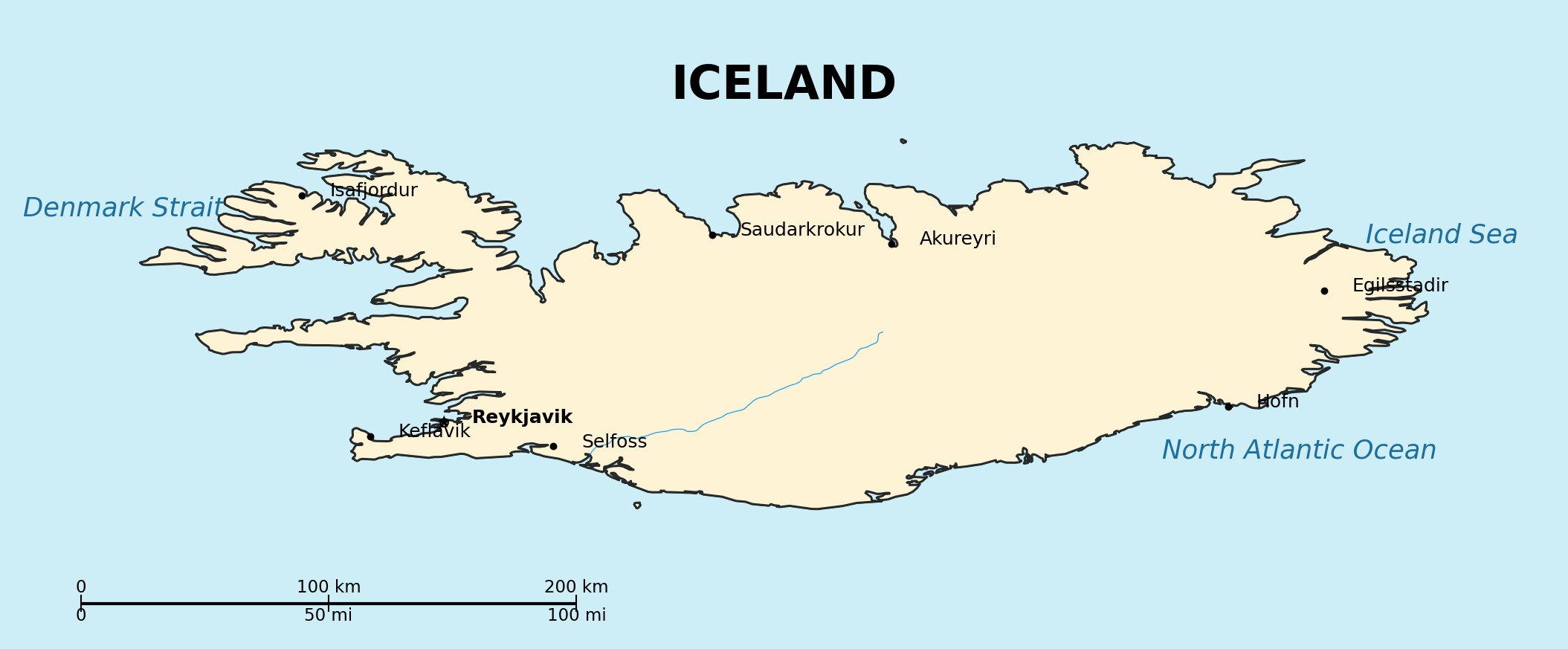
Location: Northern Europe, island between the Greenland Sea and the North Atlantic Ocean, northwest of the United Kingdom
Map references: Europe
Area:
total: 103,125 sq km
Coastline: island nation, no land borders
Terrain: mostly plateau interspersed with mountain peaks, icefields; coast deeply indented by bays and fjords; fjords, glaciers, mountains, waterfalls, volcanoes, lava fields, cold deserts, and tundra; only about 20-25% of the island is habitable, mostly along the southern and eastern coasts
| People |
Population: 389,444-400,000 (2025 est.); least densely populated country in Europe besides Greenland
Life expectancy at birth:
total population: 83.64 years
male: 81.41 years
female: 85.97 years
Infant mortality rate: 1.65 deaths/1,000 live births
Nationality:
noun/adjective: Icelander(s)/Icelandic
Languages: Icelandic (official)
| Government |
Country name:
conventional short form: Iceland
local short form: Island
Data code: IC
Government type: parliamentary republic
National capital: Reykjavik
Independence: 17 June 1944 (from Denmark)
Background: settled by Norwegian and Celtic (Scottish and Irish) immigrants in the late 9th and 10th centuries AD; boasts the world's oldest functioning legislative assembly, the Althingi, established in 930; ruled by Norway and then Denmark for centuries; the Askja volcano's 1875 eruption devastated the economy and caused widespread famine, driving 20% of the population to emigrate, mostly to Canada and the US; Denmark granted limited home rule in 1874 and complete independence in 1944
| Economy |
Economy - overview: advanced, high-income economy; substantial growth in the second half of the 20th century driven by the fishing industry; diversified greatly after joining the European Economic Area in 1994; the 2008 global financial crisis hit Iceland especially hard; tourism has since become a major economic driver
GDP (purchasing power parity): $31.53-31.08 billion (2025 est.)
GDP - real growth rate: 2.0% (2025 est.)
GDP - per capita: $80,466-90,280 PPP (2025 est.); among the highest in the world
Inflation rate: 4.3% (2025)
Unemployment rate: 3.6% (2025 est.)
Currency: Icelandic krona (ISK)
| Military |
Military - note: Iceland has no standing military force - the only NATO member without one; defense is a NATO commitment, with NATO maintaining an air policing presence in Icelandic airspace; the Icelandic National Police, regional police, and Coast Guard fall under the Ministry of Justice; participates in international peacekeeping via the civilian-manned Icelandic Crisis Response Unit; was one of the original 12 signatories of the 1949 North Atlantic Treaty