

Country information
Indonesia
- Capital
- Jakarta
- Population
- 288,315,089
Languages spoken
About Indonesia
Bahasa Indonesia - the sole official language, a modified form of Malay.
Javanese - the most widely spoken local dialect, spoken by ~40.1% of the population.
English and Dutch are also spoken, along with hundreds of regional and ethnic languages.
More than 700 languages are used in Indonesia, reflecting its extraordinary linguistic diversity across over 300 ethnic groups.
Bahasa Indonesia is the sole official language of Indonesia.
| Geography |
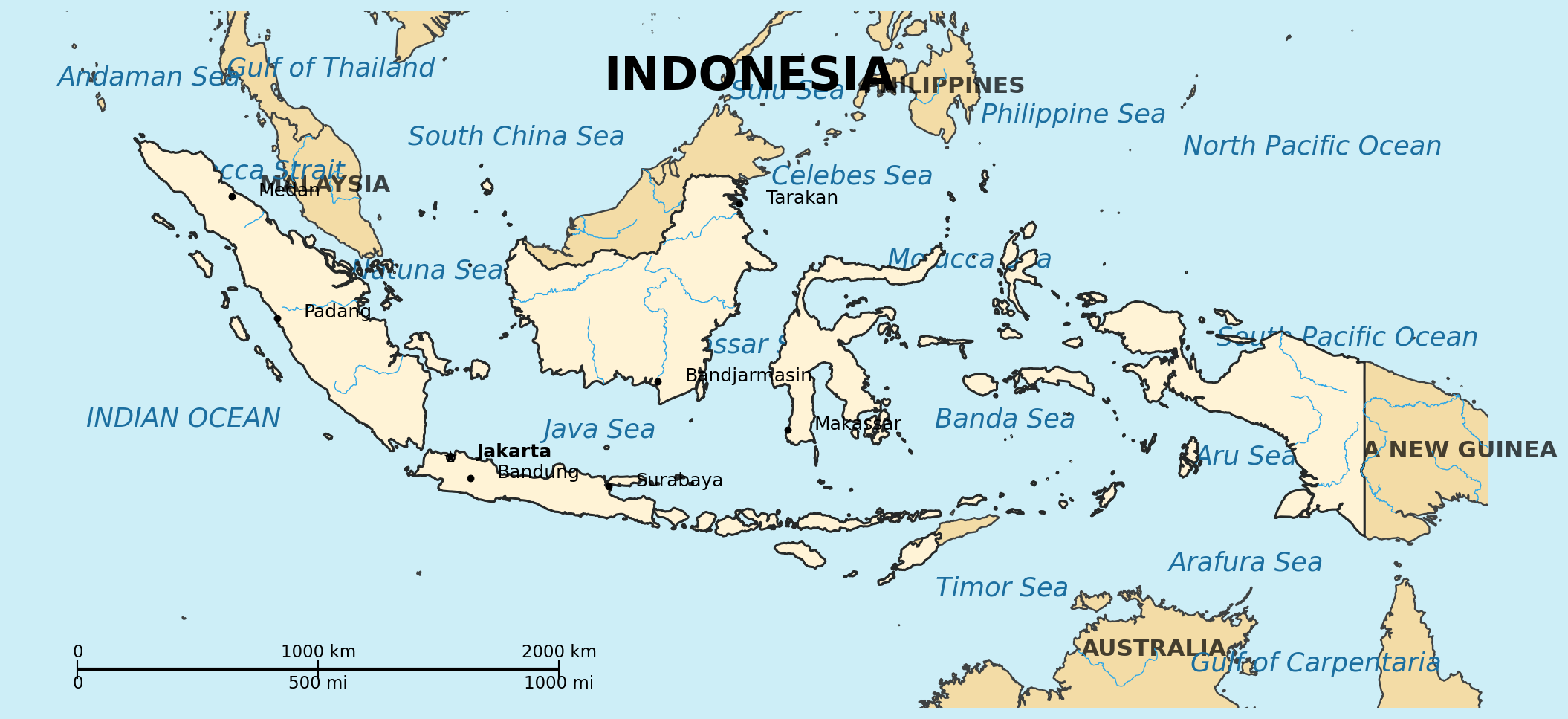
Location: Southeastern Asia, an archipelago between the Indian Ocean and the Pacific Ocean
Map references: Southeast Asia
Geography - note: the world's largest archipelagic state, straddling the equator; one of the countries along the Pacific Ring of Fire, containing about 75% of the world's volcanoes and up to 90% of earthquakes; despite its huge population, remains the most heavily forested region on earth after the Amazon
| People |
Population: 281.6-287.2 million (2025-2026 est.) - 4th most populous country in the world
Infant mortality rate: 18.5 deaths/1,000 live births (2025 est.)
Nationality:
noun/adjective: Indonesian(s)
Ethnic groups: Javanese 40.1%, Sundanese 15.5%, Malay 3.7%, Batak 3.6%, Madurese 3%, Betawi 2.9%, Minangkabau 2.7%, Buginese 2.7%, other 15% (2010 est.)
Religions: Muslim 87.4% (world's largest Muslim population), Protestant 7.5%, Roman Catholic 3.1%, Hindu 1.7%, other 0.8% (2022 est.)
Languages: Bahasa Indonesia (official, modified form of Malay), English, Dutch, local dialects (most widely spoken is Javanese); more than 700 languages used in Indonesia
Population distribution: major concentration on Java, one of the most densely populated places on Earth; significant clusters also on Sumatra, particularly in the south and along the northeastern coast near Medan
| Government |
Country name:
conventional long form: Republic of Indonesia
conventional short form: Indonesia
Data code: ID
Government type: presidential republic
National capital: Jakarta; a new capital, Nusantara, on Borneo, is under construction to eventually replace Jakarta
Background: a period of sometimes unruly parliamentary democracy ended in 1957 when President Soekarno declared martial law and instituted "Guided Democracy"; after an abortive coup in 1965 by alleged communist sympathizers, Soekarno was gradually eased from power; from 1967 to 1998, President Suharto ruled Indonesia under his "New Order" government
| Economy |
Economy - overview: newly industrialized, developing economy; ranks among the world's largest by PPP; diversified sectors spanning agriculture, industry, and services; part of the G-20, BRICS, and multiple regional trade blocs (ASEAN, RCEP)
GDP (purchasing power parity): $5.449 trillion (2026 est.)
GDP - real growth rate: 5.11% (2025)
GDP - per capita: $18,973 PPP (2026 est.)
Inflation rate: 2.42% (April 2026)
Unemployment rate: 3.2% (2025 est.)
Population below poverty line: 8.25% (national poverty line, Sep 2025); 65% on less than $8.30/day (2025)
Currency: Indonesian rupiah (IDR)
| Communications |
Space: focuses largely on rocket development and satellite acquisition/operation; national space program building up the country's private space sector; relations with foreign space agencies including those of France, Germany, India, Japan, Russia, South Korea, and the US (2025)