
Country information
Iran
- Capital
- Tehran
- Population
- 87,134,000
Languages spoken
About Iran
Persian (Farsi) - the official language, spoken by ~61% of the population as a first language, and understood more broadly as a lingua franca.
Azerbaijani/Azeri and other Turkic dialects - spoken by ~14.3% of the population, mainly in the northwest.
Kurdish (~9.1%), Gilaki and Mazandarani (~7.4% combined), Luri/Bakhtiari, Arabic, Balochi, and Turkmen are also spoken by significant minorities.
Persian (Farsi) is the sole official language of Iran.
| Geography |
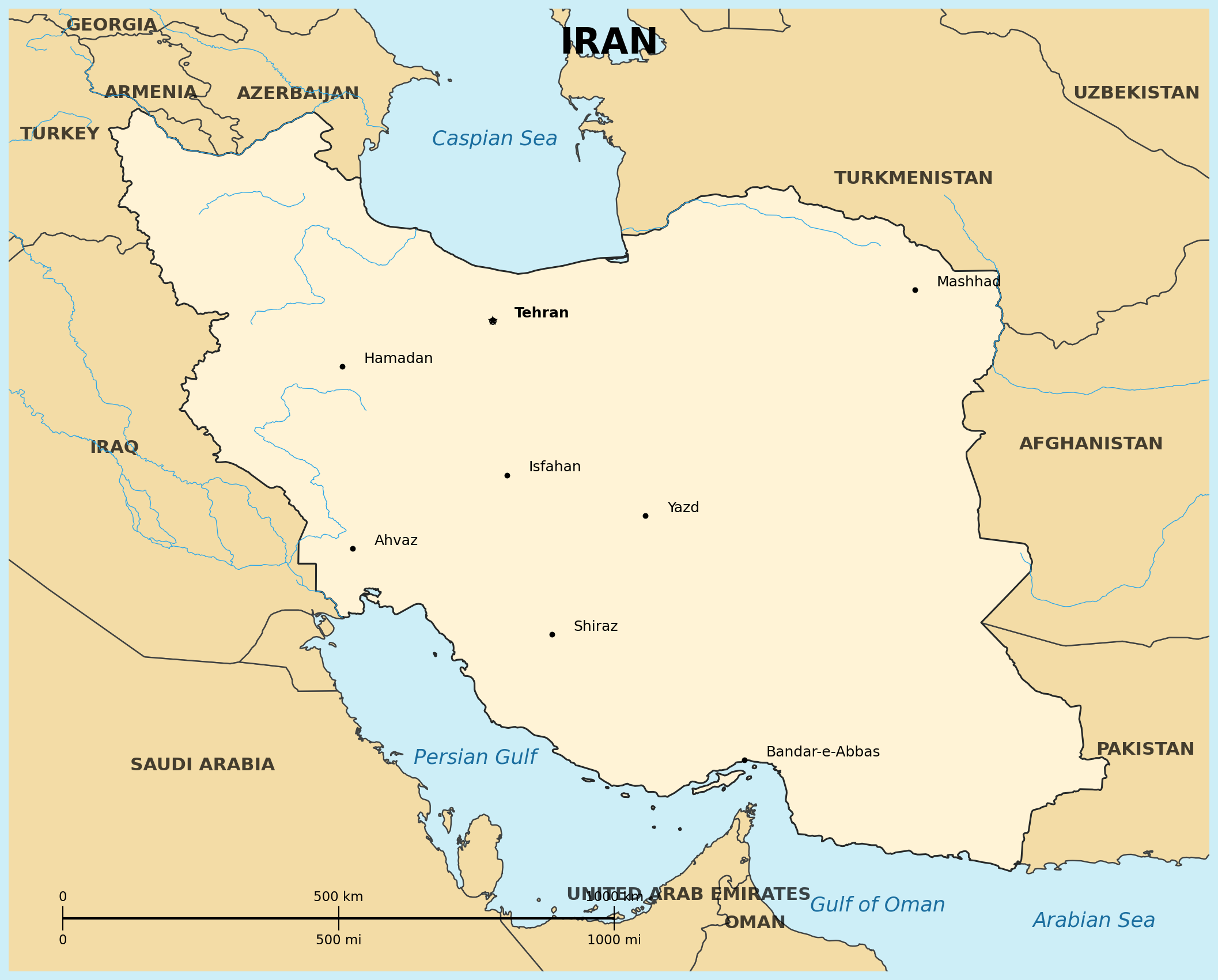
Location: Middle East, bordering the Gulf of Oman, the Persian Gulf, and the Caspian Sea, between Iraq and Pakistan
Map references: Middle East
Area:
total: 1,648,195 sq km
Land boundaries:
border countries: Afghanistan, Armenia, Azerbaijan, Iraq, Pakistan, Turkey, Turkmenistan
Terrain: rugged, mountainous rim surrounding a high, central basin with deserts, small discontinuous plains along both coasts
Natural hazards: periodic droughts, floods; dust storms, sandstorms; earthquakes
Geography - note: strategic location on the Persian Gulf and the Strait of Hormuz
| People |
Population: 89,177,357-92,417,681 (2025 est.)
Age structure:
0-14 years: 23.3%
15-64 years: 69.8%
65 years and over: 7% (2024 est.)
Life expectancy at birth:
total population: 75.6 years
male: 74.3 years
female: 77.1 years (2024 est.)
Infant mortality rate: 14.3 deaths/1,000 live births (2024 est.)
Nationality:
noun/adjective: Iranian(s)
Ethnic groups: Persians (majority); significant Azeri, Kurdish, Lur, Baloch, Gilaki, Mazanderani, Qashqai, Khoozi, and Turkmen minorities
Languages: Persian/Farsi (official) 61%, Azerbaijani/other Turkic dialects 14.3%, Kurdish 9.1%, Gilaki 3.8%, Mazanderani 3.6%, Arabic 2.0%, Balochi 2.0%, Bakhtiari 1.3%, Turkmen 1.2%, Armenian 0.2%, other 1.5%
Population distribution: concentrated in the north, northwest, and west, reflecting the position of the Zagros and Elburz Mountains; the vast, dry central and eastern areas around the Dasht-e Kavir and Dasht-e Lut deserts have much lower population density
| Government |
Country name:
conventional long form: Islamic Republic of Iran
conventional short form: Iran
Data code: IR
Government type: theocratic republic
National capital: Tehran
| Economy |
Economy - overview: upper-middle-income, developing economy heavily dependent on petroleum and petrochemicals; subject to significant international sanctions; high inflation and a large informal economy remain persistent challenges
GDP (purchasing power parity): $2.18 trillion (2026 est.)
GDP - real growth rate: 0.3% (2025)
GDP - per capita: $21,888 PPP (2026 est.)
Inflation rate: 40% (2026)
Unemployment rate: 8.3-9.2% (2024-2025 est.)
Labor force: 27,358,987 (2019)
Population below poverty line: 55% living on less than 3.4 million tomans/month (2019, per Majlis Research Center)
Industries: petroleum, petrochemicals, fertilizers, horticulture, car manufacture and parts, pharmaceuticals, home appliances, electronics, telecommunications, energy, textiles, construction materials, food processing, metal fabrication, armaments
Exports: $100.031 billion (2024)
Currency: Iranian rial (IRR)
| Communications |
Broadcast media: state-run broadcast media with no private, independent broadcasters; Islamic Republic of Iran Broadcasting (IRIB) operates over 60 TV channels and over 50 radio stations; satellite dishes are illegal and sometimes confiscated, though widely used (2023)
| Military |
Military branches: military forces divided between the Islamic Republic of Iran Regular Forces (Artesh: Ground Forces, Navy, Air Force, Air Defense) and the Islamic Revolutionary Guard Corps (IRGC: Ground Forces, Navy, Aerospace Force, Qods Force, Cyber Electronic Command, Basij Paramilitary Forces) (2025)
Military service age and obligation: compulsory for men at 18-19 years of age; 14-21 month obligation depending on location; women exempt but may volunteer (2025)
| Transnational Issues |
Trafficking in persons - tier rating: Tier 3 (2025)