
About Iraq
Arabic - an official language, predominantly spoken in the central and southern regions.
Kurdish - also an official language, used primarily in the northern areas of the country.
Turkmen (a Turkish dialect), Syriac (Neo-Aramaic), and Armenian are recognized as official languages in areas where native speakers form a majority.
Both Arabic and Kurdish are official languages of Iraq nationwide.
| Geography |
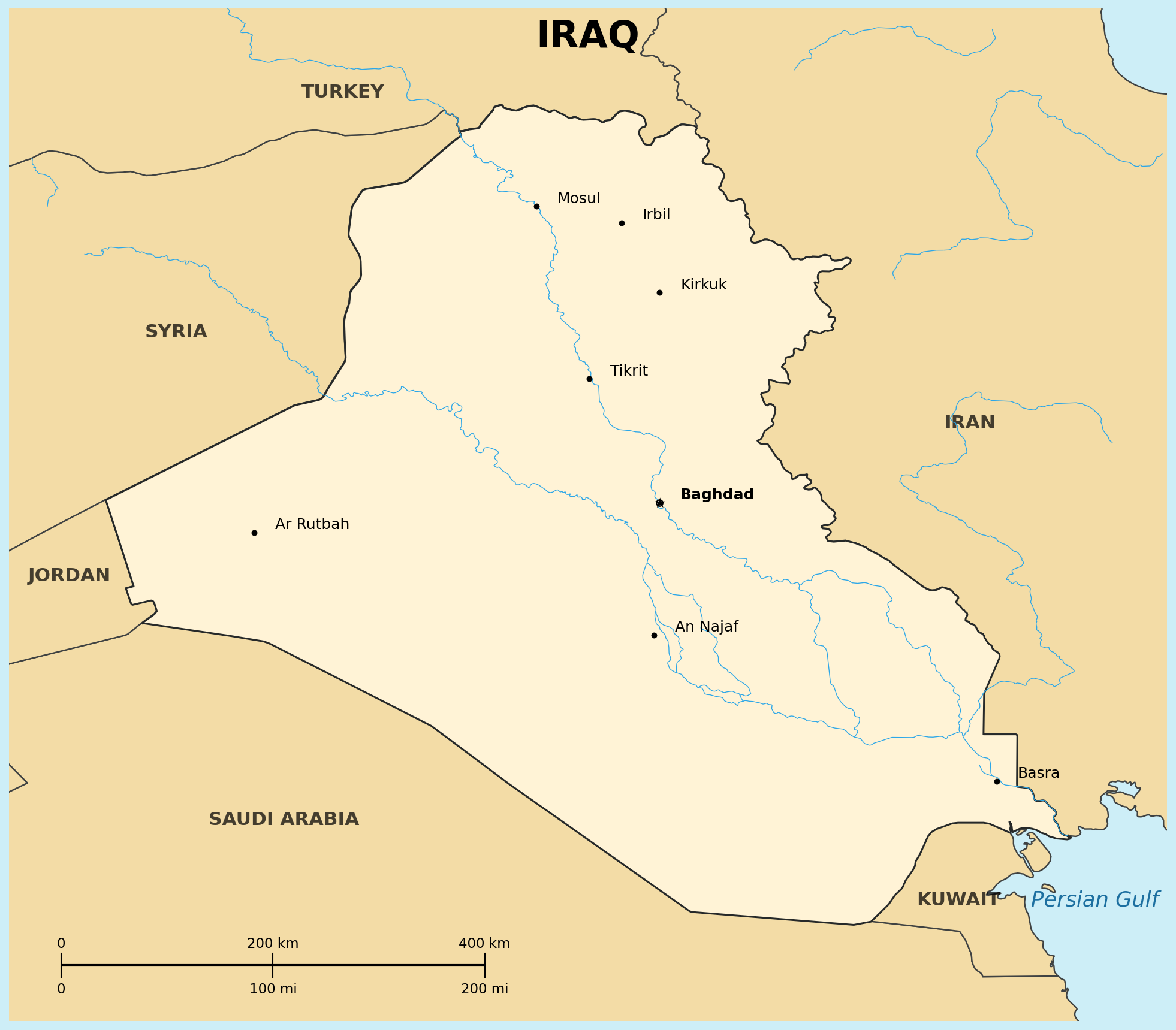
Location: Middle East, bordering the Persian Gulf, between Iran and Kuwait
Map references: Middle East
Area:
total: 438,317 sq km
Land boundaries:
border countries: Iran, Jordan, Kuwait, Saudi Arabia, Syria, Turkey
| People |
Population: 42,917,742-46,118,793 (2024-2025 est.)
Age structure:
0-14 years: 35.90%
15-64 years: 60.44%
65 years and over: 3.66% (2024)
Life expectancy at birth:
total population: 73.18 years
male: 71.3 years
female: 75.15 years
Infant mortality rate: 19.62 deaths/1,000 live births
Nationality:
noun/adjective: Iraqi(s)
Ethnic groups: Arab 75-80%, Kurdish 15-20%, other 5% (includes Turkmen, Yezidi, Shabak, Kaka'i, Bedouin, Romani, Assyrian, Circassian, Sabaean-Mandaean, Persian)
Religions: Muslim (official) 95-98% (Shia 61-64%, Sunni 29-34%), Christian 1%, other 1-4% (2015 est.); note - the Christian population has decreased significantly since 2003, with many fleeing to Syria, Jordan, and Lebanon
Languages: Arabic (official), Kurdish (official); Turkmen (a Turkish dialect) and Syriac (Neo-Aramaic) are recognized as official languages where native speakers are present
Population distribution: concentrated in the north, center, and eastern parts of the country
| Government |
Country name:
conventional long form: Republic of Iraq
conventional short form: Iraq
Data code: IZ
Government type: federal parliamentary republic
National capital: Baghdad
Independence: 3 October 1932 (from League of Nations mandate under UK administration)
Background: formerly part of the Ottoman Empire, occupied by the UK during WWI, and declared a League of Nations mandate in 1920; attained independence as a kingdom in 1932; proclaimed a republic in 1958 after a coup overthrew the monarchy, though a series of strongmen ruled the country until 2003, the last being Saddam Hussein (1979-2003); adopted a new constitution in 2005 following the US-led invasion
| Economy |
Economy - overview: upper-middle-income economy heavily reliant on oil exports; the government is eager to attract foreign direct investment but faces obstacles including a tenuous political system, security concerns, rampant corruption, outdated infrastructure, and skilled labor shortages that constrain growth of non-oil sectors
GDP (purchasing power parity): $670.507-990.902 billion (2025-2026 est.)
GDP - real growth rate: 0.5% (2025f)
GDP - per capita: $14,376-14,464 PPP (2025-2026 est.)
Inflation rate: 1.2% (2024)
Unemployment rate: 15.5% (2025 est.)
Labor force: 11,744,262 (2023)
Population below poverty line: 1.82% (2024)
Currency: Iraqi dinar (IQD)
| Terrorism |
Terrorist group(s): Ansar al-Islam; Asa'ib Ahl al-Haq; Islamic Revolutionary Guard Corps (IRGC)/Qods Force; Harakat al-Nujaba