
About Israel
Hebrew - the official language, revived as a modern spoken language and used nationally.
Arabic - holds special status under Israeli law, spoken by the Arab minority (~21% of the population).
English is the most commonly used foreign language, widely taught and understood.
Hebrew is Israel's official language, with Arabic holding special legal status.
| Geography |
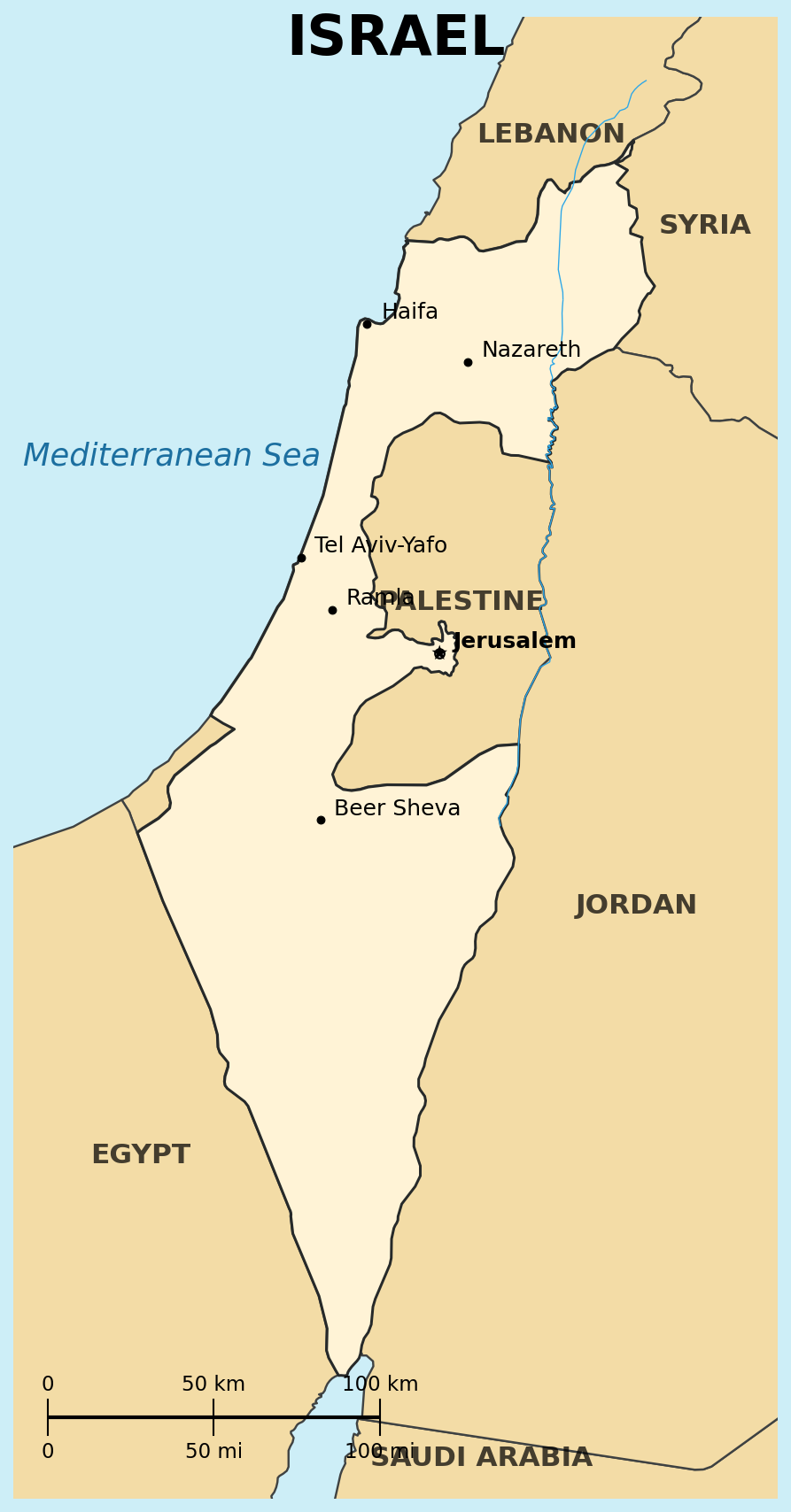
Location: Middle East, bordering the Mediterranean Sea, between Egypt and Lebanon
Map references: Middle East
Area:
total: 20,770-22,072 sq km (varies by source, depending on treatment of disputed territories)
Land boundaries:
border countries: Egypt, Gaza Strip, Jordan, Lebanon, Syria, West Bank
Terrain: Negev desert in the south; low coastal plain; central mountains; Jordan Rift Valley
Environment - current issues: limited arable land and restricted natural freshwater resources; desertification; air pollution from industrial and vehicle emissions; groundwater pollution from industrial and domestic waste, chemical fertilizers, and pesticides
| People |
Population: 9,601,720-10,147,200 (2025-2026 est.)
Age structure:
0-14 years: 27.5%
15-64 years: 60.3%
65 years and over: 12.3% (2024 est.)
Life expectancy at birth:
total population: 83.1 years
male: 81.1 years
female: 85.1 years (2024 est.)
Urbanization: 92.9% of the population is urban (2023)
Nationality:
noun/adjective: Israeli(s)
Ethnic groups: Jewish 71.9-73.5%, Arab 21%, other 4.5-7.1% (2022-2025 est.)
Religions: Jewish 73.5-73.7%, Muslim 18.1-18.3%, Christian 1.9%, Druze 1.6%, other 4.5-4.9% (2022-2023 est.)
Languages: Hebrew (official), Arabic (special status under Israeli law), English (most commonly used foreign language)
Population distribution: concentrated in and around Tel Aviv, as well as around the Sea of Galilee; the south remains sparsely populated except along the Gulf of Aqaba coast
| Government |
Country name:
conventional short form: Israel
Data code: IS
Government type: unitary parliamentary republic
National capital: Jerusalem (limited international recognition)
Executive branch:
chief of state: President Isaac HERZOG
head of government: Prime Minister Benjamin NETANYAHU
Independence: 14 May 1948 (Declaration of Independence)
| Economy |
Economy - overview: advanced, high-income, technology-driven economy; underwent a dramatic transformation over the past several decades, led by cutting-edge high-tech sectors; offshore Mediterranean gas discoveries (Tamar, Leviathan fields) position Israel as a potential regional natural gas hub; longer-term structural issues include low labor force participation among some minority populations and high housing/consumer costs
GDP (purchasing power parity): $609.411 billion (2026 est.)
GDP - real growth rate: 3.1% (2025)
GDP - per capita: $59,095 PPP (2026 est.)
Inflation rate: 2.4% (2024)
Unemployment rate: 3.5% (2025 est.)
Labor force: 4,065,500 (2020)
Population below poverty line: 20.9% (2023)
Currency: Israeli new shekel (ILS)