

French Canadian
Most Popular French Canadian Language Product Types
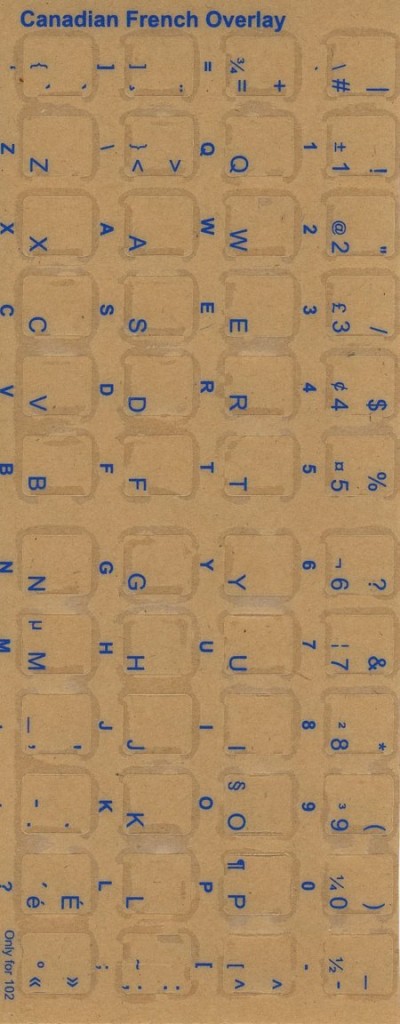
All French Canadian language product types
Language Information
French is one of the Romance languages, descended from Latin. The appearance of Latin in France (then called Gaul) dates from Caesar's conquest of the region in the period 58-51 B.C. Gaul became one of the richest and most important provinces of the Roman Empire and Latin superseded the various Celtic (Gaulish) tongues as the language of the domain. A number of dialects emerged but history favored the north; Paris became the capital of France in the 12th century and Parisian French gained ascendancy over the others. In the 17th, 18th, and 19th centuries French was preeminent as an inter-national language, though it has been partially eclipsed by English in the 20th. French was one of the two official languages of the League of Nations and is now one of the six official languages of the United Nations.
The French alphabet is the same as that of English, though the letter (w) appears only in foreign words. Grave (è), acute (é), and circum-flex (ô) accents are used (e.g., pére-father, été-summer, élève-pupil, âme-soul); and the cedilla (ç) appears under the letter c when pre-ceding a, o, or u to indicate an s sound rather than k (leçon-lesson).
French spelling generally reflects the language as it was spoken four or five centuries ago and is therefore a poor guide to modern pro-nunciation. Silent letters abound, especially at the ends of words (hommes is pronounced um; aiment pronounced em) but a normally silent final consonant is often sounded when it is followed by a word that begins with a vowel. In this process, known as liaison, the con-sonant becomes part of the first syllable of the following word, so that the sentence il est assis (he is seated) is pronounced e-le-ta-se. Although French pronunciation is governed by fairly consistent rules, the actual sounds of the language are quite difficult for the English speaker, and a good "French accent" is something not easily acquired.
As the two major languages of the Western world, English and French naturally have contributed many words to each other. The enormous Impact of Norman French on the English language has already been discussed. More recent French contributions to English—with the French pronunciation retained as closely as possible—include such words and expressions as hors d'oeuvre, à Ia carte, table d'hôte, en route, en masse, rendezvous, carte blanche, savoir-faire, faux pas, fait accompli, par excellence, bon vivant, joie de vivre, raison d'être, coup d'état, nouveau riche, esprit de corps, laissez faire, chargé d'aftaires, pièce de résistance, and R.S.V.P.
In recent years, however, traffic has been mainly in the opposite direction. To the dismay of purists of the language, to say nothing of the French Academy, French has been virtually inundated with English words of all kinds-so much so that the resulting jargon has been dubbed franglais, a combination of français (French) and anglais (English). A few examples among hundreds are le hamburger, le drugstore, le week-end, le strip-tease, le pull-over, le tee-shirt, les chewing gum, les blac jeans, Ie snack-bar, and la cover-girl. Most of these have thus far been denied official status by the Academy, but even here concessions are being made. Recently the Academy approved the adoption into French of le pipeline and le bulldozer—with the strict proviso, of course, that they be pronounced peep-LEEN and bool-do-ZAIR.
- Language Family
- Indo-European
- Subgroup
- Romance
- Branch
- Western Romance