
About Liberia
English - the official language, spoken by ~20% of the population, and used in government and formal education.
Kpelle, Bassa, Grebo, Gio, Mano, and Kru are among the most widely spoken of Liberia's 27+ indigenous languages, few of which are written or used in correspondence.
With 28 ethnic groups and languages, Liberia is one of the most ethnically diverse countries in the world.
English is the sole official language of Liberia.
| Geography |
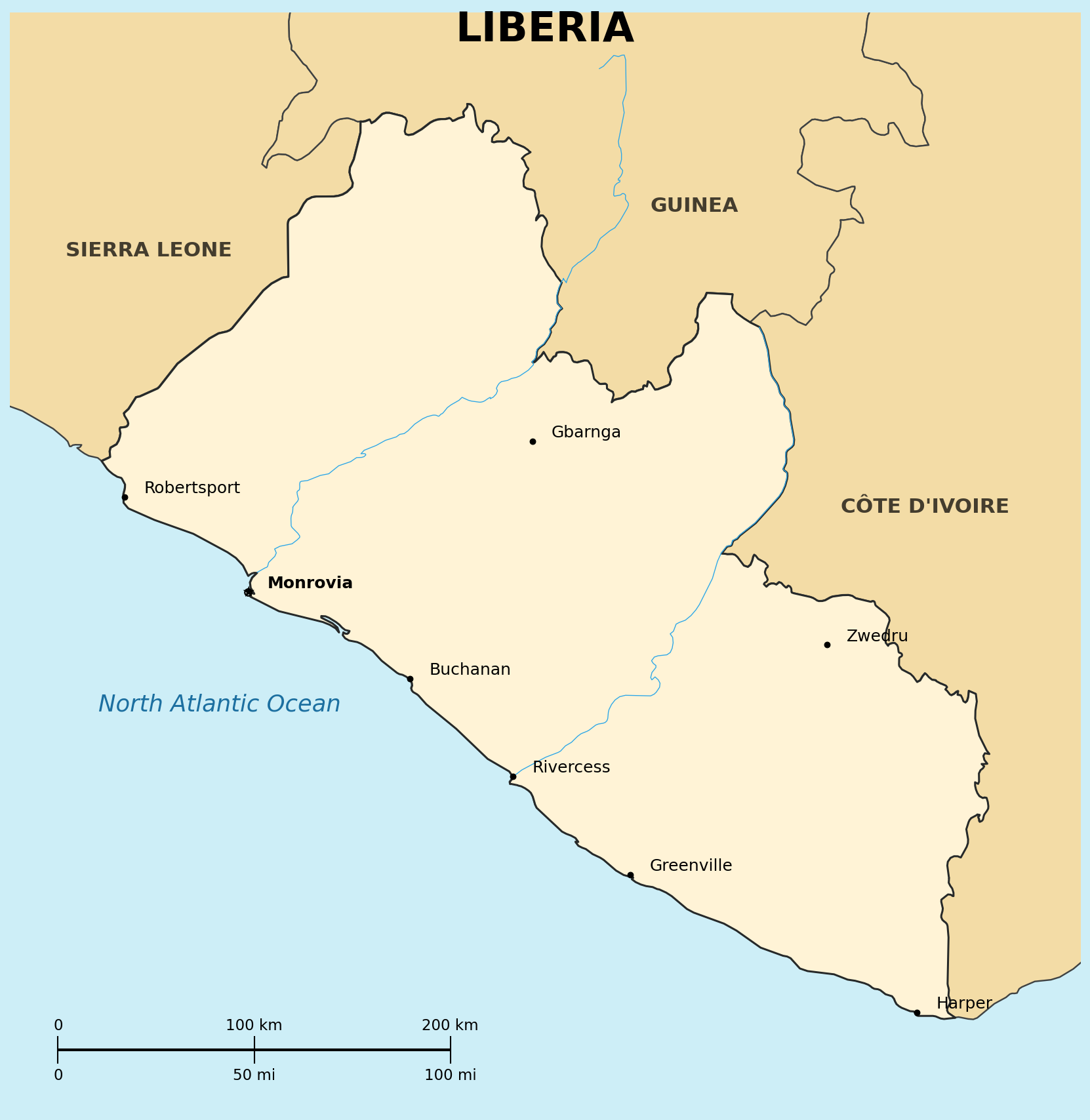
Location: Western Africa, bordering the North Atlantic Ocean, between Cote d'Ivoire and Sierra Leone
Map references: Africa
Area:
total: 111,369-111,370 sq km
Land boundaries:
border countries: Cote d'Ivoire, Guinea, Sierra Leone
Terrain: facing the Atlantic Ocean, the coastline features lagoons, mangrove swamps, and river-deposited sandbars; an inland grassy plateau supports limited agriculture
Natural hazards: dust-laden harmattan winds blow from the Sahara (December to March)
| People |
Population: 5.2-5.56 million (2025 est.)
Age structure:
0-14 years: 43.35% (2022 est.)
Life expectancy at birth:
total population: 61.6-62.2 years
male: 59.9 years
female: 63.3 years
Nationality:
noun/adjective: Liberian(s)
Ethnic groups: Kpelle 20.2%, Bassa 13.6%, Grebo 9.9%, Gio 7.9%, Mano 7.2%, Kru 5.5%, Lorma 4.8%, Krahn 4.5%, Kissi 4.3%, Mandingo 4.2%, other 17.9% (2022 est.)
Religions: Christian 85.6%, Muslim 12.2%, Traditional 0.6% (2008 est.)
Languages: English 20% (official), some 20+ ethnic group languages, few of which are written or used in correspondence
Population distribution: more than half the population lives in urban areas, with approximately one-third living within an 80-km (50-mi) radius of Monrovia
| Government |
Country name:
conventional long form: Republic of Liberia
conventional short form: Liberia; the name derives from the Latin word liber, meaning "free"
Data code: LI
Government type: presidential republic
National capital: Monrovia
Background: for hundreds of years the Mali and Songhai Empires claimed most of Liberia; beginning in the 15th century, European traders established coastal outposts, though unlike its neighbors, Liberia never fell under European colonial rule; in the early 19th century the US began sending freed enslaved people and other people of color to Liberia; in 1847 these settlers declared independence, establishing Africa's first republic; tensions between Americo-Liberian settlers and the indigenous population led to a 1980 coup by Samuel Doe and a decade of authoritarian rule; Charles Taylor's 1989 rebellion sparked a prolonged civil war; a 2003 peace agreement ended the war; Ellen Johnson Sirleaf became president in 2005, Africa's first elected female head of state
| Economy |
Economy - overview: low-income West African economy shaped by the legacy of civil war; centered on agriculture, mining (iron ore and gold), forestry, rubber processing, and maritime registration; food scarcity, high poverty, and a large informal economy remain persistent challenges; longest continuously operated rubber plantation in the world
GDP (purchasing power parity): $11.42 billion (2025 est.)
GDP - real growth rate: 5.3% (2025 est.)
GDP - per capita: $2,010 PPP (2025 est.)
Inflation rate: 8.2% (2024 est.)
Unemployment rate: 6.4% (2025 est.)
Population below poverty line: approximately 60%
Currency: Liberian dollar (LRD); US dollar also widely used
| Military |
Military branches: Armed Forces of Liberia (AFL): Army, Liberian Coast Guard; Ministry of Justice: Liberia National Police, Liberia Drug Enforcement Agency (2025)
| Transnational Issues |
Trafficking in persons - tier rating: Tier 2 Watch List (2025)