
About Moldova
Romanian - the sole official language, spoken by ~80.2% of the population (56.7% identify their mother tongue as Moldovan, virtually the same as Romanian; 23.5% identify it as Romanian); as of March 2023, "Romanian" formally replaced "Moldovan" as the official name of the language.
Russian is spoken by ~9.7%, and Gagauz (a Turkish language) by ~4.2%.
Romanian is the sole official language of Moldova.
| Geography |
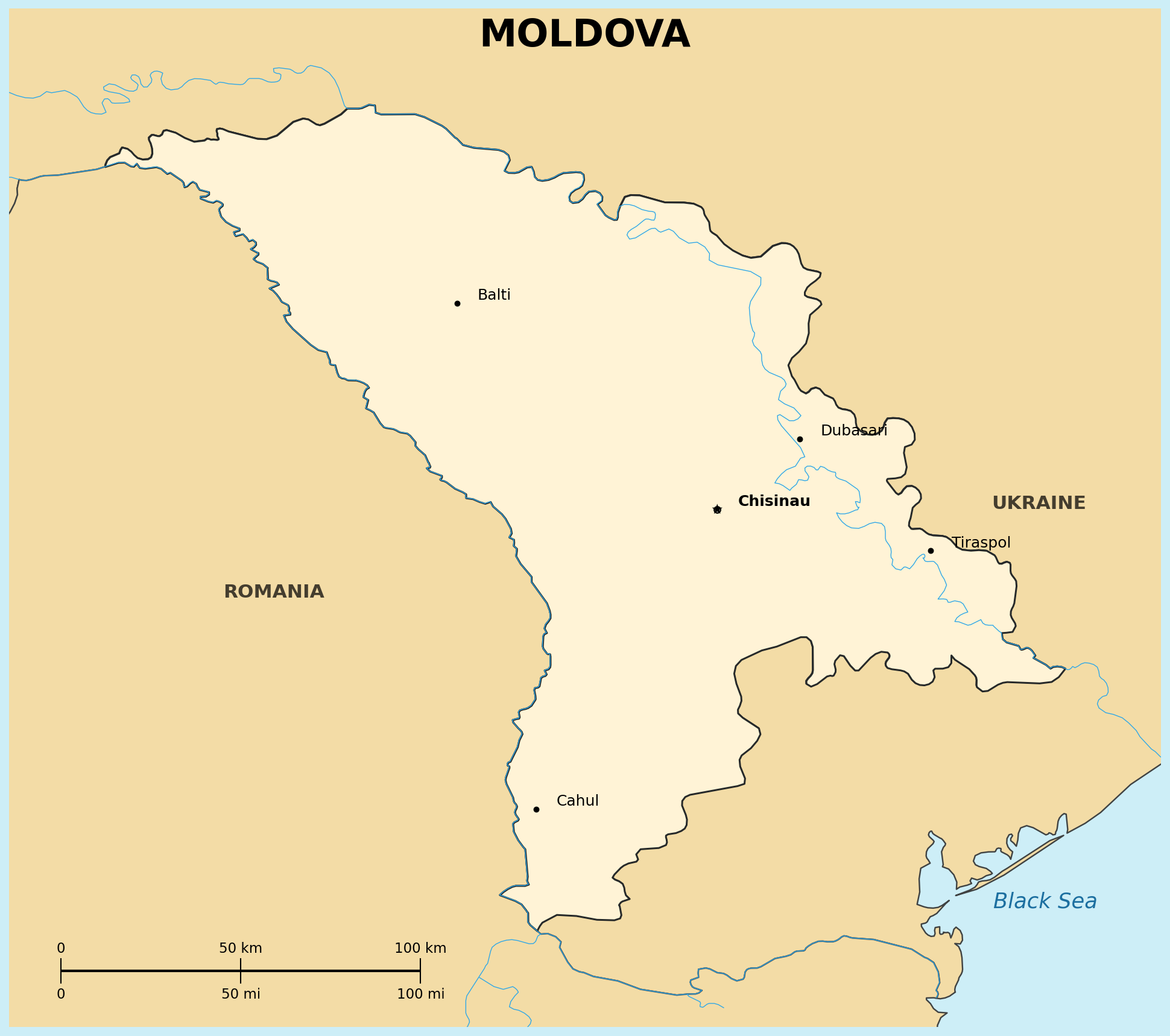
Location: Eastern Europe, landlocked, between Romania and Ukraine
Map references: Europe
Area:
total: 33,846-33,851 sq km
Land boundaries:
border countries: Romania, Ukraine
Environment - current issues: soil and water pollution from heavy use of agricultural chemicals; extensive soil erosion and declining soil fertility from farming methods
| People |
Population: 2.38-3.58 million (figures vary depending on whether Transnistria is included; 2024-2025 est.)
Age structure:
0-14 years: 14.8-16.4%
15-64 years: 70.2-73.6%
65 years and over: 10-15%
Median age: 40.4 years (2025 est.)
Life expectancy at birth:
total population: 70.1-71.9 years
male: 66.1-67.5 years
female: 74.4-76.4 years
Nationality:
adjective: Moldovan
Ethnic groups: Moldovans 76.7% majority
Religions: Orthodox 90.1%, other Christian 2.6%, unspecified 6.9% (2014 est.)
Languages: Moldovan/Romanian (official) 80.2%, Russian 9.7%, Gagauz 4.2%, Ukrainian 3.9%, Bulgarian 1.5%, Romani 0.3% (2014 est.)
Population distribution: pockets of agglomeration throughout the country, largest in the center around the capital, Chisinau, followed by Tiraspol and Balti; urban population 43.4% of total (2023)
| Government |
Country name:
conventional short form: Moldova; named for the Moldova River in neighboring eastern Romania
Data code: MD
Government type: parliamentary republic
National capital: Chisinau (Romanian); Kishinev (Russian)
Executive branch:
chief of state: President Maia Sandu (since 24 December 2020)
head of government: Prime Minister Dorin Recean (since 16 February 2023)
| Economy |
Economy - overview: emerging, upper-middle-income Eastern European economy; among the poorest countries in Europe despite recent progress; relies heavily on agriculture (fruits, vegetables, wine, wheat, tobacco) and remittances (about $1.2 billion annually, nearly 15% of GDP) from roughly one million Moldovans working abroad; imports nearly all energy from Russia and Ukraine, with significant debt to Gazprom tied to the breakaway Transnistria region; pursuing EU integration and market-oriented reforms
GDP (purchasing power parity): $49.54 billion (2026 est.)
GDP - real growth rate: 1.9% (2026)
GDP - per capita: $21,170 PPP (2026 est.)
Inflation rate: 5.0% (2025)
Unemployment rate: 28.7% (2025 est.; note: figure may reflect broader labor underutilization measure)
Population below poverty line: 26.8% (2020)
Currency: Moldovan leu (MDL)