

About Nepal
Nepali - the official language, spoken by ~44.6-44.9% of the population as a mother tongue.
Maithali (~11.1%), Bhojpuri (~6.2%), Tharu (~5.9%), and Tamang (~4.9%) are also widely spoken.
123 languages were reported as mother tongues in the national census; many in government and business also speak English.
Nepali is the sole official language of Nepal.
| Geography |
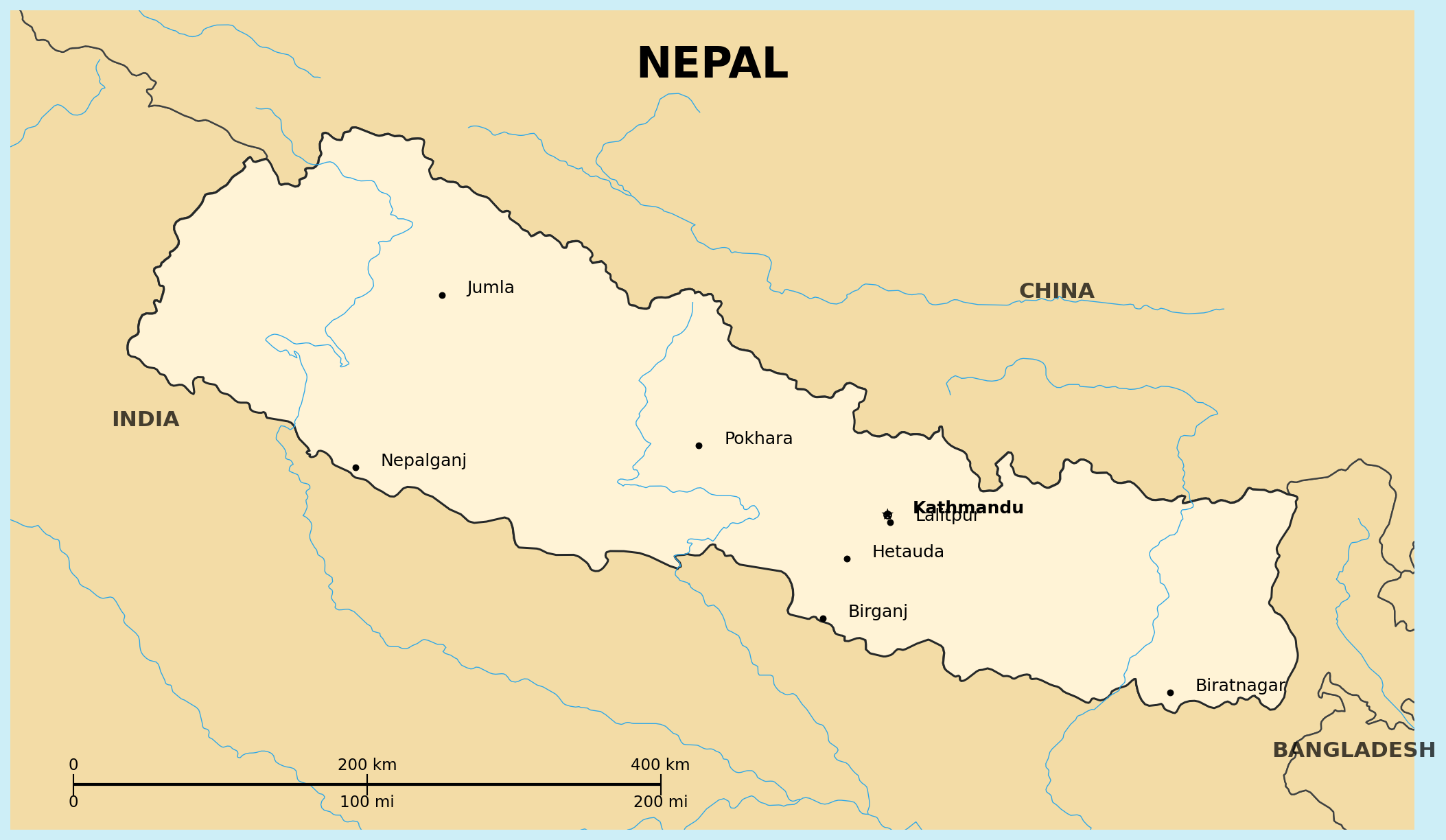
Location: Southern Asia, between China and India; a rugged, landlocked Himalayan nation
Map references: Asia
Area:
total: 147,181-148,007 sq km
Land boundaries:
border countries: China, India
Geography - note: contains some of the most rugged and difficult mountain terrain in the world; the name likely comes from the Sanskrit term nepala, referring to villages at the base of the mountains
| People |
Population: 29.1-31.3 million (2025 est.)
Age structure:
0-14 years: 25.8-29.5%
15-64 years: 67.8%
65 years and over: 5.3-6.4%
Median age: 24.5-28.1 years
Nationality:
noun/adjective: Nepali(s)/Nepalese
Religions: Hindu 81.2-81.3%, Buddhist 8.2-9%, Muslim 4.4-5.1%, Kirat 3.1-3.2%, Christian 1.4-1.8%, other 0.5% (2021 est.)
Languages: Nepali (official) 44.6-44.9%, Maithali 11.1-11.7%, Bhojpuri 6-6.2%, Tharu 5.8-5.9%, Tamang 4.9-5.1%, other 21%; 123 languages reported as mother tongue in national census; many in government and business also speak English
Literacy: total population 67.9-68.7% (male 78.6-79.8%, female 59.4-59.7%) (2018-2019 est.)
| Government |
Country name:
conventional short form: Nepal
Data code: NP
Government type: federal parliamentary republic; interim government following September 2025 unrest
National capital: Kathmandu
Executive branch:
chief of state: President Ram Chandra Poudel
head of government: Prime Minister Sushila Karki (interim, since 12 September 2025, Nepal's first female head of government)
Background: during the late 18th and early 19th centuries, the principality of Gorkha united many other principalities and states of the sub-Himalayan region into a Nepali Kingdom; retained independence after the Anglo-Nepalese War of 1814-16; in 1951 the Nepali monarch ended a century-old system of hereditary rule; the monarchy was abolished in 2008 following years of instability; in September 2025, Gen Z-led protests against corruption and a social media ban toppled the elected government of PM K.P. Sharma Oli, with government buildings including parliament set ablaze and at least 72 people killed; the House of Representatives was dissolved, an interim government was formed under Karki, and fresh elections were held in early 2026, with Balen Shah forming the successor government in March 2026
| Economy |
Economy - overview: least-developed, lower-middle-income economy; among the least developed nations in the world, with about one-quarter of the population living below the poverty line; heavily dependent on remittances (up to 30% of GDP); agriculture is the mainstay, employing almost two-thirds of the population though accounting for less than a third of GDP; considerable untapped hydropower potential (an estimated 42,000 MW commercially feasible)
GDP (purchasing power parity): $170.1-194.852 billion (2024-2026f)
GDP - real growth rate: 4.3% (2026f)
GDP - per capita: $6,578 PPP (2026f)
Inflation rate: 4.7% (2024)
Unemployment rate: 10.5% (2025)
Population below poverty line: 20.3% (2022)
Currency: Nepalese rupee (NPR)
| Transnational Issues |
Trafficking in persons - tier rating: Tier 2 Watch List (2025)