

About Norway
Norwegian - the official language, existing in two written forms: Bokmal and Nynorsk, both official.
Sami - a small minority language, official in nine municipalities across Norway's three northernmost counties (Finnmark, Nordland, and Troms); has three dialects (Lule, North, and South Sami).
A small Finnish-speaking minority also exists, and English is widely spoken as a second language.
Bokmal and Nynorsk Norwegian are both official languages of Norway, with Sami holding official status regionally.
| Geography |
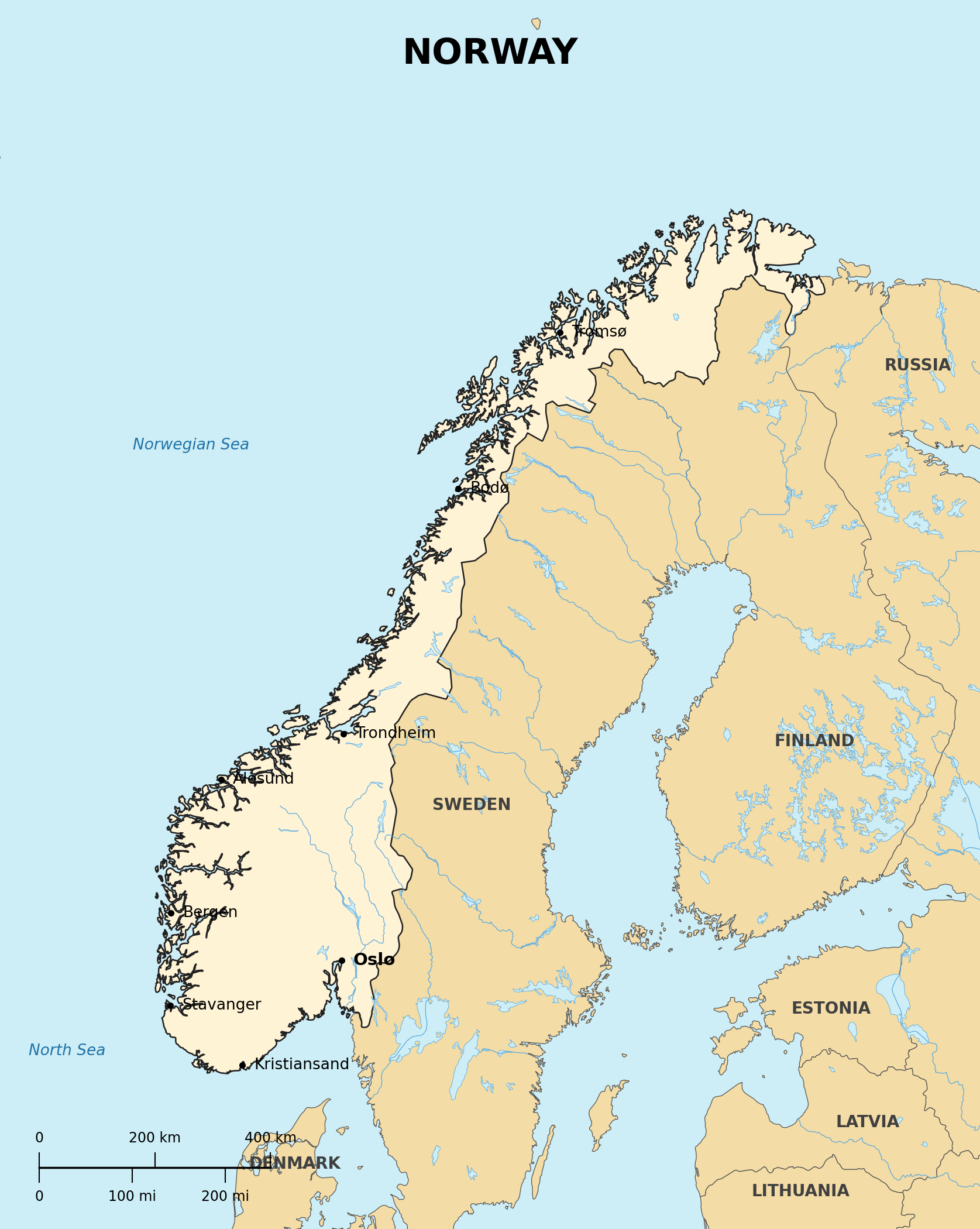
Location: Northern Europe, bordering the North Sea and North Atlantic Ocean, west of Sweden
Map references: Europe
Area:
total: 323,802-386,224 sq km (varies by source; includes Svalbard and Jan Mayen in broader figures)
Land boundaries:
border countries: Finland, Russia, Sweden
Terrain: about two-thirds mountains; some 50,000 islands off its much-indented coastline; one of the most rugged and longest coastlines in the world
Natural hazards: rockslides, avalanches; Beerenberg (2,227 m) on Jan Mayen Island is the country's only active volcano
Geography - note: strategic location adjacent to sea lanes and air routes in the North Atlantic
| People |
Population: 5,509,733-5,606,944 (2024-2025 est.)
Age structure:
0-14 years: 16.29%
15-64 years: 64.81%
65 years and over: 18.90%
Life expectancy at birth:
total population: 82.55-83.1 years
male: 80.42 years
female: 84.79 years
Infant mortality rate: 1.9-2.31 deaths/1,000 live births
Nationality:
noun/adjective: Norwegian(s)
Ethnic groups: Norwegian 80.0%; other minorities including Sami
Religions: Church of Norway (Evangelical Lutheran, official) 70.6%, Muslim 3.2%, Roman Catholic 3%, other Christian 3.7%, unspecified 17% (2016 est.)
Languages: Bokmal Norwegian (official), Nynorsk Norwegian (official), small Sami- and Finnish-speaking minorities; Sami is an official language in nine municipalities in Norway's three northernmost counties (Finnmark, Nordland, Troms)
Population distribution: most people live in the south; population clusters found along the North Sea coast in the southwest and Skagerrak in the southeast; interior areas of the north remain sparsely populated
| Government |
Country name:
conventional long form: Kingdom of Norway
conventional short form: Norway
Data code: NO
Government type: unitary parliamentary constitutional monarchy
National capital: Oslo
| Economy |
Economy - overview: stable, high-income economy with a vibrant private sector, a large state sector, and an extensive social safety net; opted out of the EU in a 1994 referendum but participates partially in the EU single market via the European Economic Area; richly endowed with oil, gas, fish, forests, and minerals; a leading producer and the world's second-largest exporter of seafood (after China); the petroleum sector accounts for about 9% of jobs, 12% of GDP, and 37% of exports, though production is well below its 2000 peak
GDP (purchasing power parity): $606.590 billion (2025 est.)
GDP - real growth rate: 1.5% (2024)
GDP - per capita: $107,892 PPP (2025 est.); among the highest in the world
Inflation rate: 3.3% (2024 est.)
Unemployment rate: 4.6% (2025 est.)
Currency: Norwegian krone (NOK)
| Military |
Military branches: Norwegian Armed Forces (Forsvaret): Army, Royal Norwegian Navy (includes Coastal Rangers and Coast Guard), Royal Norwegian Air Force, Home Guard (2025)
Military service age and obligation: 17 (men) or 18 (women) for voluntary service; all citizens 19-44 subject to selective compulsory service; 19-month obligation for those selected (2025)