
About Philippines
Filipino (based on Tagalog) and English - the two official languages.
Tagalog is the most widely spoken as a home language (~39.9%), followed by Bisaya/Binisaya (~16%), Hiligaynon/Ilonggo (~7.3%), Ilocano (~7.1%), and Cebuano (~6.5%).
The country is home to over 100 languages and dialects total, with 8 major regional languages: Tagalog, Cebuano, Ilocano, Hiligaynon, Bicolano, Waray, Kapampangan, and Pangasinan.
Filipino and English are the official languages of the Philippines.
| Geography |
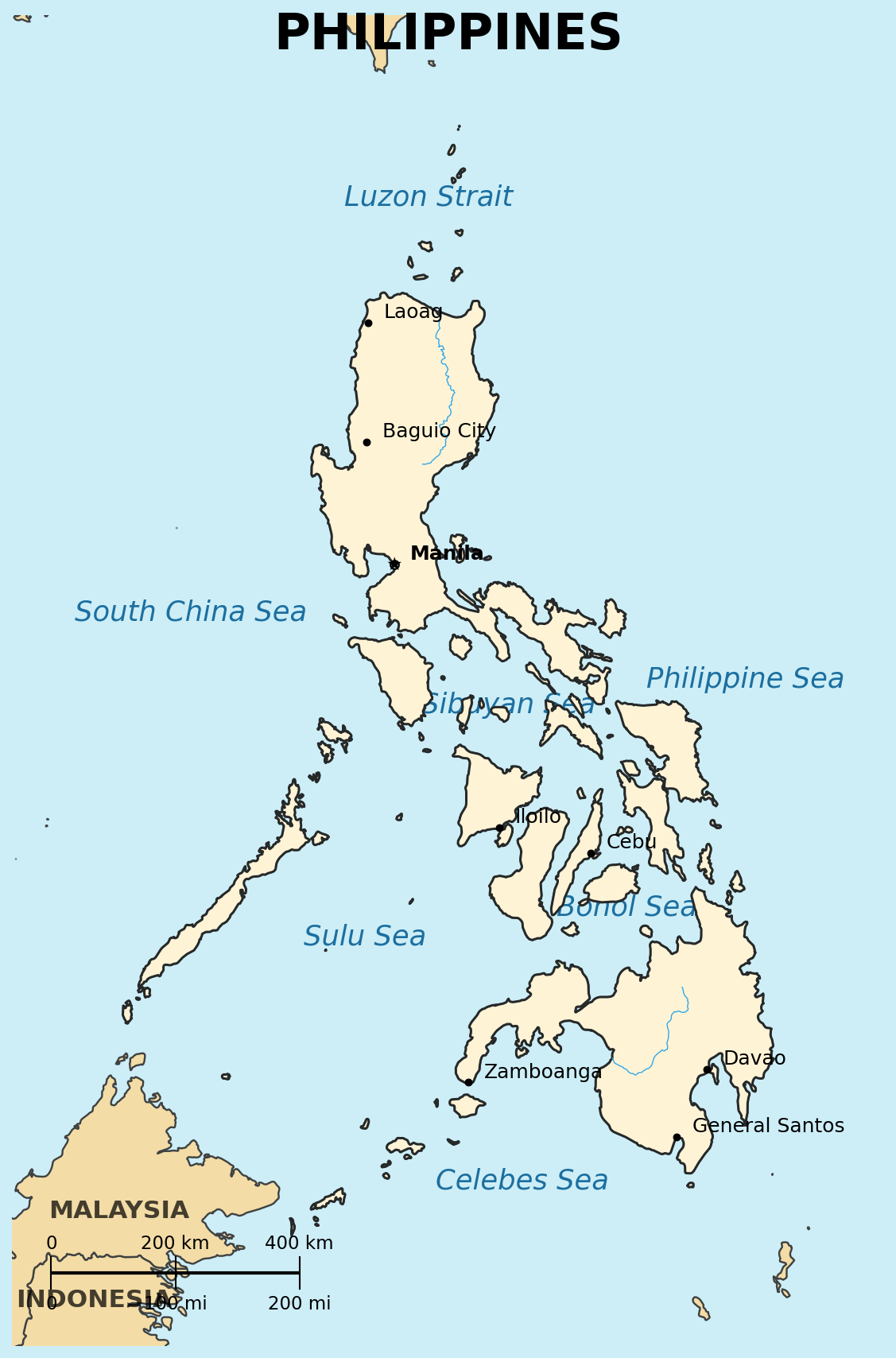
Location: Southeastern Asia, an archipelago between the Philippine Sea and the South China Sea, east of Vietnam
Map references: Southeast Asia
| People |
Population: 112,729,484 (2024 census); population density exceeding 382 persons per sq km
Age structure:
0-14 years: 29.98-30.2%
15-64 years: 64.22-64.3%
65 years and over: 5.6-5.8%
Life expectancy at birth: total population 72.66 years
Infant mortality rate: 24.0 deaths/1,000 live births
Nationality:
noun/adjective: Filipino(s)
Ethnic groups: Visayan (Cebuano, Waray, Hiligaynon/Ilonggo, and others) 31.6%, Tagalog 28.1%, Ilocano 9%, Bikol 6%, Kapampangan 3%, Pangasinan 2%, other 23.3% (2000 census)
Religions: Roman Catholic 78.8%, Muslim 6.4%, Iglesia ni Cristo 2.6%, other Christian 3.9%, other 8.2% (2020 est.)
Languages: Filipino (based on Tagalog) and English are official languages; Tagalog 39.9%, Bisaya/Binisaya 16%, Hiligaynon/Ilonggo 7.3%, Ilocano 7.1%, Cebuano 6.5%, Bikol/Bicol 3.9%, Waray 2.6%, Kapampangan 2.4%, other 11.2% (2020 est.); recognized regional languages also include Maranao, Maguindanao, and Zamboangueno Chavacano; Spanish and Arabic hold protected auxiliary status
Population distribution: concentrated in areas with good farmland; highest concentrations in northwest and south-central Luzon and the islands of the Visayan Sea, particularly Cebu and Negros; Manila is home to one-eighth of the national population
Major urban areas: 14.667 million Manila (capital, metro area), 1.949 million Davao, 1.025 million Cebu City (2023)
| Government |
Country name:
conventional short form: Philippines
Data code: RP
Government type: presidential republic
National capital: Manila
Background: named after King Philip II of Spain, who ruled during the 16th-century Spanish colonization; experienced 333 years of Spanish rule and 48 years under US administration, leading to significant Western cultural influences; emerged as a regional education leader in the late 20th century with one of the highest literacy rates in Asia
| Economy |
Economy - overview: lower-middle-income, newly industrialized economy; key sectors include electronics assembly, business process outsourcing, agribusiness, and tourism; heavily reliant on remittances from overseas Filipino workers (~8.7% of GDP); faces a high poverty rate and significant outward migration of skilled workers, including medical personnel
GDP (purchasing power parity): $1.572 trillion (2026 est.)
GDP - real growth rate: 4.4% (2025)
GDP - per capita: $13,639 PPP (2026 est.)
Inflation rate: 7.2% (April 2026)
Unemployment rate: 2.2-5.0% (varies by source; 2025-2026)
Labor force: 49.07 million (March 2026)
Population below poverty line: 15.5% (2023)
Industries: electronics assembly, aerospace/parts, agribusiness, automotive/parts, IT and business process outsourcing, food processing, pharmaceuticals, shipbuilding, textiles, tourism
Exports: $116.52 billion (2023); electronic products (54.3%), agricultural products
Currency: Philippine peso (PHP)
| Terrorism |
Terrorist group(s): Abu Sayyaf Group; Communist Party of the Philippines/New People's Army (CPP/NPA); Islamic State of Iraq and ash-Sham - East Asia (ISIS-EA)