
About Senegal
French - the official language, a remnant of colonial rule, used in government and education.
Wolof - the most widely spoken language day-to-day, spoken by the largest ethnic group (~43% of the population).
Pulaar, Serer, Jola, and Mandinka are also commonly spoken indigenous languages.
French is the sole official language of Senegal.
| Geography |
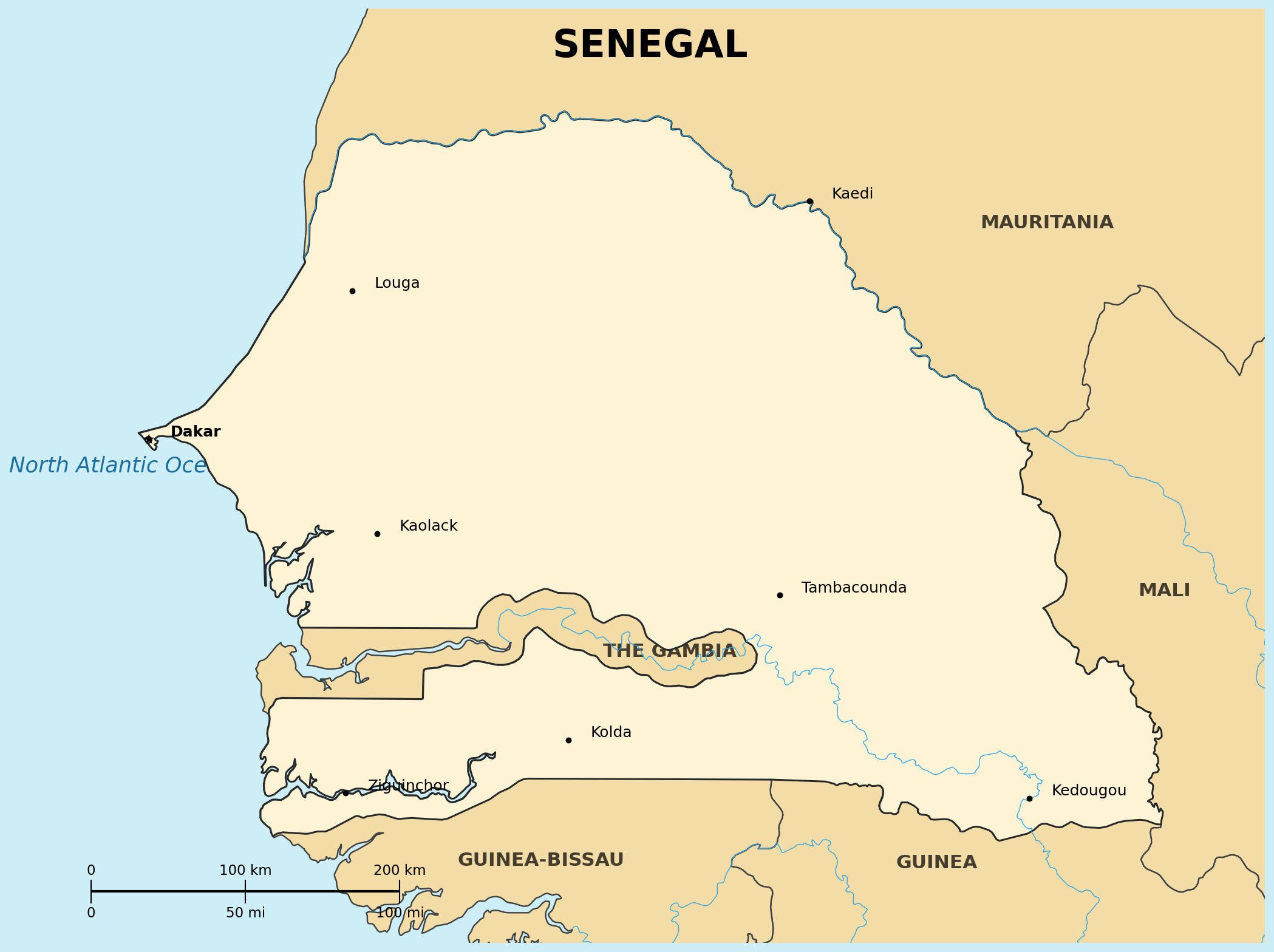
Location: Western Africa, bordering the North Atlantic Ocean, between Guinea-Bissau and Mauritania; the westernmost country in West Africa
Map references: Africa
Area:
total: 196,722 sq km
Land boundaries:
border countries: The Gambia, Guinea, Guinea-Bissau, Mali, Mauritania
Geography - note: named for the Senegal River, which forms the northern border; the river's name may derive from "Azenegue," the Portuguese name for the Berber Zenaga people, or from a local word meaning "navigable"
| People |
Population: 18,384,660-18,847,519 (2023-2024 est.)
Life expectancy at birth:
total population: 69.96 years
male: 68.23 years
female: 71.77 years
Infant mortality rate: 32.44 deaths/1,000 live births
Nationality:
noun/adjective: Senegalese
Ethnic groups: Wolof (largest group, ~43%), Pulaar, Serer, Jola, Mandinka, and others
Languages: French (official); Wolof (most widely spoken), Pulaar, Serer, Jola, and other indigenous languages
Literacy: total population 50.4% (male 61.5%, female 41.5%) (2023 est.)
| Government |
Country name:
conventional long form: Republic of Senegal
conventional short form: Senegal
Data code: SG
Government type: presidential republic
National capital: Dakar
Independence: 4 April 1960 (from France); 20 August 1960 (withdrawal from the short-lived Mali Federation)
| Economy |
Economy - overview: lower-middle-income, least-developed West African economy; agricultural exports, fishing, tourism, and growing industries (including offshore oil and gas) drive growth; the government aims to position Senegal as a regional economic hub, with investments in infrastructure such as the Dakar-Diamniadio Toll Highway
GDP (purchasing power parity): $105.43 billion (2025 est.)
GDP - real growth rate: 8.4% (2025)
GDP - per capita: $5,500 PPP (2025 est.)
Inflation rate: 2.0% (2025)
Unemployment rate: 15.7% (2017)
Labor force: 5,257,332 (2023)
Population below poverty line: 46.7% (2011 est.)
Industries: agricultural and fish processing, phosphate mining, fertilizer production, petroleum refining, zircon and gold mining, construction materials, ship construction and repair
Exports: $8.1 billion (2024); gold, refined petroleum, phosphoric acid, fish, cement
Currency: West African CFA franc (XOF)
| Military |
Military - note: the Senegalese military is responsible for both territorial defense and internal security, and assists the civilian government with preventive healthcare, infrastructure development, and disaster response; key focus areas include a low-level insurgency in the country's south, maritime security, and securing the border against smuggling and Sahel-based Islamist insurgent groups; France is its closest security partner (2025)