
About Slovakia
Slovak - the sole official language, spoken by ~81.8% of the population.
Hungarian - spoken by ~8.5%, reflecting the country's Hungarian minority.
Roma (~1.8%) is also spoken, along with Czech, Ruthenian, Ukrainian, Russian, German, and Polish among smaller minority communities.
Slovak is the sole official language of Slovakia.
| Geography |
| People |
Population: 5.42-5.56 million (2024 est.)
Life expectancy at birth:
total population: 77.2 years
male: 73.7 years
female: 81 years (2024 est.)
Infant mortality rate: 5 deaths/1,000 live births (2025 est.)
Nationality:
noun/adjective: Slovak(s)
Ethnic groups: Slovak 83.8%, Hungarian 7.8%, Romani 1.2%, other 1.8% (Czech, Ruthenian, Ukrainian, Russian, German, Polish), unspecified 5.4% (2021 est.); Romani populations are usually underestimated and may represent 7-11% of the population
Religions: Roman Catholic 55.8%, Evangelical Church of the Augsburg Confession 5.3%, Greek Catholic 4%, Reformed Christian 1.6%, other 3%, none 23.8% (2021 est.)
Languages: Slovak (official) 81.8%, Hungarian 8.5%, Roma 1.8%, other 2.2%, unspecified 5.7% (2021 est.)
Population distribution: fairly even distribution throughout most of the country, with a slightly larger concentration in the west near the Czech border
| Government |
Country name:
conventional long form: Slovak Republic
conventional short form: Slovakia
Data code: LO
Government type: parliamentary republic
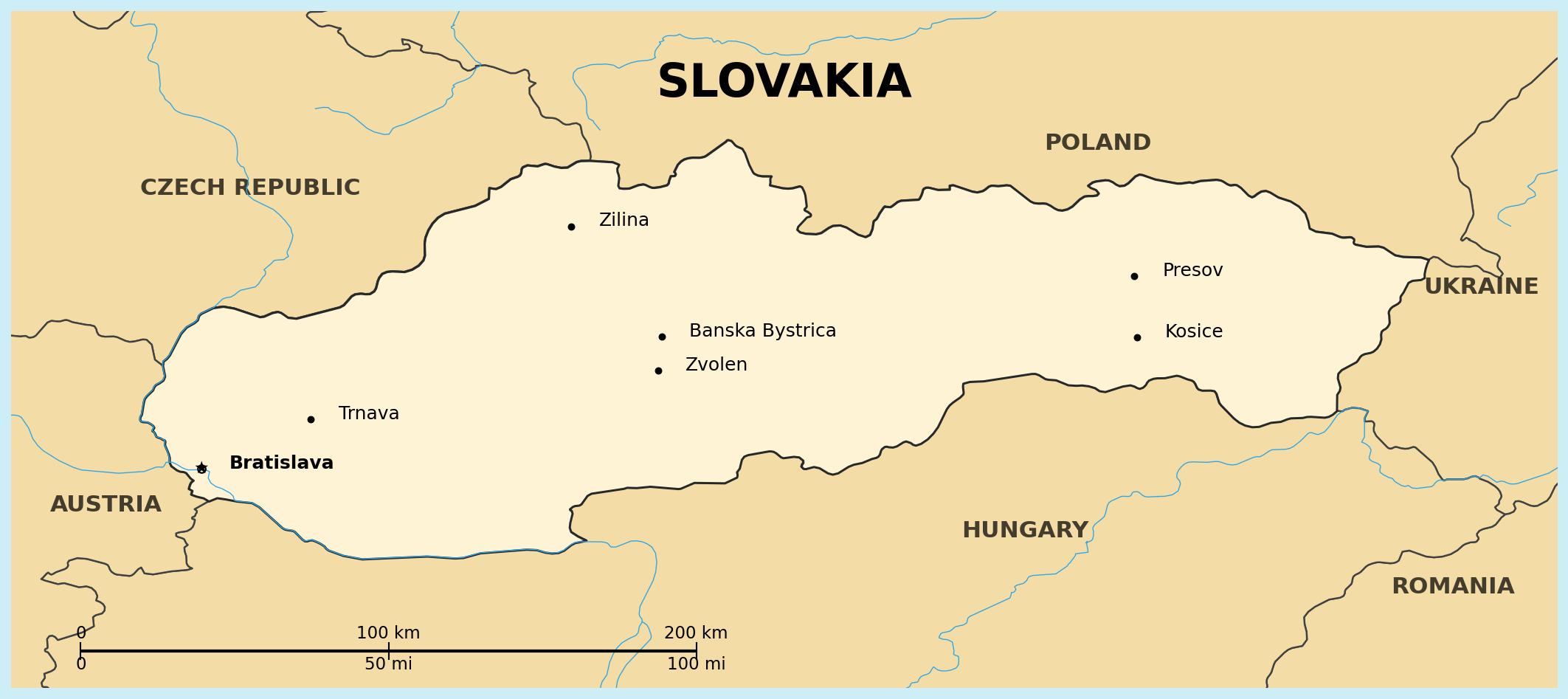
National capital: Bratislava
Background: Slovakia traces its roots to the 9th-century state of Great Moravia; Slovaks then became part of the Hungarian Kingdom, remaining so for roughly 1,000 years; formed Czechoslovakia with the Czechs after WWI; split peacefully from the Czech Republic in 1993 (the "Velvet Divorce"); joined the EU and NATO in 2004, and the Eurozone in 2009
| Economy |
Economy - overview: advanced, high-income EU and Eurozone economy; strong automotive manufacturing sector (one of the world's largest per capita car producers), alongside technology and tourism industries
GDP (purchasing power parity): $257.02 billion (2025 est.)
GDP - real growth rate: 1.7% (2026)
GDP - per capita: $47,600 PPP (2025 est.)
Inflation rate: 3.9% (2025)
Unemployment rate: 5.8% (March 2025)
Population below poverty line: 13.7% (2021); 18.3% at risk of poverty or social exclusion (2024)
Industries: automobiles, metal and metal products, electricity/gas/coke/oil/nuclear fuel, chemicals, synthetic fibers, wood and paper products, machinery, ceramics, textiles, rubber products, food and beverages, pharmaceuticals
Currency: Euro (EUR)
| Military |
Military - note: a NATO member since 2004, focused on modernizing to NATO-compatible equipment; has hosted a multinational NATO ground force battlegroup since 2022 in response to Russia's invasion of Ukraine; signed a defense agreement with the US in 2022; Slovak Air Force is assisted by NATO air policing from Czechia and Poland (2025)