

About St. Kitts & Nevis
English - the sole official language, spoken by virtually the entire population.
St. Kitts Creole - an English-based creole, also widely spoken informally.
English is the sole official language of St. Kitts and Nevis.
| Geography |
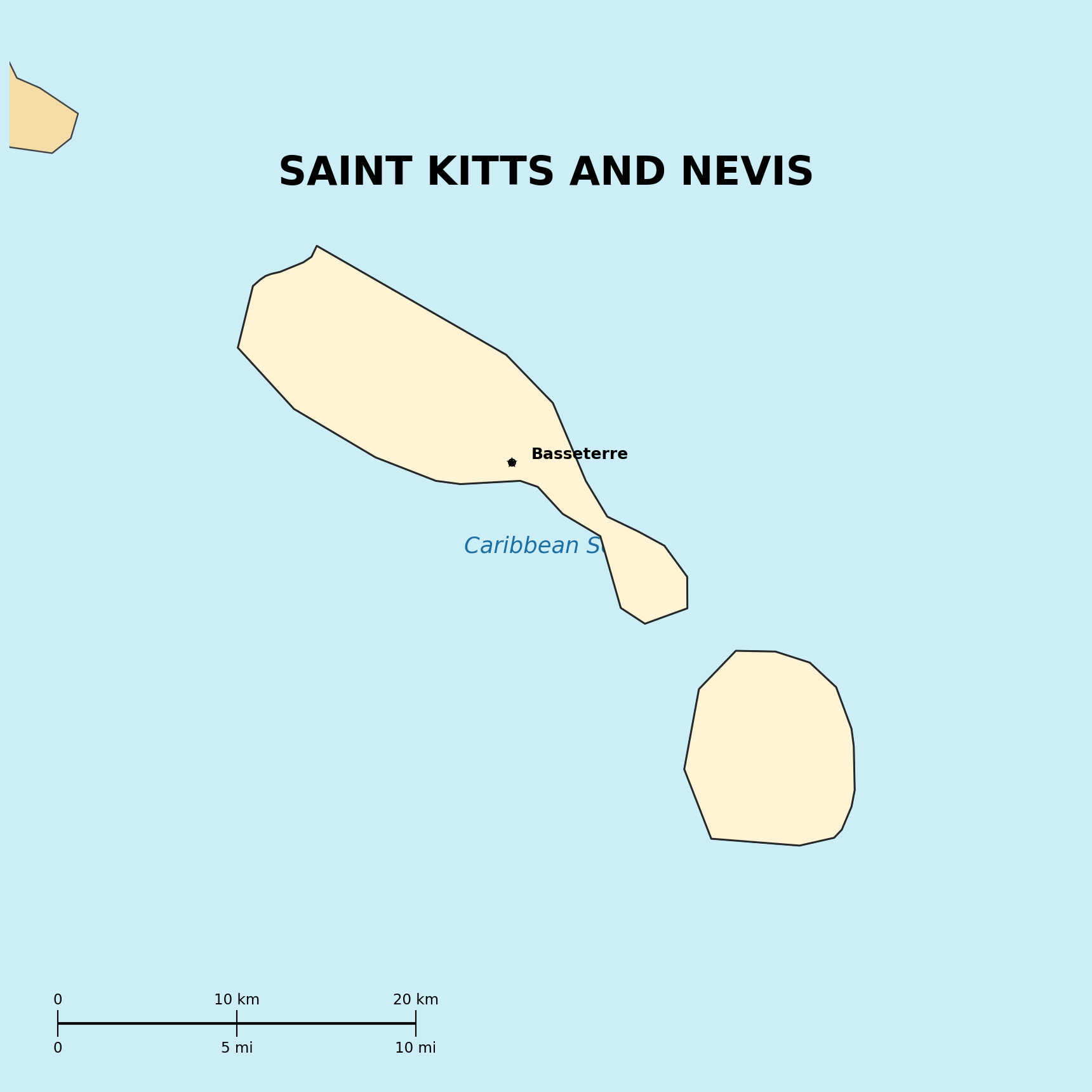
Location: Caribbean, islands between the Caribbean Sea and the North Atlantic Ocean, about one-third of the way from Puerto Rico to Trinidad and Tobago
Map references: Central America and the Caribbean
Area:
total: 261 sq km (St. Kitts 168 sq km, Nevis 93 sq km)
Climate: tropical, tempered by constant sea breezes; little seasonal temperature variation; rainy season May to November
Natural hazards: hurricanes (July to October); Mount Liamuiga volcanic activity
| People |
Population: 45,000-55,400 (varies significantly by source; 2022-2025 est.)
Median age: 36.5 years
Nationality:
noun/adjective: Kittitian(s) and Nevisian(s)
Ethnic groups: African descent 92.5%, mixed 3%, White 2.1%, East Indian 1.5%, other 0.6% (2001 est.)
Religions: Protestant 75.6% (Anglican, Methodist, Pentecostal, Church of God, Baptist, Seventh Day Adventist, and others), Roman Catholic 5.9%, Hindu 1.8%, other 8.7% (2011 est.)
Languages: English (official), St. Kitts Creole (widely spoken)
Population distribution: about 31-40% urban; the capital, Basseterre, is the country's main urban center
| Government |
Country name:
conventional long form: Federation of Saint Kitts and Nevis
conventional short form: Saint Kitts and Nevis; explorer Christopher Columbus visited in 1493 and named one island for his patron saint; Nevis derives from the Spanish "Las Nieves" (The Snows), referring to its cloud-topped mountain
Data code: SC
Government type: federal parliamentary democracy under a constitutional monarchy; a Commonwealth realm
National capital: Basseterre
Independence: 19 September 1983 (from the UK)
Background: Carib Indians occupied the islands for hundreds of years before British and French settlement began in 1623; at one time united with Anguilla, gained independence in 1983 following disagreements over provisions for Nevis; remains a UK Commonwealth realm
| Economy |
Economy - overview: high-income, tourism-based Caribbean OECS economy; better debt balancing in recent years; CARICOM and ECCU member; growing offshore financial and telecommunications hub; environmentally fragile; unique citizenship-by-investment-driven growth model; tourism has replaced sugarcane as the leading economic sector since the industry's closure after the 2005 harvest
GDP (purchasing power parity): $1.07 billion (2025 est.)
Currency: East Caribbean dollar (XCD)
| Military |
Military branches: St. Kitts and Nevis Defense Force (SKNDF): Regular Force, Coast Guard Force, Reserve Force, Cadet Force; Ministry of National Security: Royal St. Christopher and Nevis Police Force (2025)
Military - note: joined the Caribbean Regional Security System (RSS) in 1984, alongside Antigua and Barbuda, Barbados, Dominica, Grenada, Guyana, St. Lucia, and St. Vincent and the Grenadines, for mutual assistance on emergencies and security matters (2025)