

About St. Lucia
English - the sole official language.
Saint Lucian Creole French (Kweyol) - a French-based creole widely spoken and treated as a symbol of national identity, reflecting the island's history of both French and British colonial rule.
English is the sole official language of Saint Lucia.
| Geography |
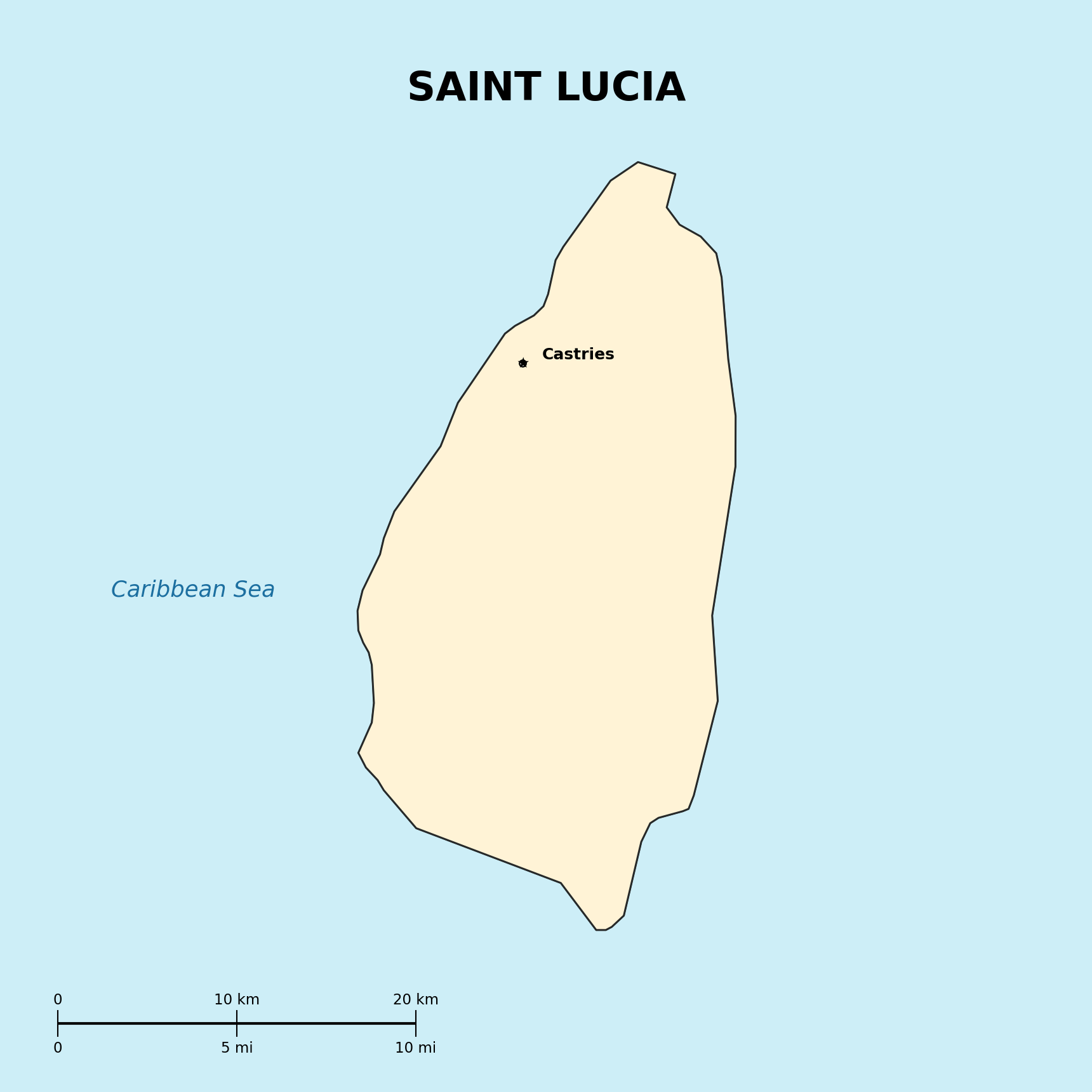
Location: Caribbean, island between the Caribbean Sea and the North Atlantic Ocean, north of Trinidad and Tobago
Map references: Central America and the Caribbean
Area:
total: 616-617 sq km
Climate: tropical, moderated by northeast trade winds; dry season January to April, rainy season May to August
| People |
Population: 168,462-185,886 (varies by source; 2023-2025 est.)
Age structure:
0-14 years: 19.24%
65 years and over: 13.1% (2022 est.)
Life expectancy at birth: total population 78.95 years
Infant mortality rate: 11.99 deaths/1,000 live births
Nationality:
noun/adjective: Saint Lucian(s)
Ethnic groups: African/Black descent 85.3%, mixed African-European 10.8%, East Indian 2.2%, White 0.6% (2010 census)
Languages: English (official), Saint Lucian Creole French (Kweyol, widely spoken, symbol of national identity)
| Government |
Country name:
conventional short form: Saint Lucia; believed to be named for Saint Lucy of Syracuse by French sailors shipwrecked on the island on 13 December 1502, the saint's feast day
Data code: ST
Government type: parliamentary democracy under a constitutional monarchy; a Commonwealth realm
National capital: Castries
Independence: 22 February 1979 (from the UK)
Background: England and France contested Saint Lucia - with its fine natural harbor at Castries and burgeoning sugar industry - throughout the 17th and early 18th centuries, with possession changing 14 times; finally ceded to the UK in 1814, becoming part of the British Windward Islands colony; joined the West Indies Federation (1958-1962) and became one of six members of the West Indies Associated States in 1967, with internal self-government; gained full independence in 1979
| Economy |
Economy - overview: upper-middle-income Caribbean island economy; primarily driven by tourism, agriculture, and services, including its iconic Pitons UNESCO World Heritage Site; faces vulnerability to natural disasters, fluctuating global market prices, and high public debt
GDP (purchasing power parity): $3.399-3.769 billion (2023-2025 est.)
GDP - real growth rate: 2.2% (2024f)
GDP - per capita: $18,435-29,258 PPP (varies by source; 2023-2025 est.)
Inflation rate: 6.4% (2022)
Population below poverty line: 20.3% on less than $5.50/day (2016)
Currency: East Caribbean dollar (XCD)
| Military |
Military - note: no regular military forces; Ministry of Home Affairs, Justice, and National Security: Royal Saint Lucia Police Force (RSLPF); a Caribbean Regional Security System (RSS) member since 1982 (2025)
| Transnational Issues |
Trafficking in persons - tier rating: Tier 2 Watch List (2025)