

Country information
St. Vincent & the Grenadines
- Capital
- Kingstown
- Population
- 110,872
Languages spoken
About St. Vincent & the Grenadines
English - the sole official language.
Vincentian Creole - an English-based creole widely spoken informally in daily life.
English is the sole official language of St. Vincent and the Grenadines.
| Geography |
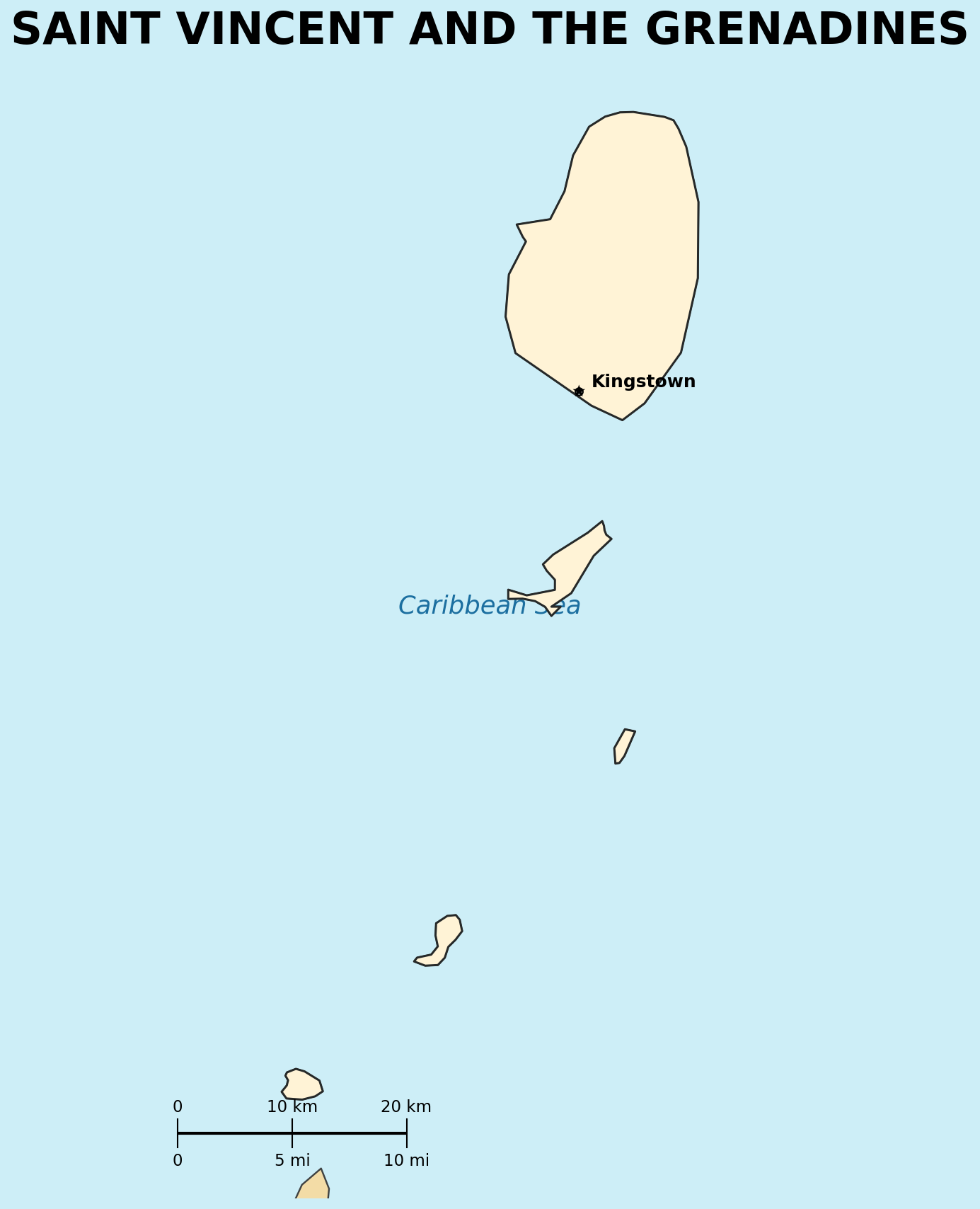
Location: Caribbean, islands between the Caribbean Sea and the North Atlantic Ocean, north of Trinidad and Tobago
Map references: Central America and the Caribbean
Area:
total: 389 sq km; composed of 32 islands and cays; twice the size of Washington, DC
Natural hazards: hurricanes; La Soufriere volcano is a constant threat, last erupting in 2021 and destroying much of Saint Vincent's most productive agricultural lands (also erupted in 1979); part of the volcanic-island arc of the Lesser Antilles extending from Saba to Grenada
| People |
Population: 99,233-110,872 (varies by source; 2022-2026 est.)
Age structure:
0-14 years: 20.15%
65 years and over: 10.72% (2022 est.)
Life expectancy at birth: total population 77.2 years (male 75.2, female 79.3) (2024 est.)
Infant mortality rate: 12 deaths/1,000 live births
Nationality:
noun/adjective: Saint Vincentian(s)/Vincentian(s)
Ethnic groups: African descent 71.2%, mixed 23-27.6%, Indigenous 3%, East Indian 1.1%, European/White 1.5%, other 0.2% (2012 est.)
Languages: English (official), Vincentian Creole (widely spoken)
| Government |
Country name:
conventional short form: Saint Vincent and the Grenadines; explorer Christopher Columbus named the island after Saint Vincent of Saragossa
Data code: VC
Government type: parliamentary democracy under a constitutional monarchy; a Commonwealth realm
National capital: Kingstown
Executive branch:
chief of state: King Charles III, represented by Governor General Stanley John (since 6 January 2026)
head of government: Prime Minister Godwin Friday (since 28 November 2025)
Independence: 27 October 1979 (from the UK)
Background: resistance from native Caribs prevented colonization on Saint Vincent until 1719; France and England disputed the island through most of the 18th century, ceded to England in 1783; the British valued Saint Vincent's fertile soil for slave-run sugar, coffee, and cotton plantations; Britain abolished slavery in 1834, followed by waves of indentured immigration from Portugal and East India
| Economy |
Economy - overview: lower-middle to upper-middle-income Caribbean island economy; primarily agricultural (world's leading arrowroot producer, bananas a key export), unlike most tourism-dependent Caribbean neighbors; the 2021 La Soufriere eruption significantly damaged agricultural lands; vulnerable to global economic and climate shocks
GDP (purchasing power parity): $1.16-1.32 billion (varies by source/year)
GDP - per capita: $9,360-11,970 (varies by source; 2018-2023 est.)
Inflation rate: 2.324% (2018)
Unemployment rate: 25.8% (2017 est.)
Industries: tourism, food processing, agriculture, furniture, clothing, starch
Currency: East Caribbean dollar (XCD)
| Military |
Military - note: no regular military forces; Ministry of National Security: Royal Saint Vincent and the Grenadines Police Force (RSVPF); a Caribbean Regional Security System (RSS) member since 1982 (2025)