

About Suriname
Dutch - the sole official language; Suriname is the only South American nation with Dutch as its official language.
Sranang Tongo (also known as Taki-Taki) - the native language of the Creole population and much of the younger generation, and a widely used lingua franca.
English is also widely spoken, alongside Caribbean Hindustani (a dialect of Hindi) and Javanese.
Dutch is the sole official language of Suriname.
| Geography |
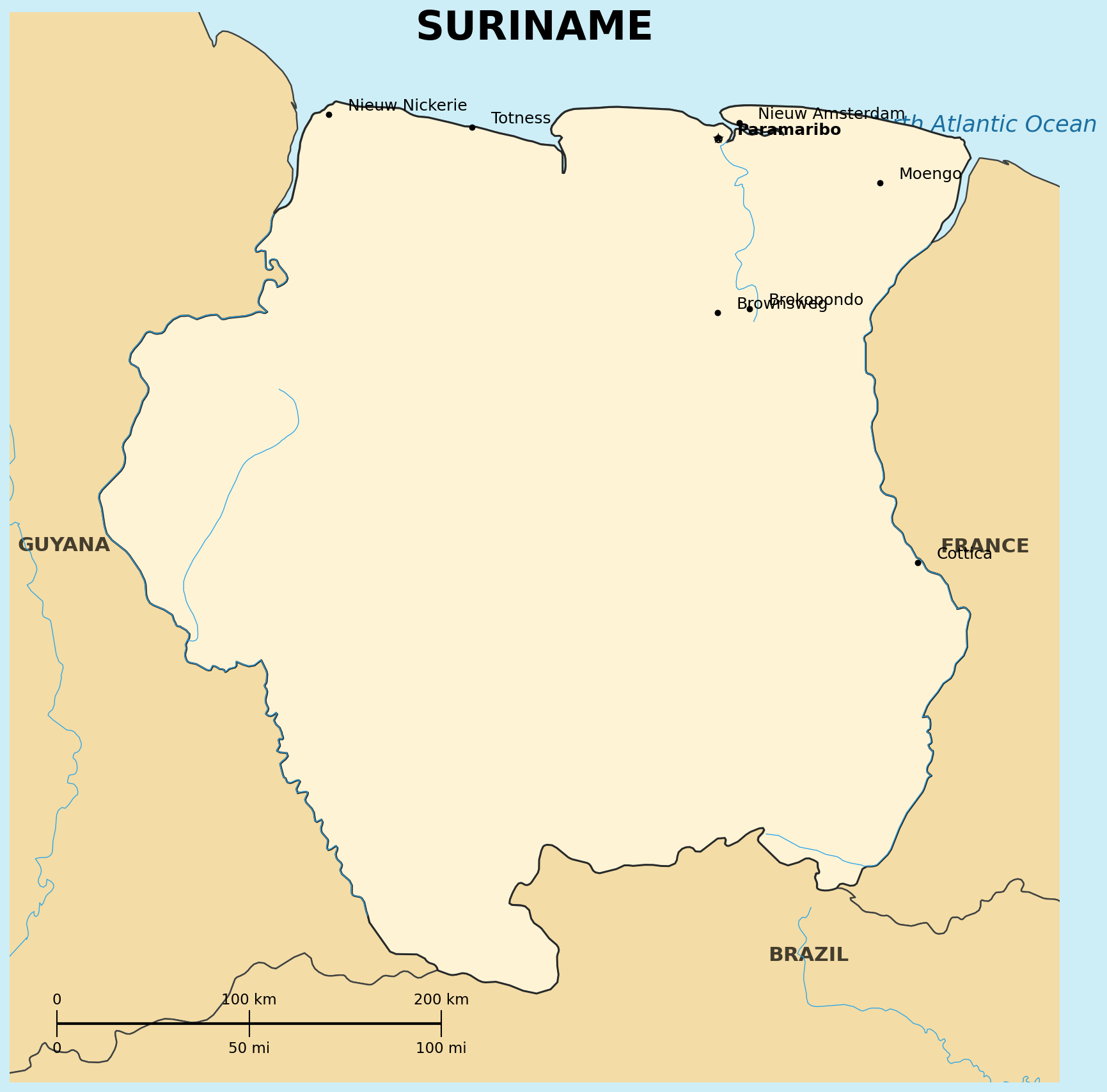
Location: Northern South America, bordering the North Atlantic Ocean, between French Guiana and Guyana; the smallest sovereign country in South America
Map references: South America
Area:
total: 163,820 sq km
Land boundaries:
border countries: Brazil, French Guiana, Guyana
| People |
Population: 617,000-653,605 (varies by source; 2025 est.)
Life expectancy at birth: total population 73.6 years (World Bank, 2025)
Infant mortality rate: 29.3 deaths/1,000 live births
Nationality:
noun/adjective: Surinamese
Ethnic groups: Hindustani (East Indian) 27.4%, Maroon (descendants of escaped enslaved Africans) 21.7%, Creole (mixed white and Black) 15.7%, Javanese 13.7%, mixed 13.4%, other 7.6% (2012 est.)
Religions: Protestant 23.6% (Evangelical, Moravian, Reformed, Lutheran), Hindu 22.3%, Roman Catholic 21.6%, Muslim 13.8%, other Christian 3.2%, Winti 1.8%, other 4.6% (2012 est.)
Languages: Dutch (official), English (widely spoken), Sranang Tongo (Taki-Taki, native language of Creoles and much of the younger population), Caribbean Hindustani (Hindi dialect), Javanese
Population distribution: concentrated along the northern coastal strip; the remainder of the country is sparsely populated
| Government |
Country name:
conventional long form: Republic of Suriname
conventional short form: Suriname
Data code: NS
Government type: presidential republic
National capital: Paramaribo
Independence: 25 November 1975 (from the Netherlands)
Background: a military government continued to exert control through a succession of nominally civilian administrations until 1987, when international pressure forced a democratic election; in 1990 the military overthrew the civilian leadership, but a democratically elected coalition government returned to power in 1991; the coalition expanded and ruled until 2010, when voters returned former military leader Desire Bouterse and his opposition coalition to power
| Economy |
Economy - overview: upper-middle-income South American economy dominated by mining; oil and gold exports account for approximately 85% of exports and 27% of government revenues, making the economy highly vulnerable to mineral price volatility; carbon-negative economy, with a pledge to produce 35% of electricity from renewable sources; growing offshore oil sector
GDP (purchasing power parity): $14.74 billion (2025 est.)
GDP - real growth rate: 3.2% (2025)
GDP - per capita: $22,440 PPP (2025 est.)
Inflation rate: 22% (2020)
Unemployment rate: 7.47% (2020)
Population below poverty line: 70% (2002 est.)
Currency: Surinamese dollar (SRD)
| Military |
Military - note: the National Leger (National Army) is responsible for defending Suriname's sovereignty and territorial integrity against foreign aggression; military police handle immigration control at ports of entry; the military assists police in combating crime, particularly narco-trafficking, through joint patrols and special security teams; also provides aid during natural emergencies and participates in socio-economic development projects (2025)