

Country information
Taiwan
- Capital
- Taipei
- Population
- 23,262,544
Languages spoken
About Taiwan
Mandarin (Standard Chinese) - the official language and language of instruction.
Taiwanese Hokkien - widely spoken by the majority Holo population.
Hakka - spoken by the Hakka community.
Formosan languages - a family of Austronesian languages spoken by Taiwan's indigenous Malayo-Polynesian peoples.
Matsu, Wuqiu, and Taiwan Sign Language are also recognized national languages.
Mandarin is the official language of Taiwan, with Hokkien, Hakka, and Formosan languages recognized as national languages.
| Geography |
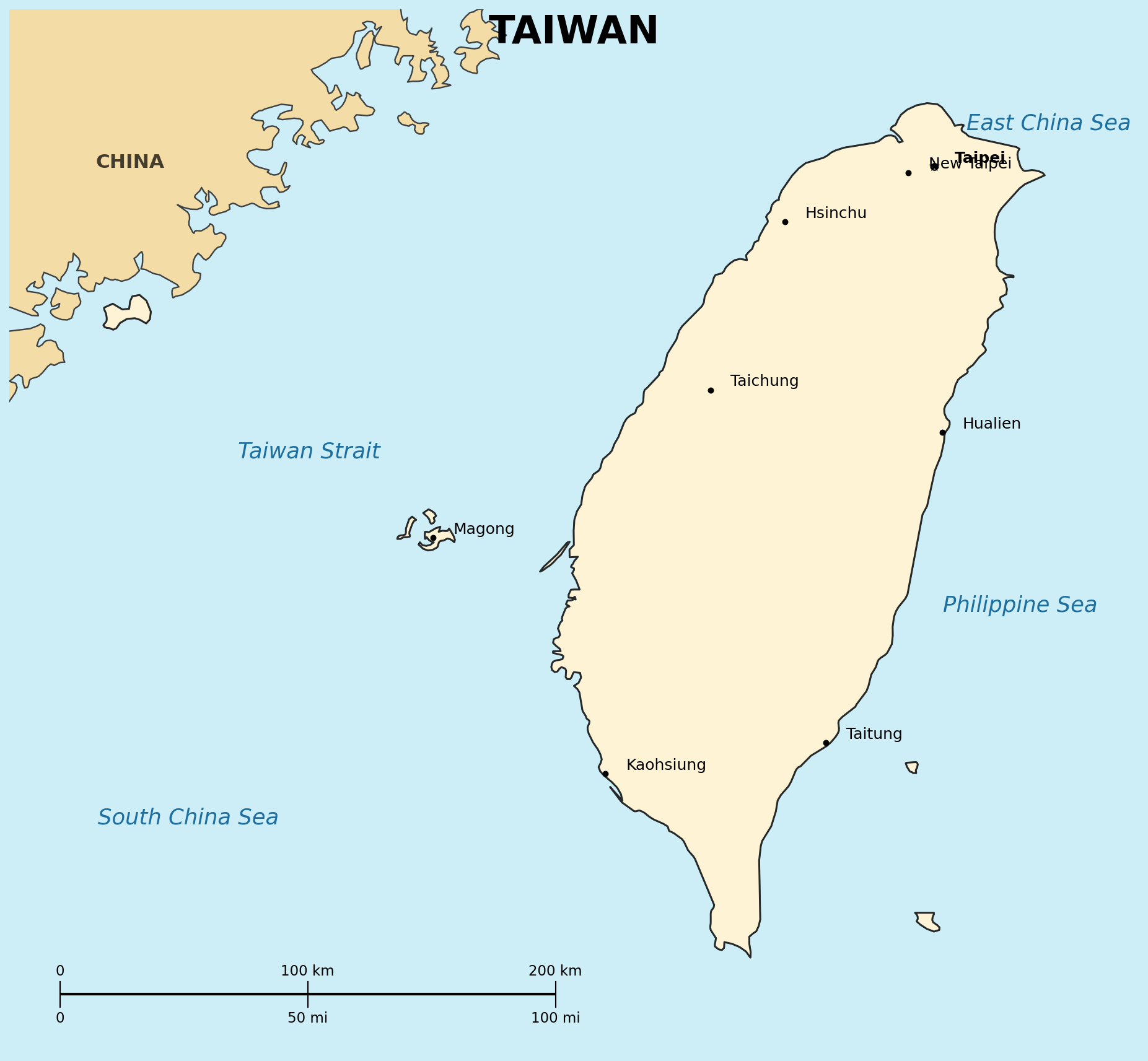
Location: Eastern Asia, islands bordering the East China Sea, Philippine Sea, South China Sea, and Taiwan Strait, north of the Philippines, off the southeastern coast of China
Map references: Asia
Area:
total: 36,197 sq km
| People |
Population: 23.2-23.4 million (2025-2026 est.)
Age structure:
0-14 years: 11.66%
15-64 years: 68.86%
65 years and over: 19.48-20%
Life expectancy at birth:
total population: 81.16 years
male: 78.17 years
female: 84.34 years
Nationality:
noun/adjective: Taiwanese
Ethnic groups: Han Chinese (including Holo, approximately 70% of the population, plus Hakka and other groups originating in mainland China) more than 95%, Indigenous Malayo-Polynesian peoples 2.3-2.5%, new immigrants (primarily from China and Southeast Asia) 2.5%
Religions: Buddhist 28-35.3%, Taoist 24-33.2%, no religion 27%, Christian 3.9-7%, other 10-13% (varies by source; 2005-2023 est.)
Languages: Mandarin (official), Taigi/Hokkien, Hakka, Formosan (Indigenous Austronesian) languages, Matsu, Wuqiu, Taiwan Sign Language
Population distribution: peripheral coastal settlement pattern, with the largest populations on the north and west coasts
Major urban areas: 4.504 million New Taipei City, 2.754 million Taipei (capital), 2.319 million Taoyuan, 1.553 million Kaohsiung, 1.369 million Taichung (2023)
| Government |
Country name:
conventional long form: Republic of China (ROC)
conventional short form: Taiwan
Data code: TW
Government type: unitary semi-presidential republic; a multiparty democracy
National capital: Taipei
Executive branch:
chief of state: President Lai Ching-te
head of government: Premier (Executive Yuan President) Cho Jung-tai
Background: the main island was inhabited by Taiwanese Indigenous peoples speaking Austronesian languages until Han settlement began in the early 17th century; controlled by the Dutch, then Ming loyalists, then Qing China; ceded to Japan in 1895; came under Republic of China administration in 1945; the ROC government retreated to Taiwan in 1949 after losing the Chinese Civil War; throughout the following decades the island prospered, becoming one of East Asia's economic "Tiger" economies, and has become a major investor in mainland China as cross-Strait economic ties matured since 2000
| Economy |
Economy - overview: advanced, high-income East Asian economy; global leader in semiconductor manufacturing and electronics; runs a large trade surplus with many economies including China and the US; among the world's largest foreign reserves; population aging rapidly
GDP (purchasing power parity): $1.99-2.275 trillion (2025-2026 est.)
GDP - real growth rate: 8.68% (2025)
GDP - per capita: $98,051 PPP (2026 est.) - among the highest in the world
Inflation rate: 1.66% (April 2025)
Unemployment rate: 3.35% (2025)
Population below poverty line: 1.13% (2024)
Industries: electronics/semiconductors, communications and IT products, petroleum refining, chemicals, textiles, iron and steel, machinery, cement, food processing, vehicles, pharmaceuticals
Currency: New Taiwan dollar (TWD)