
Country information
Yugoslavia (former)
- Capital
- Belgrade
- Population
- 10,750,000
Languages spoken
About Yugoslavia (former)
Serbian - spoken in Serbia.
Croatian - spoken in Croatia.
Bosnian - spoken in Bosnia and Herzegovina.
Slovenian - spoken in Slovenia.
Macedonian - spoken in North Macedonia.
Montenegrin - spoken in Montenegro.
Albanian - widely spoken in Kosovo.
Serbian, Croatian, Bosnian, and Montenegrin are closely related and mutually intelligible, all descending from the former common Serbo-Croatian language.
For current country-specific information, see the individual entries for Serbia, Croatia, Bosnia and Herzegovina, Slovenia, North Macedonia, Montenegro, and Kosovo.
| Geography |
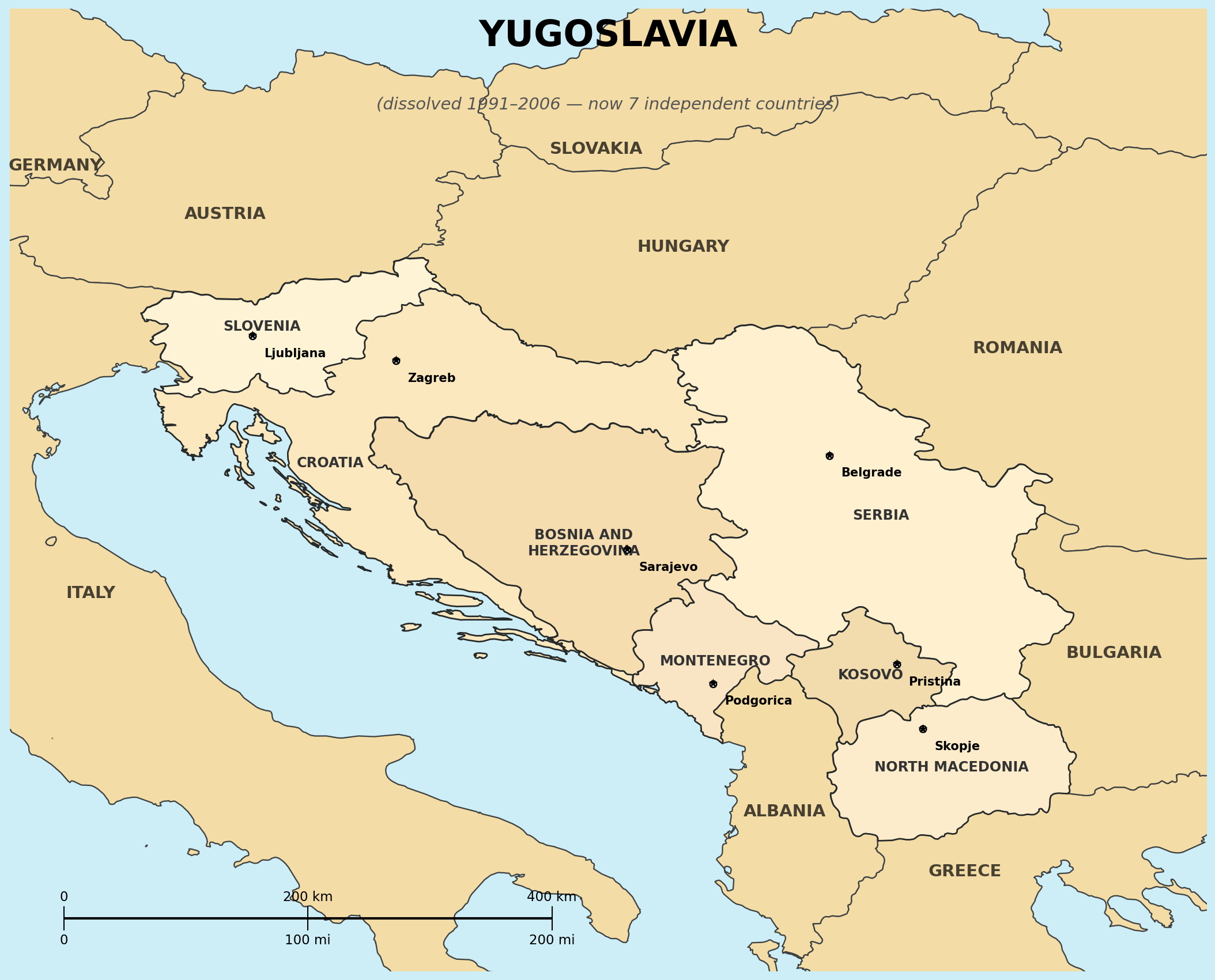
Location: formerly occupied the west-central Balkan Peninsula in southeastern Europe, bordering the Adriatic Sea
Map references: Europe
Geography - note: Yugoslavia no longer exists as a country; its former territory is now divided among seven independent successor states: Slovenia, Croatia, Bosnia and Herzegovina, Serbia, Montenegro, North Macedonia, and Kosovo
| People |
Population: the combined population of the former Yugoslav territories today totals approximately 20 million across the seven successor states
Ethnic groups: a multi-ethnic, multi-religious federation of South Slavic peoples, including Serbs, Croats, Bosniaks, Slovenes, Macedonians, Montenegrins, and ethnic Albanians, among others
Languages: Serbian, Croatian, Bosnian, Slovenian, Macedonian, Montenegrin, and Albanian are spoken across the successor states (see individual country entries for details)
| Government |
Country name:
historical names: Kingdom of Serbs, Croats, and Slovenes (1918-1929); Kingdom of Yugoslavia (1929-1941); Federative People's Republic of Yugoslavia (1945); Socialist Federal Republic of Yugoslavia (1963-1992); Federal Republic of Yugoslavia (1992-2003, Serbia and Montenegro only); State Union of Serbia and Montenegro (2003-2006)
Government type: dissolved; no longer exists as a sovereign state
National capital: Belgrade (former federal capital, now capital of Serbia)
Background: Yugoslavia was formed in 1918 as the Kingdom of Serbs, Croats, and Slovenes, uniting South Slavic peoples following the collapse of the Austro-Hungarian and Ottoman Empires; renamed Yugoslavia in 1929; occupied during World War II, after which Josip Broz Tito established the Socialist Federal Republic of Yugoslavia, a federation of six constituent republics (Serbia, Croatia, Slovenia, Bosnia and Herzegovina, Macedonia, and Montenegro) held together under Tito's strong central leadership; following Tito's death in 1980, suppressed nationalist tensions resurfaced amid economic crisis and the broader collapse of communism in Eastern Europe; the country began disintegrating in 1991 amid rising ethno-nationalism, with Slovenia, Croatia, Bosnia and Herzegovina, and Macedonia declaring independence, followed by a series of brutal ethnic conflicts known as the Yugoslav Wars (1991-2001); Serbia and Montenegro remained together as the Federal Republic of Yugoslavia (later the State Union of Serbia and Montenegro) until Montenegro's 2006 independence referendum dissolved the union entirely; Kosovo, formerly an autonomous province of Serbia, declared independence in 2008, a status Serbia does not recognize; the country's breakup left a profound and lasting impact on the political and social landscape of southeastern Europe
| Economy |
Economy - overview: no longer exists as a unified economy; from the 1960s to 1980s Yugoslavia was a regional economic success story and a notable exception among communist states for its market-oriented reforms and openness to the West; wealthier republics (Slovenia, Croatia) resented subsidizing less developed regions, fueling demands for greater autonomy that contributed to the country's breakup; each successor state now maintains its own independent economy (see individual country entries)