
About Congo, Democratic Republic of (DRC)
French - the official and most widely spoken language, making the DRC the most populous Francophone country in the world.
Lingala - the most widely spoken of the national trade languages, serving as a lingua franca.
Kingwana (a dialect of Swahili), Kikongo, and Tshiluba are also national languages.
Over 200 additional indigenous languages are spoken across the country.
French is the official language of the DRC, with Lingala, Kingwana/Swahili, Kikongo, and Tshiluba as national languages.
| Geography |
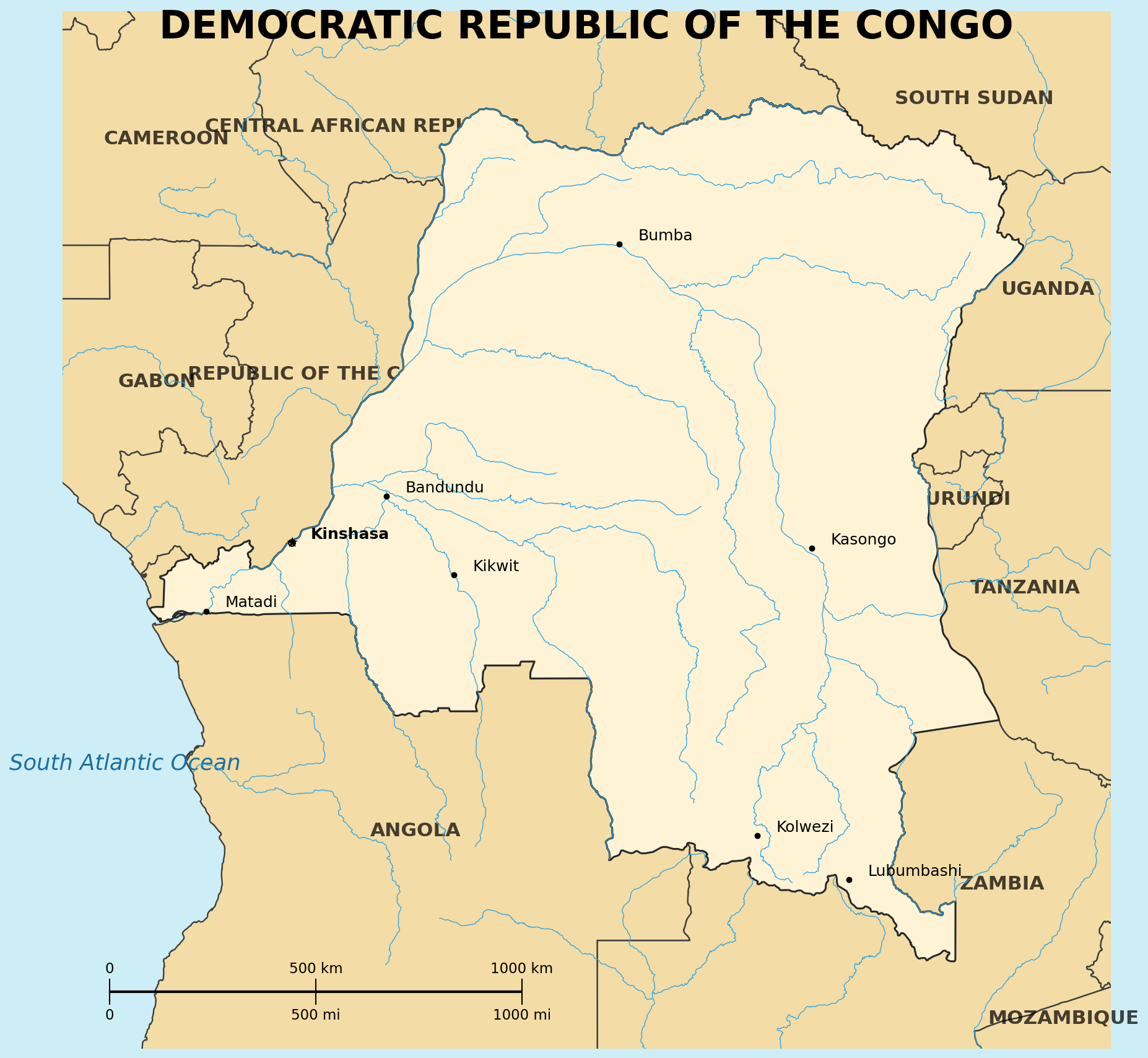
Location: Central Africa, bordering the South Atlantic Ocean, between Angola and the Republic of the Congo
Map references: Africa
Area:
total: 2,344,858-2,345,409 sq km; 2nd largest country in Africa, 11th largest in the world
Land boundaries:
border countries: Angola, Burundi, Central African Republic, Republic of the Congo, Rwanda, South Sudan, Tanzania, Uganda, Zambia (9 countries)
| People |
Population: 108-124 million (varies significantly by source; 2022-2025 est.) - most populous Francophone country in the world; 4th most populous in Africa
Age structure:
0-14 years: 41.25-46.38%
65 years and over: 2.47-2.69%
Life expectancy at birth:
total population: 61.83 years
male: 60.03-60.7 years
female: 63.69-64.6 years
Infant mortality rate: 60.85 deaths/1,000 live births
Nationality:
noun/adjective: Congolese
Ethnic groups: more than 200 African ethnic groups, majority Bantu; the four largest - Mongo, Luba, Kongo, and Mangbetu-Azande - make up about 45% of the population
Languages: French (official), Lingala (trade language), Kingwana (Swahili dialect), Kikongo, Tshiluba
| Government |
Country name:
conventional long form: Democratic Republic of the Congo
conventional short form: DRC; also known as Congo (Kinshasa) to distinguish from the neighboring Republic of the Congo, Congo (Brazzaville)
former: Zaire (1971-1997)
Data code: CG
Government type: semi-presidential republic
National capital: Kinshasa; the largest city in Central Africa and the country's administrative, economic, and cultural hub
Background: gained independence from Belgium in 1960; Col. Joseph Mobutu seized power in a 1965 coup, later renaming himself Mobutu Sese Seko and the country Zaire, ruling for 32 years; a rebellion led by Laurent Kabila overthrew Mobutu in 1997, restoring the name Democratic Republic of the Congo; Kabila was assassinated in 2001, succeeded by his son Joseph Kabila; the country continues to face significant conflict-driven instability, particularly in its eastern provinces, alongside massive internal displacement
| Economy |
Economy - overview: low-income, least-developed economy, despite vast mineral wealth (copper, cobalt, gold, diamonds, coltan); persistent conflict and weak governance have severely constrained development; the DRC is a leading global source of cobalt, critical to battery manufacturing
GDP (purchasing power parity): $200.76 billion (2025 est.)
GDP - real growth rate: 4.7% (2025)
GDP - per capita: $1,880-1,881 PPP (2025 est.)
Inflation rate: 5.0% (2020 est.)
Unemployment rate: 4.5% (2022)
Population below poverty line: 63.9% (2012)
Industries: mining (copper, cobalt, gold, diamonds, coltan, zinc, tin, tungsten), mineral processing, consumer products, metal products, lumber, cement, ship repair
Currency: Congolese franc (CDF)
| Military |
Military branches: Armed Forces of the DRC (FARDC): Land Forces, National Navy, Congolese Air Force; Republican Guard; Ministry of Interior: Congolese National Police (2025)
| Transnational Issues |
Trafficking in persons - tier rating: Tier 2 Watch List (2025)