
Country information
Zambia
- Capital
- Lusaka
- Population
- 19,693,423
Languages spoken
About Zambia
Bemba - the most widely spoken language, ~33.4% of the population.
Nyanja (~14.7%), Tonga (~11.4%), Lozi (~5.5%), and Chewa (~4.5%) are also widely spoken.
English - the sole official language, spoken by ~1.7% as a first language, though widely used in government, education, and business.
Zambia is said to have over 70 languages, though many may be considered dialects; nearly all of Zambia's major languages belong to the Bantu family.
English is the sole official language of Zambia.
| Geography |
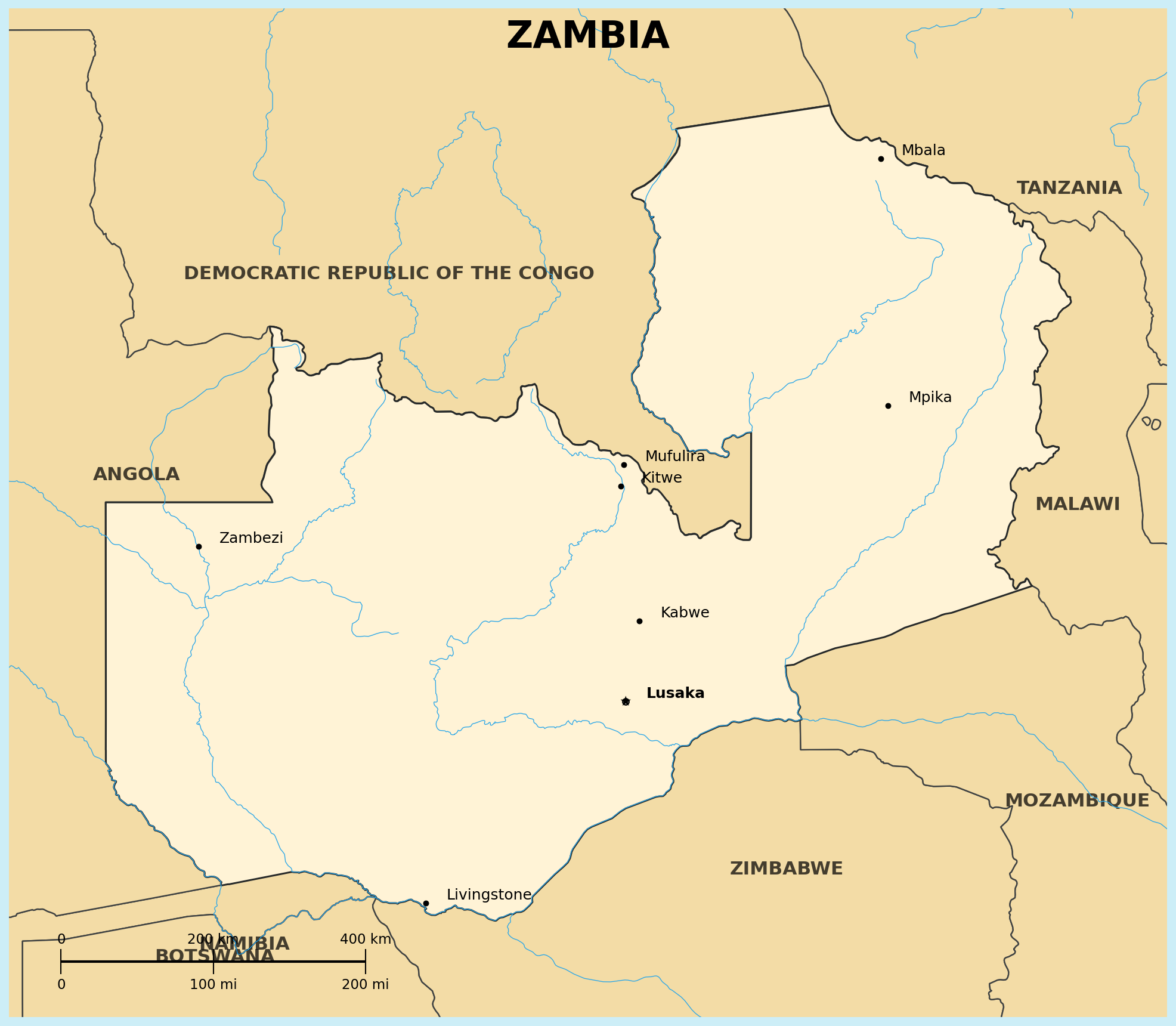
Location: Southern Africa, landlocked, east of Angola
Map references: Africa
Area:
total: 752,618 sq km
Land boundaries:
border countries: Angola, Botswana, Democratic Republic of the Congo, Malawi, Mozambique, Namibia, Tanzania, Zimbabwe (8 countries)
Geography - note: the name derives from the Zambezi River, which flows through the western part of the country and forms the southern border with Zimbabwe; home to Victoria Falls, one of the world's largest waterfalls
| People |
Population: 19.6-22 million (2022-2025 est.)
Nationality:
noun/adjective: Zambian(s)
Ethnic groups: home to about 35 African ethnic groups, comprising about 99% of the population; Bemba, Tonga, Chewa, Lozi, Nsenga, Tumbuka, and Ngoni are among the largest
Religions: Protestant 75.3%, Roman Catholic 20.2%, other 2.7% (Muslim, Buddhist), none 1.8% (2010 est.)
Languages: Bemba 33.4%, Nyanja 14.7%, Tonga 11.4%, Lozi 5.5%, Chewa 4.5%, Nsenga 2.9%, Tumbuka 2.5%, English (official) 1.7%, other languages (over 70 total, many Bantu dialects) (2010 est.)
Literacy: total population 71.1% (male 81.7%, female 62.2%) (2018 est.)
| Government |
Country name:
conventional long form: Republic of Zambia
conventional short form: Zambia
former: Northern Rhodesia
Data code: ZA
Government type: presidential republic
National capital: Lusaka; named after a village whose headman (chief) was called Lusaakas
Independence: 24 October 1964 (from the UK)
Background: Bantu-speaking groups from the Luba and Lunda Kingdoms in the Congo River Basin and from the Great Lakes region in East Africa settled in what is now Zambia beginning around 300 AD, displacing and mixing with earlier population groups; the Mutapa Empire ruled large parts of the region from the 14th to 17th century before collapsing amid the growing slave trade and Portuguese incursions; in the 1880s British companies began securing mineral concessions, and the territory of Northern Rhodesia was administered by the British South Africa Company from 1891 until the UK took over in 1923; the name changed to Zambia upon independence in 1964
| Economy |
Economy - overview: lower-middle-income sub-Saharan economy; regional hydroelectricity producer; copper mining and processing remain central to the economy, alongside emerald mining and agriculture; strong trade ties and infrastructure investment from China; IMF assistance to restructure a heavy debt burden; one of the youngest and fastest-growing labor forces in the world, though extreme rural poverty and systemic corruption persist
GDP (purchasing power parity): $98.16 billion (2025 est.)
GDP - real growth rate: 6.2% (2025)
GDP - per capita: $4,520 PPP (2025 est.)
Inflation rate: 9.4% (January 2026 est.)
Unemployment rate: 5.9% (2023)
Population below poverty line: 60.5% (2010)
Industries: copper mining and processing, emerald mining, construction, foodstuffs, beverages, chemicals, textiles, fertilizer, horticulture
Currency: Zambian kwacha (ZMW)