
About Bosnia and Herzegovina
Bosnian - the most widely spoken official language, ~52.9% of the population.
Serbian - also official, ~30.8%.
Croatian - also official, ~14.6%.
Bosnian, Serbian, and Croatian are closely related and largely mutually intelligible, all descending from the former common Serbo-Croatian language.
Bosnian, Serbian, and Croatian are all official languages of Bosnia and Herzegovina.
| Geography |
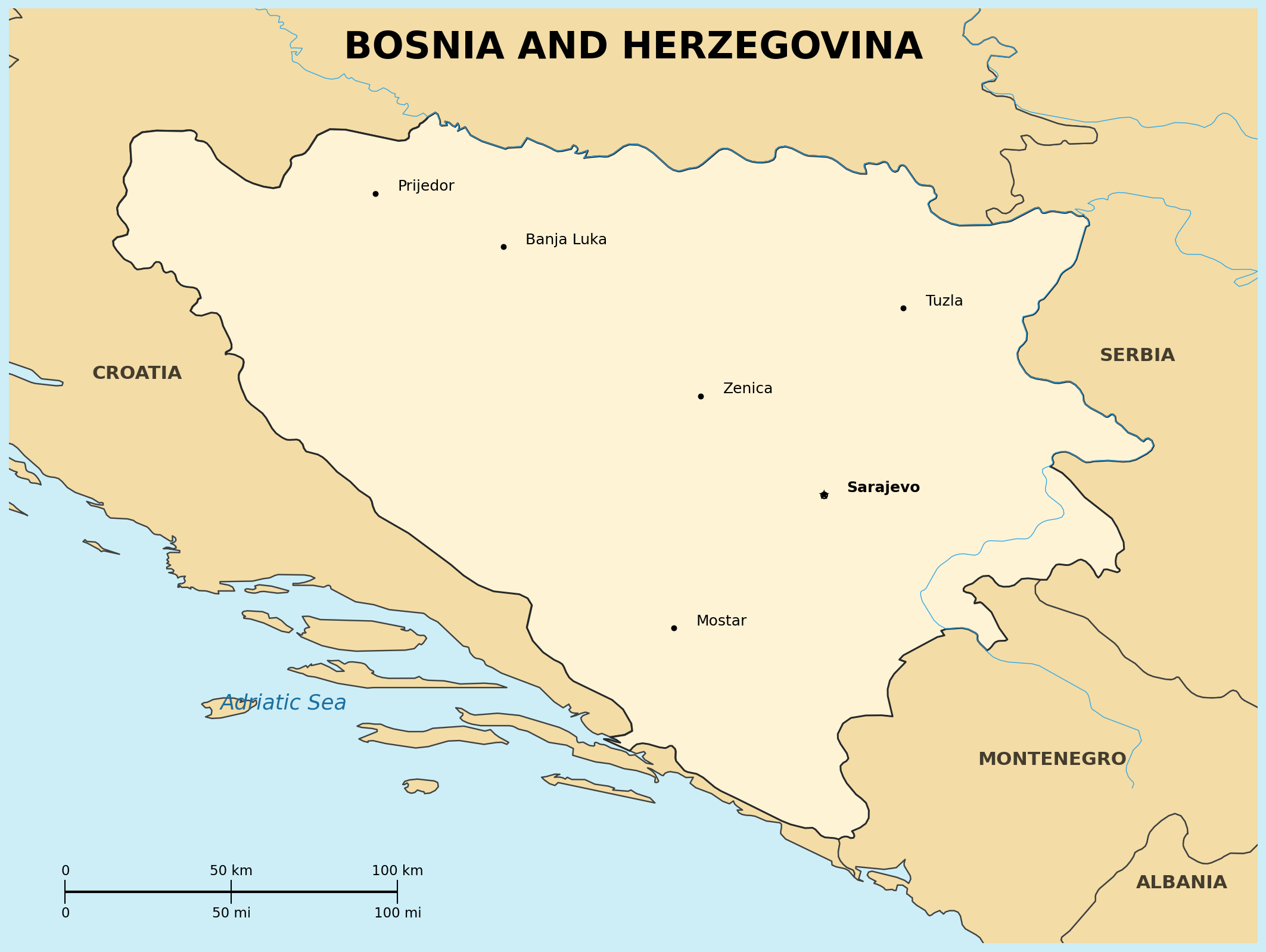
Location: Southeastern Europe, on the Balkan Peninsula, bordering the Adriatic Sea and Croatia
Map references: Europe
Area:
total: 51,197 sq km
Land boundaries:
border countries: Croatia, Montenegro, Serbia
Coastline: approximately 20 km on the Adriatic Sea
Geography - note: the region called Herzegovina is contiguous to Croatia and Montenegro
| People |
Population: 3,140,095-3,653,499 (varies by source; 2025 est.)
Age structure:
0-14 years: 13.18%
65 years and over: 16.22%
Life expectancy at birth:
total population: 77.98 years
male: 75.02 years
female: 81.15 years
Infant mortality rate: 3.8-5.21 deaths/1,000 live births (2025 est.)
Nationality:
noun/adjective: Bosnian(s), Herzegovinian(s)
Ethnic groups: Bosniak 50.1%, Serb 30.7-30.8%, Croat 15.4%, other 2.7% (2013 est.)
Languages: Bosnian (official) 52.9%, Serbian (official) 30.8%, Croatian (official) 14.6%, other 1.6% (2013 est.)
| Government |
Country name:
conventional short form: Bosnia and Herzegovina
Data code: BK
Government type: federal parliamentary republic
National capital: Sarajevo
Administrative divisions: 3 first-order divisions - Brcko District (ethnically mixed), Federation of Bosnia and Herzegovina (predominantly Bosniak-Croat), Republika Srpska (predominantly Serb)
Background: after four centuries of Ottoman rule, Austria-Hungary took control in 1878; incorporated into the Kingdom of Serbs, Croats, and Slovenes in 1918, then joined the Socialist Federal Republic of Yugoslavia after WWII; declared independence from Yugoslavia on 3 March 1992 after a referendum boycotted by ethnic Serbs; Bosnian Serb militias, backed by Serbia and Croatia, then sought to seize territory they claimed as their own; ethnic cleansing campaigns from 1992-1995 killed thousands and displaced more than two million people; a peace agreement was signed at Dayton, Ohio in November 1995, finalized in Paris in December 1995
| Economy |
Economy - overview: upper-middle-income, developing economy; the Dayton-era federal structure duplicates administrative costs, weighing on growth; metals, furniture, and hydropower exports plus large diaspora remittances sustain the economy; the convertible mark is anchored to the euro; slow progress toward EU integration
GDP (purchasing power parity): $82.89 billion (2026f)
GDP - real growth rate: 3.0% (2025)
GDP - per capita: $24,123 PPP (2026)
Inflation rate: 4.5% (2025)
Unemployment rate: 11.2% (2025); youth unemployment 27.9% (2024)
Population below poverty line: 17.5% (2021)
Currency: Bosnia and Herzegovina convertible mark (BAM)
| Military |
Military branches: Armed Forces of Bosnia and Herzegovina (AFBiH): Army, Air and Air Defense Forces; Ministry of Security: Border Police (2025)