
About Holy See (Vatican City)
Italian - the de facto working language of the city-state.
Latin - the de jure official legal language of the Holy See.
French and various other languages are also used, reflecting the international makeup of the Vatican's clergy and diplomatic corps.
Italian and Latin are the primary languages of the Holy See (Vatican City), the world's smallest sovereign state.
| Geography |
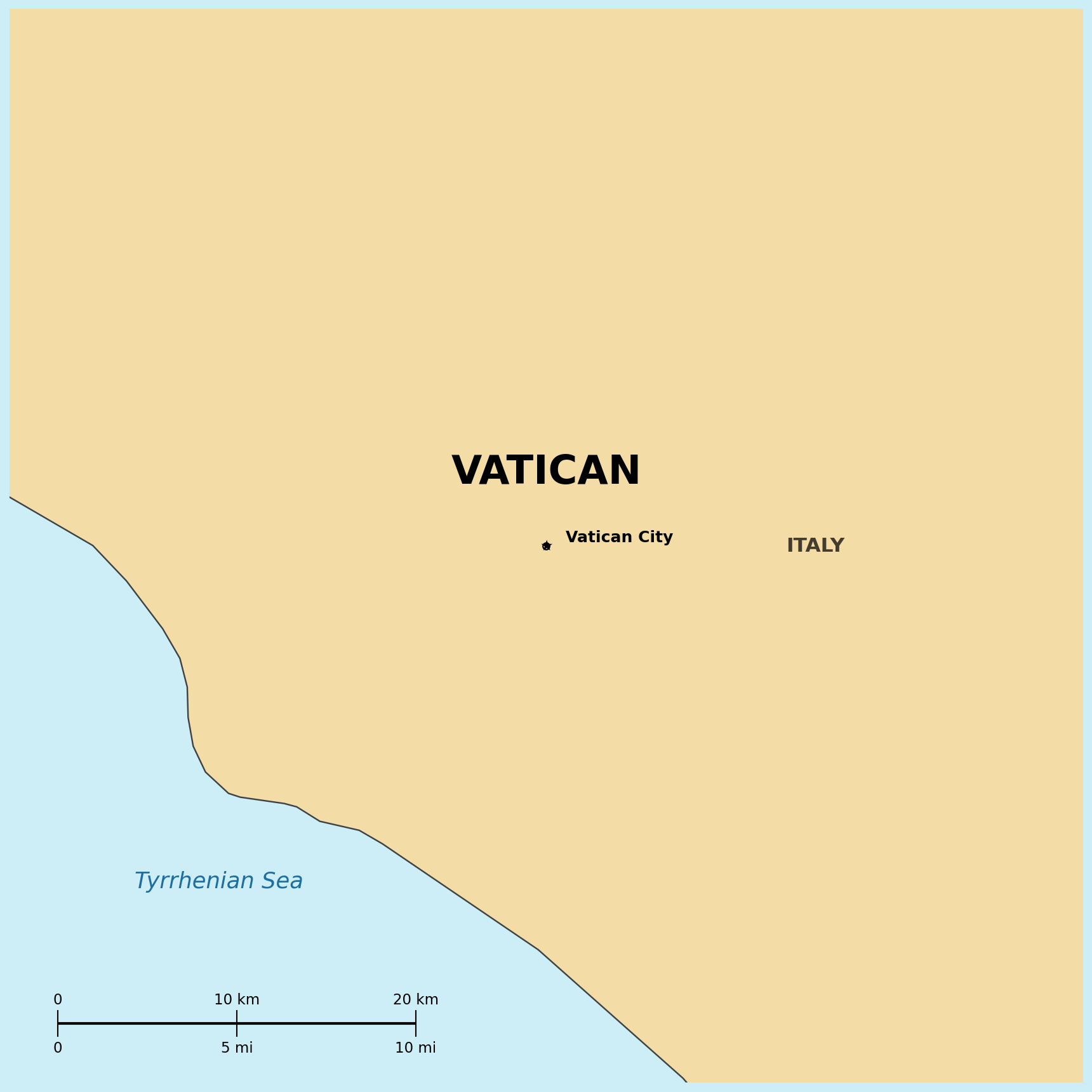
Location: Southern Europe, an enclave of Rome, Italy; landlocked
Map references: Europe
Area:
total: 0.44 sq km; the world's smallest sovereign state
Geography - note: beyond the territorial boundary of Vatican City, the 1929 Lateran Treaty grants the Holy See extraterritorial authority over 23 sites in Rome and five sites outside Rome, including the Pontifical Palace at Castel Gandolfo, the Pope's traditional summer residence
| People |
Population: 800-1,000 (varies by source; 2024-2025 est.); roughly 760-882 residents including clergy, Swiss Guard members, and lay officials, most holding citizenship tied to their office rather than by birth
Nationality:
noun/adjective: Vatican (de facto; no nationality de jure)
Ethnic groups: Italians, Swiss, and other nationalities represented among clergy and Swiss Guard
Religions: Roman Catholic (virtually the entire population)
Languages: Italian (de facto working language), Latin (de jure legal language of the Holy See), French, various other languages
| Government |
Country name:
conventional short form: Holy See (Vatican City)
Data code: VT
Government type: ecclesiastical elective monarchy (theocracy)
National capital: Vatican City
Executive branch:
chief of state: Pope Leo XIV (since 8 May 2025)
head of government: President of the Governorate of Vatican City State Fernando Vergez Alzaga (since 1 October 2021)
Background: popes in their secular role ruled portions of the Italian peninsula for more than a thousand years until the mid-19th century, when many of the Papal States were seized by the newly united Kingdom of Italy; in 1870 the pope's holdings were further reduced when Rome itself was annexed; disputes between a series of "prisoner" popes and Italy were resolved in 1929 by the Lateran Treaties, which established the independent state of Vatican City and granted Roman Catholicism special status in Italy; a 1984 concordat between the Holy See and Italy modified certain earlier treaty provisions, including ending the primacy of Roman Catholicism as the Italian state religion
| Economy |
Economy - overview: unique, non-commercial economy funded by donations from the faithful (Peter's Pence), returns on investments and real estate, museum admissions, and sales of publications, stamps, and coins; not a typical market economy
| Military |
Military - note: the Pontifical Swiss Guard Corps serves as the de facto military force of Vatican City, requiring members to be single Roman Catholic males with Swiss citizenship who have completed basic training with the Swiss military; the Gendarmerie Corps of Vatican City is a police force that augments the Swiss Guard during papal appearances and provides general security, traffic direction, and investigative duties (2025)