

Country information
Brunei
- Capital
- Bandar Seri Begawan
- Population
- 458,600
Languages spoken
About Brunei
Malay (Bahasa Melayu) - the sole official language, serving as a key element of national identity.
English - widely spoken, particularly in business and education, reflecting historical ties to the British Empire.
Chinese dialects are also spoken among the ethnic Chinese community (~9.6% of the population).
Malay is the sole official language of Brunei.
| Geography |
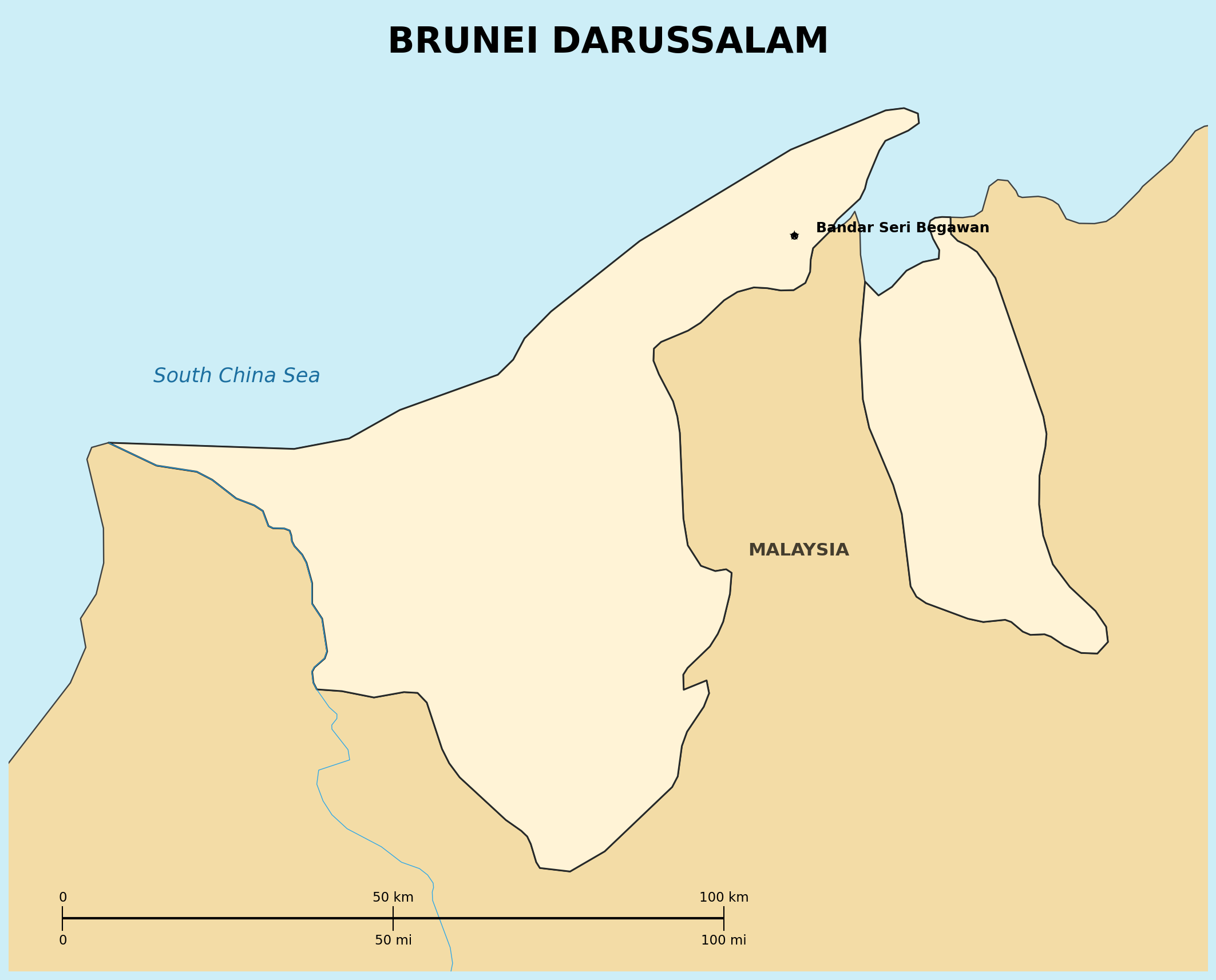
Location: Southeastern Asia, on the island of Borneo, bordering the South China Sea and Malaysia
Map references: Southeast Asia
Area:
total: 5,765-5,770 sq km
Land boundaries:
border countries: Malaysia
Climate: tropical; hot, humid, rainy
Natural resources: petroleum, natural gas, timber
Geography - note: the vast majority of the population is found along the coast in the western part of Brunei, which is separated from the eastern portion by Malaysia
| People |
Population: 458,949-478,054 (2022-2023 est.)
Age structure:
0-14 years: 21.7%
15-64 years: 70.8%
65 years and over: 7.5% (2024 est.)
Life expectancy at birth:
total population: 78.9 years
male: 76.5 years
female: 81.3 years (2024 est.)
Nationality:
noun/adjective: Bruneian(s)
Ethnic groups: Malay 67.4%, Chinese 9.6%, other 23% (2021 est.)
Religions: Muslim (official) 82.1%, Christian 6.7%, Buddhist 6.3%, other 4.9% (2021 est.)
Languages: Malay (Bahasa Melayu) (official), English, Chinese dialects
Population distribution: largest population concentration is in the far north on the western side of Brunei Bay, in and around the capital, Bandar Seri Begawan
| Government |
Country name:
conventional long form: Brunei Darussalam ("Abode of Peace")
conventional short form: Brunei
Data code: BX
Government type: absolute monarchy (sultanate)
National capital: Bandar Seri Begawan
Administrative divisions: 4 districts (daerah-daerah): Belait, Brunei dan Muara, Temburong, Tutong
Background: the Sultanate of Brunei's influence peaked between the 15th and 17th centuries, when its control extended over coastal areas of northwest Borneo and the southern Philippines; became a British protectorate in 1888; achieved independence in 1984; the same family has ruled Brunei for over six centuries
| Economy |
Economy - overview: high-income economy, almost exclusively driven by oil and gas; expansive and robust welfare system; the majority of the population works for the government; promoting a nationalized halal brand and considering a bond market and stock exchange
GDP (purchasing power parity): $45.28 billion (2026 est.)
GDP - real growth rate: 2.5% (2025f)
GDP - per capita: $97,445 PPP (2026 est.)
Inflation rate: 0.5% (2024)
Labor force: 233,198 (2023)
Currency: Brunei dollar (BND), pegged 1:1 with the Singapore dollar
| Military |
Military branches: Royal Brunei Armed Forces (RBAF): Royal Brunei Land Force, Royal Brunei Navy, Royal Brunei Air Force (2025)
Military - note: long-standing defense relationship with the UK, which maintains a garrison including a Gurkha battalion and jungle warfare school; also has close security ties with Singapore, which maintains a military training detachment in Brunei (2025)
| Transnational Issues |
Trafficking in persons - tier rating: Tier 2 Watch List (2025)