

Country information
Cabo Verde (Cape Verde)
- Capital
- Praia
- Population
- 491,233
Languages spoken
About Cabo Verde (Cape Verde)
Portuguese - the sole official language, used in government and formal education.
Cape Verdean Creole (Crioulo) - the recognized national language, a Portuguese-based creole spoken by nearly the entire population in daily life; it fuses European and African cultural and linguistic traditions.
Portuguese is the sole official language of Cape Verde, while Cape Verdean Creole is recognized as the national language.
| Geography |
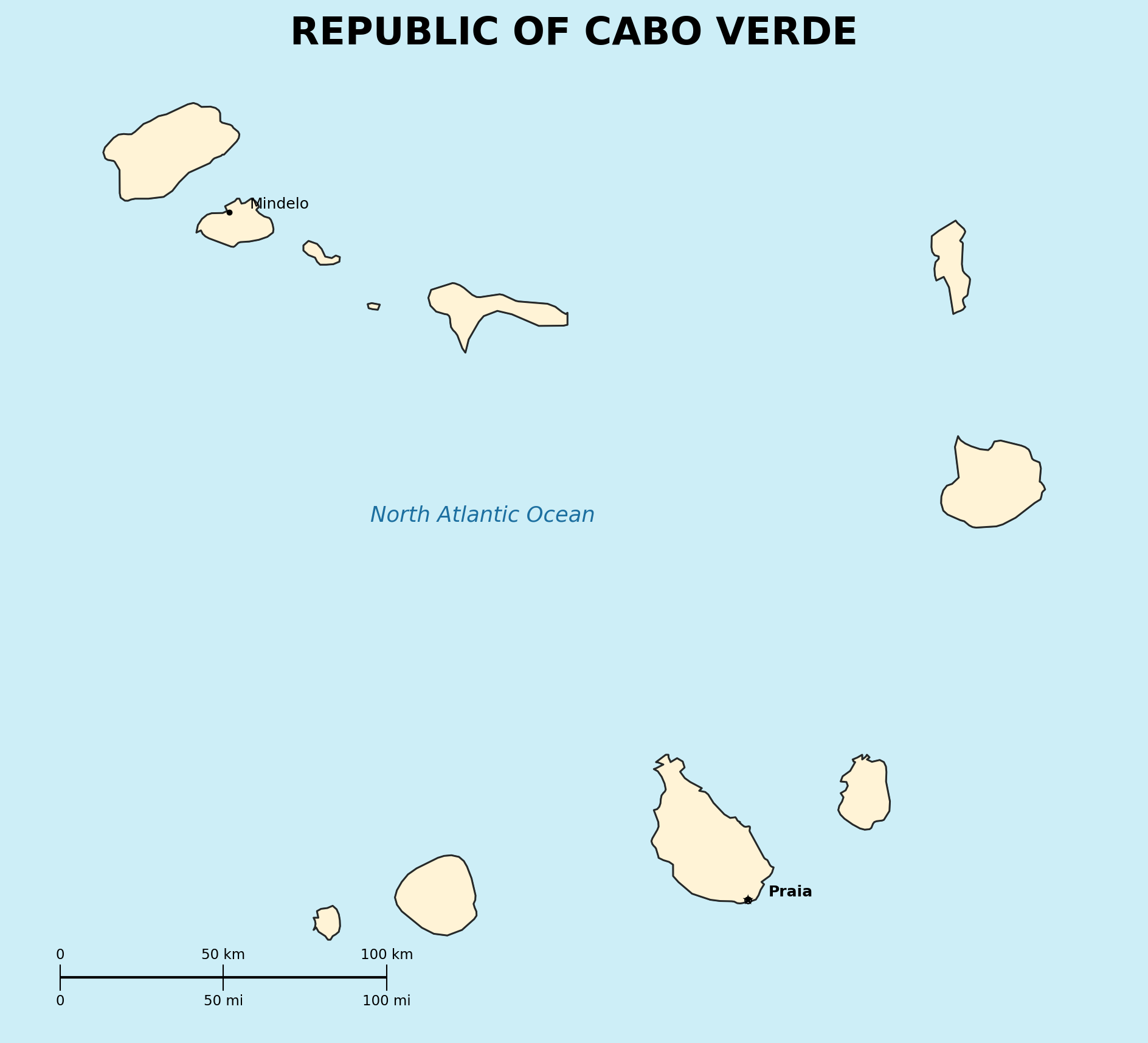
Location: Western Africa, a group of islands in the North Atlantic Ocean, west of Senegal
Map references: Africa
Area:
total: 4,033 sq km
| People |
Population: 491,233-596,707 (2021-2022 est.)
Age structure:
0-14 years: 27.95%
65 years and over: 5.48% (2022 est.)
Life expectancy at birth:
total population: 73.75-76.1 years
male: 71.41 years
female: 76.15 years
Nationality:
noun/adjective: Cabo Verdean/Cape Verdean
Ethnic groups: primarily West African ancestry, with additional Portuguese and other European contributions from the colonial era
Religions: Christianity 81.7% (Catholicism 72.5%, other Christian 6.8%, Protestant 3.6%), no religion 15.6%, Islam 1.3% (2021 est.)
Languages: Portuguese (official), Cape Verdean Creole (recognized national language)
Population distribution: a large diaspora, especially in the US and Portugal, considerably outnumbers the population on the islands themselves
| Government |
Country name:
conventional short form: Cabo Verde (also known as Cape Verde)
Data code: CV
Government type: unitary semi-presidential republic
National capital: Praia
Independence: 5 July 1975 (from Portugal)
Executive branch:
chief of state: President Jose Maria Neves
head of government: Prime Minister Ulisses Correia e Silva
Background: the Portuguese discovered and colonized the previously uninhabited islands in the 15th century; the archipelago became a trading center for African slaves and later an important coaling/resupply stop for whaling and transatlantic shipping; after independence in 1975 a one-party system was maintained until multi-party elections in 1990; Cabo Verde has sustained one of Africa's most stable democratic governments and relatively stable economies since; repeated droughts during the second half of the 20th century caused significant hardship and prompted heavy emigration
| Economy |
Economy - overview: stable, upper-middle-income, developing island economy; lacking natural resources, mostly service-oriented with a growing focus on tourism and foreign investment; about 75% of food is imported; high reliance on foreign remittances and aid; the currency has been pegged to the euro since 1998
GDP (purchasing power parity): $6.3 billion (2025 est.)
GDP - real growth rate: 5.0% (2025)
GDP - per capita: $12,250 PPP (2025 est.)
Inflation rate: 1.275% (2018)
Population below poverty line: 15% (2010)
Currency: Cape Verdean escudo (CVE)
| Military |
Military branches: Cabo Verdean Armed Forces (FACV): National Guard, Cabo Verde Coast Guard (2025)
| Transnational Issues |
Trafficking in persons - tier rating: Tier 2 Watch List (2025)